If your telephony provider has enabled headset support in the managed package, you can
use a headset for voice call, and control call actions such as accept, mute, unmute, and decline
calls from the headset. You can use only the headset models and brands supported by your telephony
provider.
Required Editions
This article applies to:
Salesforce Voice with Partner Telephony
Available in: Enterprise and Unlimited Editions
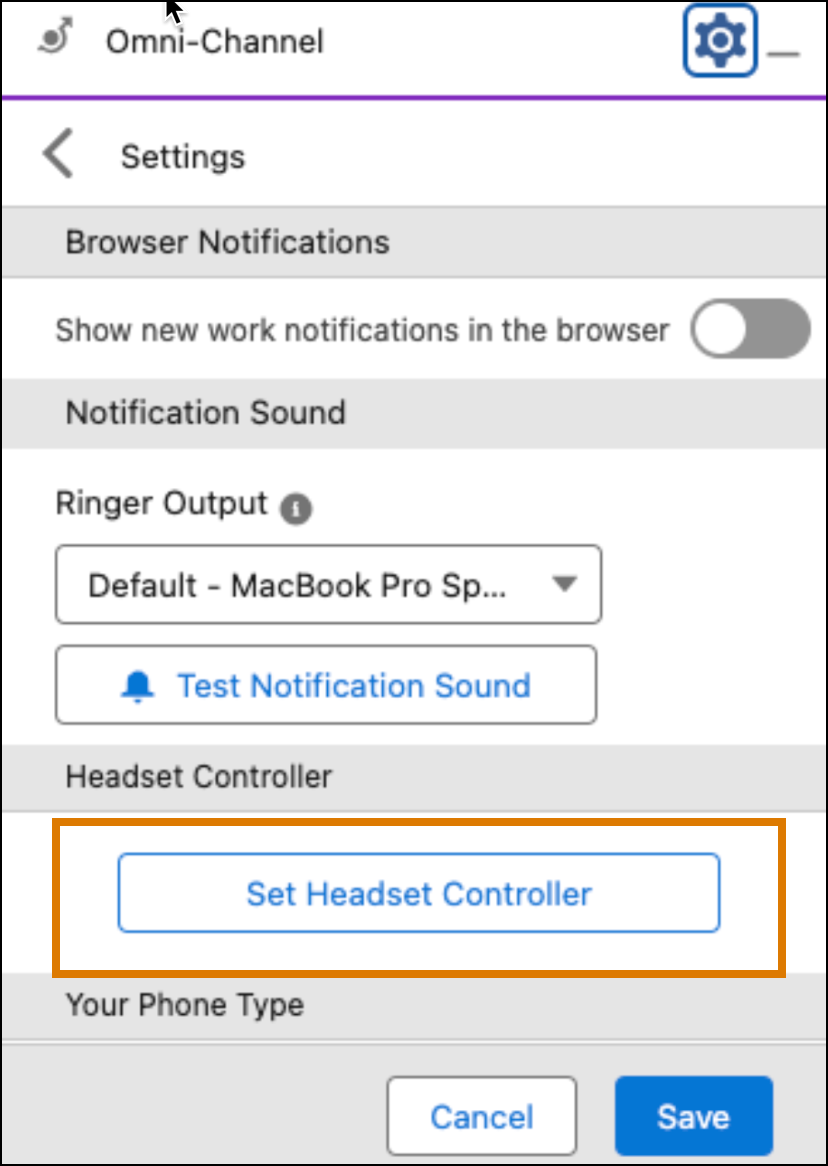
In the headset controller section in the Omni-Channel settings, click the Set Headset Controller to choose the headset for voice calls.
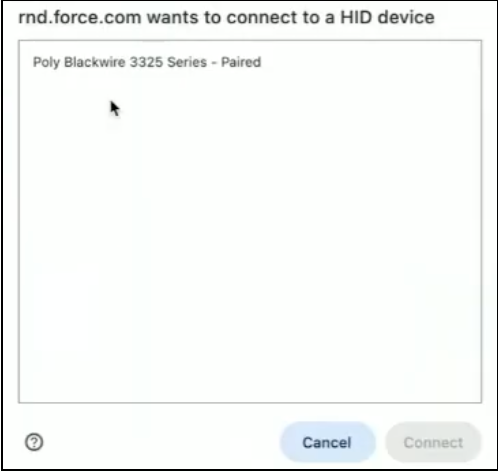
Select the headset from the browser window and click Connect. The browser window shows only HID-compatible devices that support
telephony.
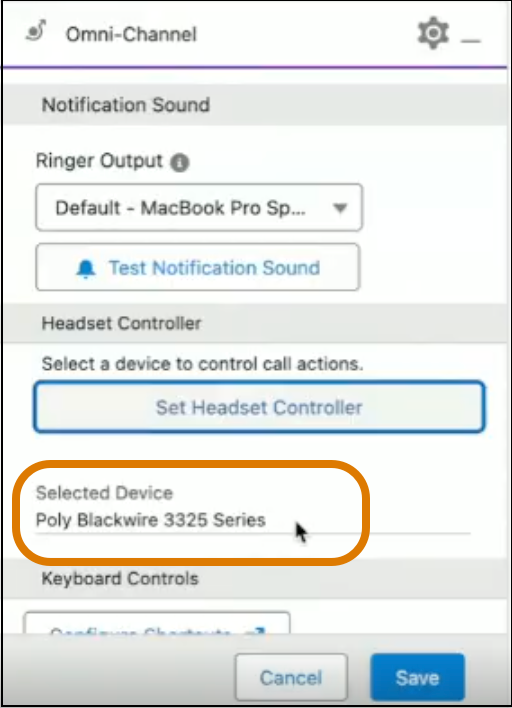
To use the headset for voice calls, click Save in the Omni-Channel settings.
When the headset is paired, the Omni-Channel console shows the selected device
name.
Note
Firefox doesn’t support headset call controls. Google Chrome and Edge support headset call
controls.
If you refresh the browser, you must select the headset again to continue using it for voice
calls.
If you log in and pairs a headset to a browser tab, and if you log in from another tab then
you will be logged out of the previous tab. But the headset continues to be paired with the
previous tab, and can cause unpredictable behavior if you use the headset in the current
browser tab. You must disconnect the headset from the previous tab before logging in from
another tab.
Did this article solve your issue?
Let us know so we can improve!
Loading
Salesforce Help | Article
Cookie Consent Manager
Cookie Consent Manager
General Information
Required Cookies
Functional Cookies
Advertising Cookies
General Information
We use three kinds of cookies on our websites: required, functional, and advertising. You can choose whether functional and advertising cookies apply. Click on the different cookie categories to find out more about each category and to change the default settings.
Privacy Statement
Required Cookies
Always Active
Required cookies are necessary for basic website functionality. Some examples include: session cookies needed to transmit the website, authentication cookies, and security cookies.
Functional Cookies
Functional cookies enhance functions, performance, and services on the website. Some examples include: cookies used to analyze site traffic, cookies used for market research, and cookies used to display advertising that is not directed to a particular individual.
Advertising Cookies
Advertising cookies track activity across websites in order to understand a viewer’s interests, and direct them specific marketing. Some examples include: cookies used for remarketing, or interest-based advertising.