Create a Data Detect Legacy-Managed Package Policy
Data Detect legacy-managed package policies look for data patterns across fields and
objects that you select. You can create multiple policies that help you find sensitive data that
users inadvertently enter into fields across your org.
Required Editions
Note The Data Detect legacy-managed package is unavailable for Summer '26. If you enabled
Data Detect legacy-managed package before Summer '26, it remains available in your
Salesforce org. We recommend that you use the new Salesforce Data Detect app instead. The
new Data Detect app is now part of the Shield app. See Data Detect End of Support.
Important Due to Salesforce platform limitations, selecting an excessive number
of fields for data scanning can cause processing errors. To avoid errors, select fewer
fields and start with smaller datasets.
Available in: Lightning Experience
Available in: Enterprise, Performance, Unlimited, and
Developer Editions.
Requires the Salesforce Shield add-on subscription or
the Data Detect add-on license.
In the Data Detect app, click the Policies tab.
Click New, and then enter a name for your policy. The name must be
alphanumeric with no spaces or special characters.
Click Save & Edit.
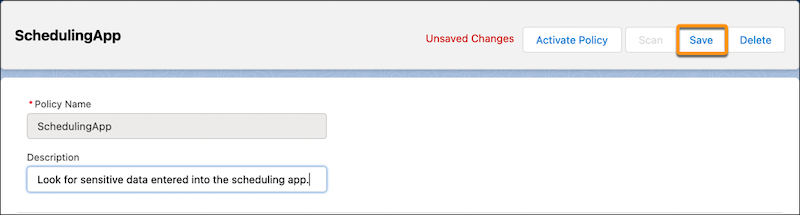
At the top of the page, enter a policy description and click
Save.
Under Objects & Fields section, in the Objects pane, select an object.
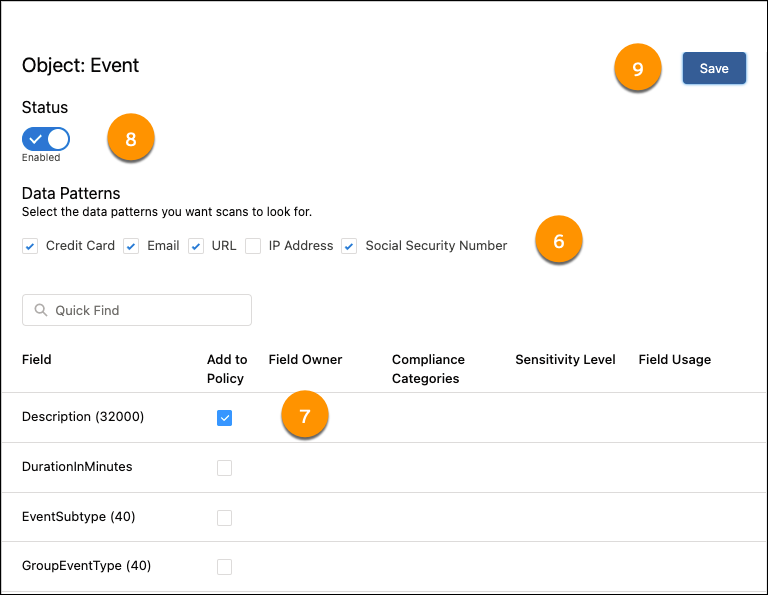
The object detail page opens with data pattern options and a list of the
object’s populated fields. By default, policies scan for all data patterns on all selected
objects and fields. To narrow your search on specific patterns, deselect the patterns that
you don’t want.
In the field list, select Add to Policy for each field that you want
to add.
To include the object’s fields and pattern selections in future scans, set the object
status to Enable.
Only enabled objects are included in the scans execution. If you leave an object’s status
as Disabled, then it’s not included in future scans. You can still save
your pattern and field selections and enable them later.
Click Save.
Repeat steps 5–9 on other objects that you want to include in your policy.
Your objects settings are added to your policy.
Did this article solve your issue?
Let us know so we can improve!
Loading
Salesforce Help | Article
Cookie Consent Manager
Cookie Consent Manager
General Information
Required Cookies
Functional Cookies
Advertising Cookies
General Information
We use three kinds of cookies on our websites: required, functional, and advertising. You can choose whether functional and advertising cookies apply. Click on the different cookie categories to find out more about each category and to change the default settings.
Privacy Statement
Required Cookies
Always Active
Required cookies are necessary for basic website functionality. Some examples include: session cookies needed to transmit the website, authentication cookies, and security cookies.
Functional Cookies
Functional cookies enhance functions, performance, and services on the website. Some examples include: cookies used to analyze site traffic, cookies used for market research, and cookies used to display advertising that is not directed to a particular individual.
Advertising Cookies
Advertising cookies track activity across websites in order to understand a viewer’s interests, and direct them specific marketing. Some examples include: cookies used for remarketing, or interest-based advertising.