
Make it easy for your customers and partners to stay in your site with longer sessions
and fewer logins. Allow users to remain logged in even after they close their browser. And keep
them logged in for up to seven days of inactivity. To extend sessions, modify the use profile for
the customers and partners in your site. You can also add more security when customers or partners
log in by enabling device activation.
Required Editions
Available in: Salesforce Classic and Lightning Experience
Available in: Enterprise, Performance, Unlimited, and
Developer Editions
User Permissions Needed
To edit session settings in profiles:
Manage Profiles and Permission Sets
From Setup, in the Quick Find box, enter Profiles, and then select
Profiles.
Next to the customer or partner profile that you want to use as the basis for the new
profile, click Clone.
Name the profile, and click Save.
Click Session Settings.
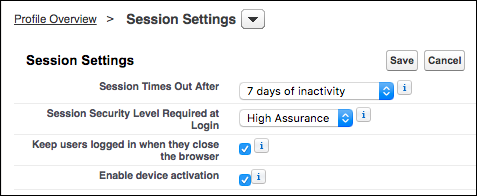
Under Session Settings, for Session Times Out After, select a timeout value.
Extend the session length to make it easy for your customers and partners to stay in your
site. You can extend session timeouts for customers and partners for up to seven days. When the
session times out, the user must log in again.
To keep customers or partners logged in until they log out, select Keep users
logged in when they close the browser.
This setting lets customer and partner user sessions remain active until users log out of
the site or when the session times out. If not selected, customers and partners are logged out
when they close their browser.
To add more security when customers or partners log in, select Enable device
activation.
When selected, Salesforce requires customers and partners to verify their identity when
they log in from a different browser or device. This option applies to the External Identity
license and community licenses.
Click Save.
Did this article solve your issue?
Let us know so we can improve!
Loading
Salesforce Help | Article
Cookie Consent Manager
General Information
Required Cookies
Functional Cookies
Advertising Cookies
General Information
We use three kinds of cookies on our websites: required, functional, and advertising. You can choose whether functional and advertising cookies apply. Click on the different cookie categories to find out more about each category and to change the default settings.
Privacy Statement
Required Cookies
Always Active
Required cookies are necessary for basic website functionality. Some examples include: session cookies needed to transmit the website, authentication cookies, and security cookies.
Functional Cookies
Functional cookies enhance functions, performance, and services on the website. Some examples include: cookies used to analyze site traffic, cookies used for market research, and cookies used to display advertising that is not directed to a particular individual.
Advertising Cookies
Advertising cookies track activity across websites in order to understand a viewer’s interests, and direct them specific marketing. Some examples include: cookies used for remarketing, or interest-based advertising.