
Configure SSO from Salesforce to AgileApps Cloud
Let your users log in to AgileApps Cloud, formerly LongJump, using single sign-on (SSO) from your Salesforce org configured as an identity provider.
Required Editions
| Available in: Lightning Experience and Salesforce Classic |
| Available in: Enterprise, Performance, Unlimited, and Developer Editions |
When you set up AgileApps Cloud as a service provider and create a connected app, users can access their AgileApps Cloud accounts using their Salesforce credentials.
Follow these high-level steps to configure SSO for Salesforce to AgileApps Cloud.
Set Up Your Salesforce Org as an Identity Provider
With the My Domain feature, your Salesforce org is enabled as an identity provider. My Domain is required for all orgs. If you don’t like your org’s My Domain name, you can change it.
The My Domain feature also creates a certificate and key pair. The certificate establishes trust between your Salesforce org and ADP. Optionally, you can use another self-signed certificate or import a CA-signed certificate.
To download the Salesforce self-signed certificate:
- From Setup, enter Identity Provider in the Quick Find box, and select Identity Provider.
- Click Download Certificate.
Configure SAML Settings in AgileApps Cloud
- Log in to your AgileApps Cloud account as an administrator.
- Under Settings, Administration, and Account Management, navigate to Single Sign-On Settings.
- Under Single Sign-On Using, select SAML.
- Configure the SAML settings for your identity provider.
- For SAML version, select 2.0.
- For Issuer, enter https://MyDomainName.my.salesforce.com. For example, https://identitydemo.my.salesforce.com.
- For User Id Type, select the type of identifier. For example, select Federated Id.
- For User Id Location, enter an attribute tag that defines the location of the User Id. For example, select Subject.
- For SAML Third Party authentication URL, enter the identity provider endpoint, for example, https://MyDomainName.my.salesforce.com/idp/endpoint/HttpRedirect.
- For Issuer Certificate, browse and select the Salesforce certificate that you downloaded previously. Click Upload.
- Save the settings.
AgileApps Cloud displays URLs that you use later to configure the connected app in Salesforce.
- Assertion Consumer Service EndPoint—When you set up the connected app, this URL is the ACS URL.
- Platform Authentication Service URL—When you set up the start URL for the connected app, use this URL as the first part of the start URL.
Create a Connected App in Salesforce
- In Salesforce, create a connected app.
- In Lightning Experience, from Setup, enter App in the Quick Find box, and select App Manager. Click New Connected App.
- In Salesforce Classic, from Setup, enter Apps in the Quick Find box, and select Apps. Under Connected Apps, click New.
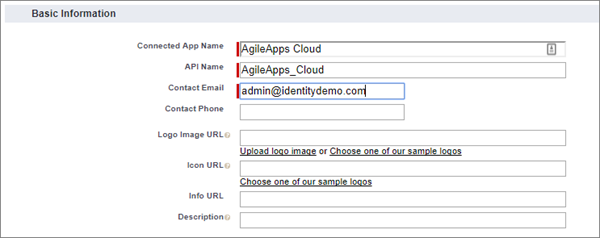
- Configure the connected app Basic Information settings.
- Enter a name for the AgileApps Cloud connected app. Salesforce uses this name to populate the API name.
- Enter your email address in case Salesforce needs to contact you or your support team.
- Optionally, upload or specify a logo and icon to represent your AgileApps Cloud application in the Salesforce App Launcher.
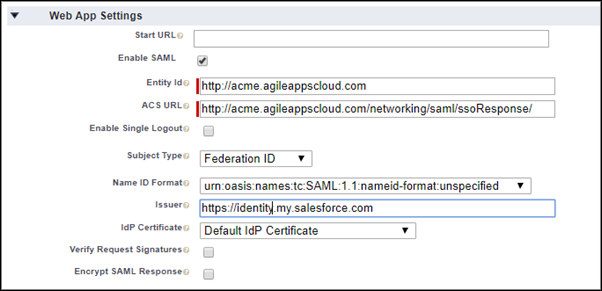
- Configure the connected app Web App Settings.
- Select Enable SAML.
- For Entity Id, enter yourdomain.agileappscloud.com. For example, https://acme.agileappscloud.com.
- For ACS URL, enter https://yourdomain.agileappscloud.com/saml/ssoResponse. For example, https://acme.agileapps.com/access/saml.
- For Subject Type, choose how users are identified to the identity provider, for example, Federation ID. A federation ID is a unique value assigned to the user across multiple web services and Salesforce orgs.
- For Name ID Format, keep the default value.
- For Issuer, keep the default value, which is your My Domain login URL.
- For IdP Certificate, keep the default (Default IdP Certificate).
- Save the settings.
- Configure profiles and permission sets for the connected app.
- From Setup, enter Apps in the Quick Find box.
- If you’re using Lightning Experience, select Manage Connected Apps.
- If you’re using Salesforce Classic, under Manage Apps, select Connected Apps.
- Click the name of your connected app for AgileApps Cloud. The connected app detail page appears.
- Click Manage Profiles or Manage Permission Sets, and add profiles or permission sets for the users who can access this app.
- From Setup, enter Apps in the Quick Find box.
- Create the start URL for the connected app.
- On the connected app detail page, click Edit Policies.
- For the beginning of the start URL, paste the Platform Authentication Service URL that AgileApps Cloud displayed when you configured the SAML settings.
- Append the parameter done= to the Platform Authentication Service URL. For example, https://acme.agileappscloud.com/networking/saml/ssoRequest?ticket=cfcflmhgbdh?done=.
- Navigate to the landing page that you want the user to see after successful SSO authentication.
- Copy the segment of the URL in the browser address bar after networking/.
- Paste this segment as the argument to the done= parameter. For example, if the URL is https://acme.agileappscloud.com/networking/dashboard/1555611998oxd1878317529, copy dashboard/1555611998oxd1878317529. For example, the entire Start URL is https://acme.agileappscloud.com/networking/saml/ssoRequest?ticket=cfcflmhgbdh?done=dashboard/1555611998oxd1878317529.
- Save the settings.
Test the SSO Configuration
In Salesforce, from the App Launcher, find and open the AgileApps Cloud app. If you configured the AgileApps Cloud logo and icon for the connected app, the App Launcher displays them. If SSO is configured properly, Salesforce creates an application session.
