Salesforce Classic Doesn’t Go Away When You Move Users to Lightning
Experience
Saying hello to Lightning Experience doesn’t mean saying goodbye to Salesforce Classic.
You and your users can easily move between the new and classic interfaces as needed. So even if
Lightning Experience isn’t a perfect fit yet, there’s no risk in rolling it out. Some occasional
switching is worth getting the productivity benefits from the new experience.
Required Editions
Available
in: Group, Professional, Enterprise, Performance,
Unlimited, and Developer Editions
In case users need access to a feature or tool that’s still back in the classic interface, we
provide the Switcher. All users who have access to Lightning Experience automatically get the
Switcher. Which
they can use to...wait for it...switch between Lightning Experience and Salesforce Classic
anytime they need.
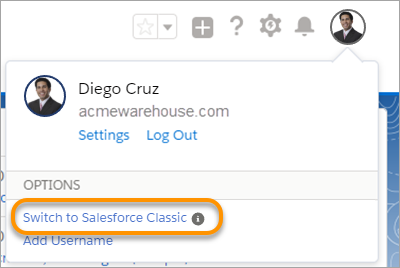
In the Lightning Experience header, click the profile picture and
select Switch to Salesforce Classic.
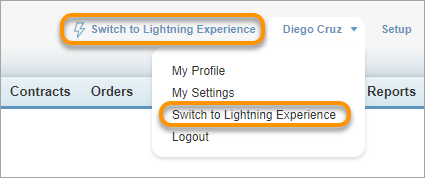
In the Salesforce Classic header, click Switch to
Lightning Experience. (The Switcher link is also available from a user’s
profile menu.)
When switching out of Salesforce Classic, a user lands on the same page in Lightning
Experience, if it exists. If the same page isn’t available in Lightning Experience, the
user sees their default landing page instead.
Each time a user switches to Lightning Experience or Salesforce Classic, that interface
becomes the user’s default interface.
We use three kinds of cookies on our websites: required, functional, and advertising. You can choose whether functional and advertising cookies apply. Click on the different cookie categories to find out more about each category and to change the default settings.
Privacy Statement
Required Cookies
Always Active
Required cookies are necessary for basic website functionality. Some examples include: session cookies needed to transmit the website, authentication cookies, and security cookies.
Functional Cookies
Functional cookies enhance functions, performance, and services on the website. Some examples include: cookies used to analyze site traffic, cookies used for market research, and cookies used to display advertising that is not directed to a particular individual.
Advertising Cookies
Advertising cookies track activity across websites in order to understand a viewer’s interests, and direct them specific marketing. Some examples include: cookies used for remarketing, or interest-based advertising.