
OAuth 2.0 Web Server Flow for Web App Integration
To integrate an external web app with the Salesforce API, use the OAuth 2.0 web server flow, which implements the OAuth 2.0 authorization code grant type. With this flow, the server hosting the web app must be able to protect the connected app’s identity, defined by the client ID and client secret.
Required Editions
| Available in: both Salesforce Classic (not available in all orgs) and Lightning Experience |
| Available in: all editions |

See New connected apps can no longer be created in Spring ‘26 for more details.
We recommend that you use the web server flow with Proof Key for Code for Exchange (PKCE,
pronounced pixy) in place of the user-agent flow or the username-password flow for special
scenarios. Use the code_challenge and code_verifier
parameters to implement PKCE with the web server flow. For more information on PKCE, see the
Internet Engineering Task Force (IETF.) We also recommend that you block all
connected apps from using the user-agent flow or the username-password flow. For steps, see
Block Authorization Flows to Improve Security.
Here’s an example use case for implementing the web server flow. You recently developed a web service that allows secure access to customer order status. The order status data is securely stored in your Salesforce CRM platform. To authorize Help Desk users to view a customer’s order status, you develop an Order Status app and configure it as a connected app with the web server flow.
- A Help Desk user clicks the Order Status web app.
- The connected app posts an authorization code request to the Salesforce authorization endpoint.
- The user is redirected to the Salesforce login page. After a successful login, the user is asked to approve the app’s access to order status data.
- After the user approves the Order Status app to access the data, Salesforce sends a callback to the Order Status app with an authorization code.
- The Order Status app passes the authorization code to the Salesforce token endpoint, requesting an access token.
- Salesforce validates the authorization code and sends back an access token that includes associated permissions in the form of scopes.
- The Order Status app sends a request back to Salesforce to access the order status data. The request includes the access token with associated scopes.
- Salesforce validates the access token and associated scopes.
- The Order Status app can access the protected data, and the customer’s order status is
displayed in the app.Note If the access token becomes invalid, the connected app can use a refresh token to get a new access token.
Let’s take a closer look at each step of this authorization flow.
- Request an Authorization Code
- User Authenticates and Authorizes Access
- Salesforce Grants Authorization Code
- Request an Access Token
- Salesforce Grants an Access Token
Request an Authorization Code
To initiate the OAuth 2.0 web server flow, the external web service—via the connected app—posts an authorization code request using the authorization code grant type to the Salesforce authorization endpoint. With an authorization code, the connected app can prove that it’s been authorized as a safe visitor to the site and that it has permission to request an access token.
The authorization code is in the form of an HTTP redirect.
https://MyDomainName.my.salesforce.com/services/oauth2/authorize?
client_id=3MVG9IHf89I1t8hrvswazsWedXWY0i1qK20PSFaInvUgLFB6vrcb9bbWFTSIHpO8G2jxBLJA6uZGyPFC5Aejq&
redirect_uri=https://www.mycustomerorderstatus.com/oauth2/callback&
response_type=code
Include these parameters in an authorization code request.
| Parameter | Description |
|---|---|
Request Header
|
The Salesforce OAuth 2.0 authorization endpoint. Connected apps send OAuth authorization requests to this endpoint. |
client_id
|
The consumer key of the connected app. To access the consumer key, from the App Manager, find the connected app, and select View from the dropdown. Then click Manage Consumer Details. You’re sometimes prompted to verify your identity before you can view the consumer key. |
redirect_uri
|
The URL where users are redirected after a successful authentication. The redirect URI must match one of the values in the connected app’s Callback URL field. Otherwise, the approval fails. You can find the redirect URI on the connected app’s Manage Connected Apps page or from the connected app’s definition. This value must be URL encoded. |
response_type
|
The OAuth 2.0 grant type that the connected app requests. The value for this
flow must be code to indicate that the connected app is requesting
an authorization code. |
You can also include these parameters in an authorization code request.
| Parameter | Description |
|---|---|
scope
|
Permissions that define the type of protected resources a connected app can access. You assign scopes to a connected app when you build it, and they’re included with the OAuth tokens during the authorization flow. If you don’t include this parameter, all scopes assigned to the connected app are requested. The scopes passed in this parameter must be a subset of the registered scopes. |
sso_provider
|
The developer name of a single sign-on (SSO) identity provider configured with a My Domain login URL or Experience Cloud site URL. You can use this parameter to create an SSO experience that feels like your app is integrated with the SSO provider. For example, you can use this parameter to offer SSO in a Headless Identity implementation. |
state
|
Any state that the external web service requests to be sent to the callback URL. This value must be URL encoded. |
immediate
|
A boolean value to determine whether the user is prompted for login and
approval. The default value is
The |
code_challenge
|
Specifies the SHA256 hash value of the This parameter is required if a
|
display
|
Changes the display type of the login and authorization pages. Salesforce supports these values.
|
login_hint
|
Provides a valid username value to prepopulate the login page with the
username, such as To pass the
|
nonce
|
Use with the openid scope to request a user ID token. The user
ID token is returned in the response. This parameter is optional, but it helps to
detect replay attacks.
|
prompt
|
Specifies how the authorization server prompts the user for reauthentication and reapproval. Salesforce supports these values.
You can pass |
Uvid-Hint header |
Optionally, to connect this flow to the headless guest flow, you can include a
If you implement the guest user flow on your app, you can optionally use this header to pass in a JSON Web Token (JWT)-based access token containing a unique visitor ID (UVID) tied to a guest user’s identity. By passing the UVID into a named user flow, you can carry contextual information from a guest user session, like the user’s cookie preferences, into a named user session. |
uvid_hint body parameter |
A plain Instead of passing the UVID in the request body, you
can also pass it in a JWT-based token with a UVID via the
|
User Authenticates and Authorizes Access
Before Salesforce provides authorization codes to connected apps, the authenticating users are asked to log in to Salesforce.
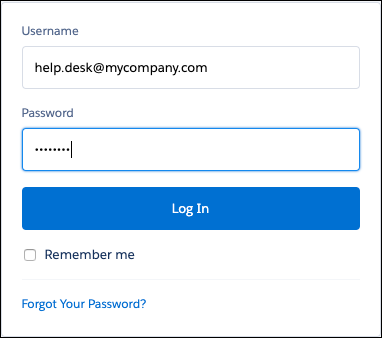
After a successful login, Salesforce redirects users to the approval page to grant access to the app.
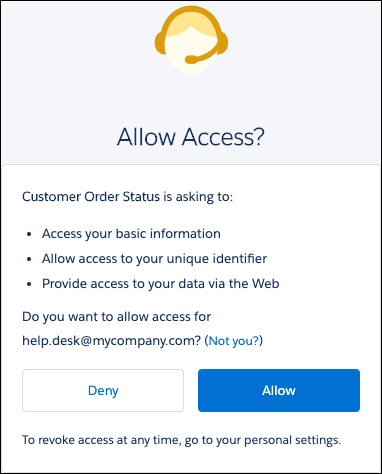
If users previously approved access, it isn’t necessary to approve access again.
Salesforce Grants Authorization Code
After users approve access to a connected app, Salesforce redirects users to the callback URL, where they can view the callback with an authorization code.
https://www.mycustomerorderstatus.com/oauth2/callback?
code=aPrx4sgoM2Nd1zWeFVlOWveD0HhYmiDiLmlLnXEBgX01tpVOQMWVSUuafFPHu3kCSjzk4CUTZg==- The first part of the callback is the connected app’s callback URL:
https://www.mycustomerorderstatus.com/oauth2/callback. - The second part is the authorization code that the connected app uses to get an access
token:
code=aPrx4sgoM2Nd1zWeFVlOWveD0HhYmiDiLmlLnXEBgX01tpVOQMWVSUuafFPHu3kCSjzk4CUTZg==. The authorization code expires after 15 minutes.
If the state parameter is included in the original query string, the
specified state is passed into the approval step.
Request an Access Token
To request an access token, the connected app passes the authorization code to the Salesforce token endpoint as an HTTP POST.
POST /services/oauth2/token HTTP/1.1
Host: mycompany.my.salesforce.com
Content-length: 307
Content-type: application/x-www-form-urlencoded
grant_type=authorization_code&
code=aPrxhgZ2MIpkSy0aOdn07LjKFvsFOis6RGcWXz7p8JQCjcqfed5NQLe7sxWwMY_JQFuLwHRaRA==&
client_id=3MVG9IHf89I1t8hrvswazsWedXWY0iqK20PSFaInvUgLFB6vrcb9bbWFTSIHpO8G2jxBLJA6uZGyPFC5Aejq&
client_secret=*******************&
redirect_uri=https://www.mycustomerorderstatus.com/oauth2/callback
The POST in the example contains these parameters.

| Parameter | Description |
|---|---|
Request Header
|
The request header can contain these parameters.
The request header also supports these parameters.
The |
grant_type
|
The type of validation that the connected app can provide to prove it’s a safe
visitor. For the web server flow, the value must be
authorization_code. |
code
|
A temporary authorization code received from the authorization server. The connected app uses this code in exchange for an access token. This type of OAuth 2.0 flow is a secure way to pass the access token back to the application. |
client_id
|
The consumer key of the connected app. To access the consumer key, from the App Manager, find the connected app, and select View from the dropdown. Then click Manage Consumer Details. You're sometimes prompted to verify your identity before you can view the consumer key. |
client_secret
|
The consumer secret of the connected app. To access the consumer secret, from the App Manager, find the connected app, and select View from the dropdown. Then click Manage Consumer Details. You’re sometimes prompted to verify your identity before you can view the consumer secret. This parameter is required unless the connected app doesn’t have
Require Secret for Web Server Flow enabled. If a
|
redirect_uri
|
The URL where users are redirected after a successful authentication. The redirect URI must match one of the values in the connected app’s Callback URL field. Otherwise, the approval fails. You can find the redirect URI on the connected app’s Manage Connected Apps page or from the connected app’s definition. This value must be URL encoded. |
You can also include these parameters.
| Parameter | Description |
|---|---|
client_assertion
|
Instead of passing a client_secret, you can provide a
client_assertion and client_assertion_type. If a
client_secret parameter isn’t provided, Salesforce checks for the
client_assertion and client_assertion_type.
|
client_assertion_type
|
Provide this value when using the The value of |
code_verifier
|
Required only if a
code_challenge parameter was specified in the authorization
request. Specifies 128 bytes of random data with high entropy to make guessing the
|
format
|
If not included in the request’s header, you can specify the expected return
format. The
|
client_assertion instead of
client_secret.If you provide a client_assertion
instead of a client_secret, the value of
client_assertion must include these parameters.
iss—Theclient_idfrom the connected app definition.sub—Theclient_idfrom the connected app definition.aud—The token servlet URL: https://hostname/services/oauth2/token.exp—The expiration time of the assertion within 5 minutes, expressed as the number of seconds from 1970-01-01T0:0:0Z measured in UTC.
The client_assertion must also be signed with the private key
associated with the OAuth consumer’s uploaded certificate. Only the RS256 algorithm is
supported. For the private_key_jwt client authentication method, see the
OpenID Connect specifications.
Instead of sending client
credentials as parameters in the body of the POST, Salesforce supports the HTTP Basic
authentication scheme. This scheme’s format requires the client_id and
client_secret in the authorization header of the post as
follows:
Authorization: Basic64Encode(client_id:secret)
The
client_id and client_secret are separated with a colon
(:). For more information, see the OAuth 2.0
Authorization Framework document.
This example shows an access token POST request that uses the HTTP Basic authentication scheme, rather than sending client credentials in the POST request’s body.
POST /services/oauth2/token HTTP/1.1
Host: mycompany.my.salesforce.com
Authorization: Basic client_id=3MVG9IHf89I1t8hrvswazsWedXWY0iqK20PSFaInvUgLFB6vrcb9bbWFTSIHpO8G2jxBLJA6uZGyPFC5Aejq&
client_secret=*******************&

grant_type=authorization_code&code=aPrxsmIEeqM9PiQroGEWx1UiMQd95_5JUZ
VEhsOFhS8EVvbfYBBJli2W5fn3zbo.8hojaNW_1g%3D%3D&
redirect_uri=https%3A%2F%2Fwww.mysite.com%2Fcode_callback.jspclient_id and client_secret are sent in
the POST’s body, the authorization header is ignored.Salesforce Grants an Access Token
After Salesforce validates the connected app’s credentials, it returns a response with the access token. In this example, the response is in a JSON format.
{
"access_token": "00DB0000000TfcR!AQQAQFhoK8vTMg_rKA.esrJ2bCs.OOIjJgl.9Cx6O7KqjZmHMLOyVb.U61BU9tm4xRusf7d3fD1P9oefzqS6i9sJMPWj48IK",
"signature": "d/SxeYBxH0GSVko0HMgcUxuZy0PA2cDDz1u7g7JtDHw=",
"scope": "web openid",
"id_token": "eyJraWQiOiIyMjAiLCJ0eXAiOiJKV1QiLCJhbGciOiJSUzI1NiJ9.eyJhdF9oYXNoIjoiSVBRNkJOTjlvUnUyazdaYnYwbkZrUSIsInN1YiI6Imh0dHBzOi8vbG9...",
"instance_url": "https://mycompany.my.salesforce.com",
"id": "https://login.salesforce.com/id/00DB0000000TfcRMAS/005B0000005Bk90IAC",
"token_type": "Bearer",
"issued_at": "1558553873237"
}
The response includes these parameters.
| Parameter | Description |
|---|---|
access_token
|
OAuth token that a connected app uses to request access to a protected resource on behalf of the client application. Additional permissions in the form of scopes can accompany the access token. |
signature
|
Base64-encoded HMAC-SHA256 signature signed with the
client_secret. The signature can include the concatenated ID and
issued_at value, which you can use to verify that the identity
URL hasn’t changed since the server sent it. |
scope
|
The scopes associated with the access token. Scopes further define the type of protected resources that the client can access. You assign scopes to a connected app when you build it, and they’re included with the OAuth tokens during the authorization flow. |
id_token
|
A signed data structure that contains authenticated user attributes, including a unique identifier for the user and a timestamp indicating when the token was issued. It also identifies the requesting client app. See OpenID Connect specifications. This parameter is
returned if the scope parameter includes
|
instance_url
|
A URL indicating the instance of the user’s org. For
example:
https://yourInstance.salesforce.com/.
|
id
|
An identity URL that can be used to identify the user and to query for more information about the user. See Identity URLs. |
token_type
|
A Bearer token type, which is used for all
responses that include an access token.
|
issued_at
|
Time stamp of when the signature was created in milliseconds. |
The response can also contain these parameters.
