OpenID Connect dynamic client registration lets OAuth 2.0 clients—connected
apps—directly register connected apps with Salesforce. To authenticate these client
registration requests, Salesforce requires an initial access token.
Required Editions
Available in: both Salesforce Classic and
Lightning Experience
Available in: All Editions
User Permissions Needed
To manage, create, edit, and delete OAuth apps:
Manage Connected Apps
Before generating an initial access token, create a connected app to integrate the OAuth 2.0
client with the Salesforce API. See Create a Connected App.
To use dynamic client registration, the registering connected app must provide the initial
access token in its request to the dynamic client registration endpoint. With a successful
authentication, Salesforce registers a new OAuth 2.0 connected app.
From Setup, enter Apps in the Quick Find box, then select
App Manager.
Locate the OAuth connected app in the apps list, click , and select View.
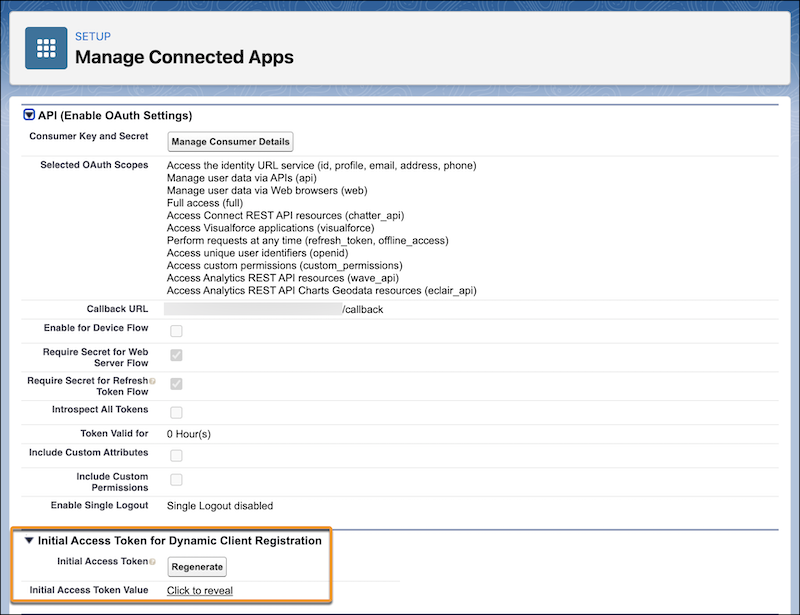
In the Initial Access Token for Dynamic Client Registration section, click
Generate if an initial access token hasn’t been created for the
connected app. If a token has already been created for the app, but you require a new token,
click Regenerate.
Regenerating the initial access token invalidates the previous one that your OAuth clients
use. Update your OAuth clients to use the new token.
Click Click to reveal, and copy the token for registration with the
app’s OAuth 2.0 client.
After generating the initial access token, register it with your external API gateway.
Did this article solve your issue?
Let us know so we can improve!
Loading
Salesforce Help | Article
Cookie Consent Manager
General Information
Required Cookies
Functional Cookies
Advertising Cookies
General Information
We use three kinds of cookies on our websites: required, functional, and advertising. You can choose whether functional and advertising cookies apply. Click on the different cookie categories to find out more about each category and to change the default settings.
Privacy Statement
Required Cookies
Always Active
Required cookies are necessary for basic website functionality. Some examples include: session cookies needed to transmit the website, authentication cookies, and security cookies.
Functional Cookies
Functional cookies enhance functions, performance, and services on the website. Some examples include: cookies used to analyze site traffic, cookies used for market research, and cookies used to display advertising that is not directed to a particular individual.
Advertising Cookies
Advertising cookies track activity across websites in order to understand a viewer’s interests, and direct them specific marketing. Some examples include: cookies used for remarketing, or interest-based advertising.