Use the User Email Domains page in Setup and email logs to identify the email domains
used to send email from Salesforce. List the email domains used in your active users' email
addresses and return email addresses on the User Email Domains page in Setup. Then check your
email logs for domains used to send system-generated email.
Required Editions
Available in: both Salesforce Classic and Lightning Experience
Available in: all editions except Database.com
User Permissions Needed
To see User Email Domains in Setup:
Email Administration or Modify All Data
Get a list of your active users’ email domains from the User Email Domains page in
Setup.
From Setup, in the Quick Find box, enter User Email Domains, and
then select User Email Domains.
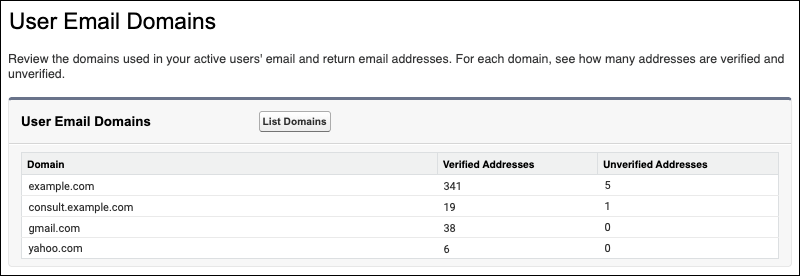
Click List Domains to populate the table.
The table shows each unique domain used in active users’ email addresses and return email
addresses, along with the count of verified and unverified addresses for each domain.
To minimize the performance impact of running the related query, the list is populated
only when you click List Domains.
Identify other email-sending domains.
With these features, Salesforce sends email from addresses that aren’t user email
addresses. Add the email domains for these addresses to your list.
To ensure email delivery from Salesforce, cross-check the final list of email-sending
domains against your DomainKeys Identified Mail (DKIM) keys and authorized email domains. See
Get a List of Your Verified Email-Sending Domains.
If the User Email Domains list includes a legitimate email-sending domain that you can’t verify,
turn on a Deliverability setting. See Send Email for Users with Unverified Domains.
We use three kinds of cookies on our websites: required, functional, and advertising. You can choose whether functional and advertising cookies apply. Click on the different cookie categories to find out more about each category and to change the default settings.
Privacy Statement
Required Cookies
Always Active
Required cookies are necessary for basic website functionality. Some examples include: session cookies needed to transmit the website, authentication cookies, and security cookies.
Functional Cookies
Functional cookies enhance functions, performance, and services on the website. Some examples include: cookies used to analyze site traffic, cookies used for market research, and cookies used to display advertising that is not directed to a particular individual.
Advertising Cookies
Advertising cookies track activity across websites in order to understand a viewer’s interests, and direct them specific marketing. Some examples include: cookies used for remarketing, or interest-based advertising.