Decide How Users Select a Verification Method During MFA Registration for Salesforce
Orgs
Optimize how users register identity verification methods for multi-factor authentication
(MFA) and device activation, based on the methods you want to prioritize. If you’re supporting
multiple verification methods, you can start with a list of all options for users to choose
from. Or, if you want to prioritize built-in authenticators, you can present that option
first.
Required Editions
Available in: both Salesforce Classic and
Lightning Experience
Available in: all editions
User Permissions Needed
To modify identity verification settings:
Customize Application
Decide which registration option is most efficient for your users.
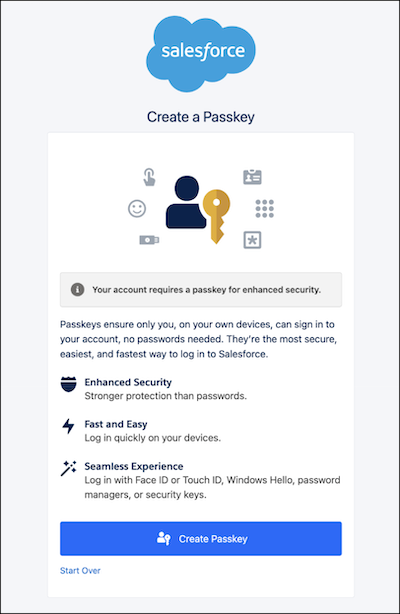
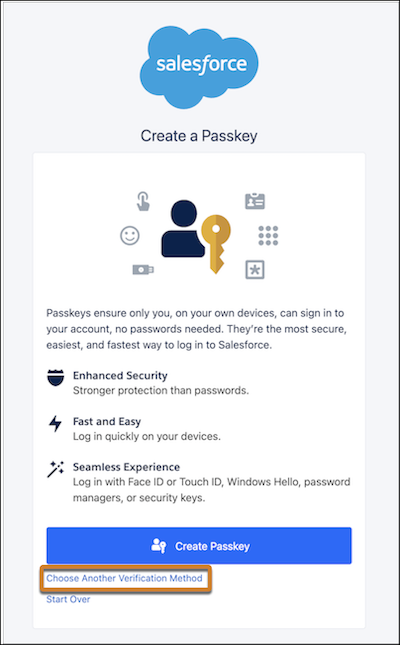
Start with the screen to connect a Built-In
Authenticator
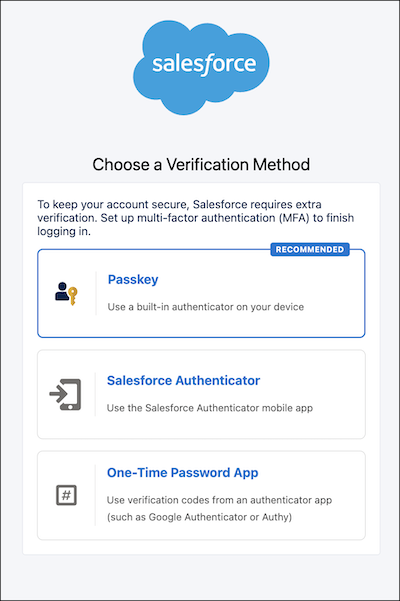
Start with a list of all available verification
methods
Best if you want to promote the use of built-in authenticators. Users can register other methods
by selecting Choose Another Verification Method. If users
register multiple methods, Salesforce uses this order of precedence for
verification: built-in authenticators, security keys, Salesforce Authenticator,
third-party authenticator apps.
Best if you’re supporting multiple types of methods, including built-in authenticators, security
keys, and authenticator apps.
To configure the verification method registration flow:
From Setup, in the Quick Find box, enter Identity, and select
Identity Verification.
Select or deselect Show all verification method registration options instead
of starting with built-in authenticators.
We use three kinds of cookies on our websites: required, functional, and advertising. You can choose whether functional and advertising cookies apply. Click on the different cookie categories to find out more about each category and to change the default settings.
Privacy Statement
Required Cookies
Always Active
Required cookies are necessary for basic website functionality. Some examples include: session cookies needed to transmit the website, authentication cookies, and security cookies.
Functional Cookies
Functional cookies enhance functions, performance, and services on the website. Some examples include: cookies used to analyze site traffic, cookies used for market research, and cookies used to display advertising that is not directed to a particular individual.
Advertising Cookies
Advertising cookies track activity across websites in order to understand a viewer’s interests, and direct them specific marketing. Some examples include: cookies used for remarketing, or interest-based advertising.