
You are here:
Add a Date Widget to Filter Dashboard Results Based on a Date
A date filter widget allows dashboard viewers to filter the CRM Analytics dashboard results based on a selected date range. The range can use relative dates based on UTC (like 2 years ago), absolute dates (like 1/15/2016), or presets (like Current Fiscal Year To Date). For example, you can add a date widget to filter support cases, showing only cases that closed this month or last month.
The date widget requires a query that has a single grouping based on a date field.

- Drag the date widget to the dashboard canvas.
-
To open the wizard, click the button inside the
widget.
The Select a Field screen appears, showing a list of all date fields in the specified dataset.
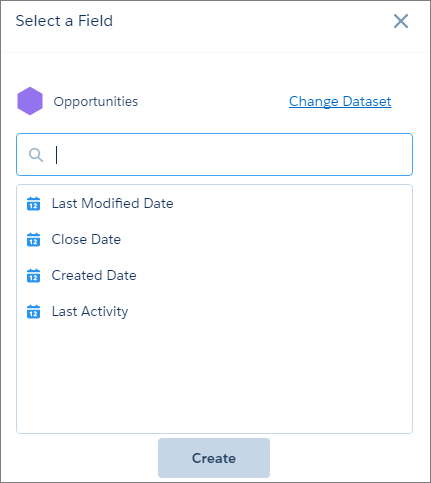
- To use a different dataset, click Change Dataset.
- Select the date field that you want to filter on by selecting it from the field list or typing in its API name.
-
Click Create.
Behind the scenes, CRM Analytics creates a query grouped by the field that you selected. CRM Analytics adds the query to the query panel, but you can’t reuse it in other widgets. CRM Analytics doesn’t apply any selections to the widget, by default.
-
To change the widget and query properties, select the
widget.
The Widget panel groups the widget properties into sections. So that you don’t accidentally overlook any properties, expand any collapsed sections.
- In the widget properties, specify whether to show absolute, relative, or preset dates, select the default calendar type.
- Use a List of presets for a fixed interval.
-
Specify whether users can switch calendar types while viewing the dashboard in Default
Calendar Type.
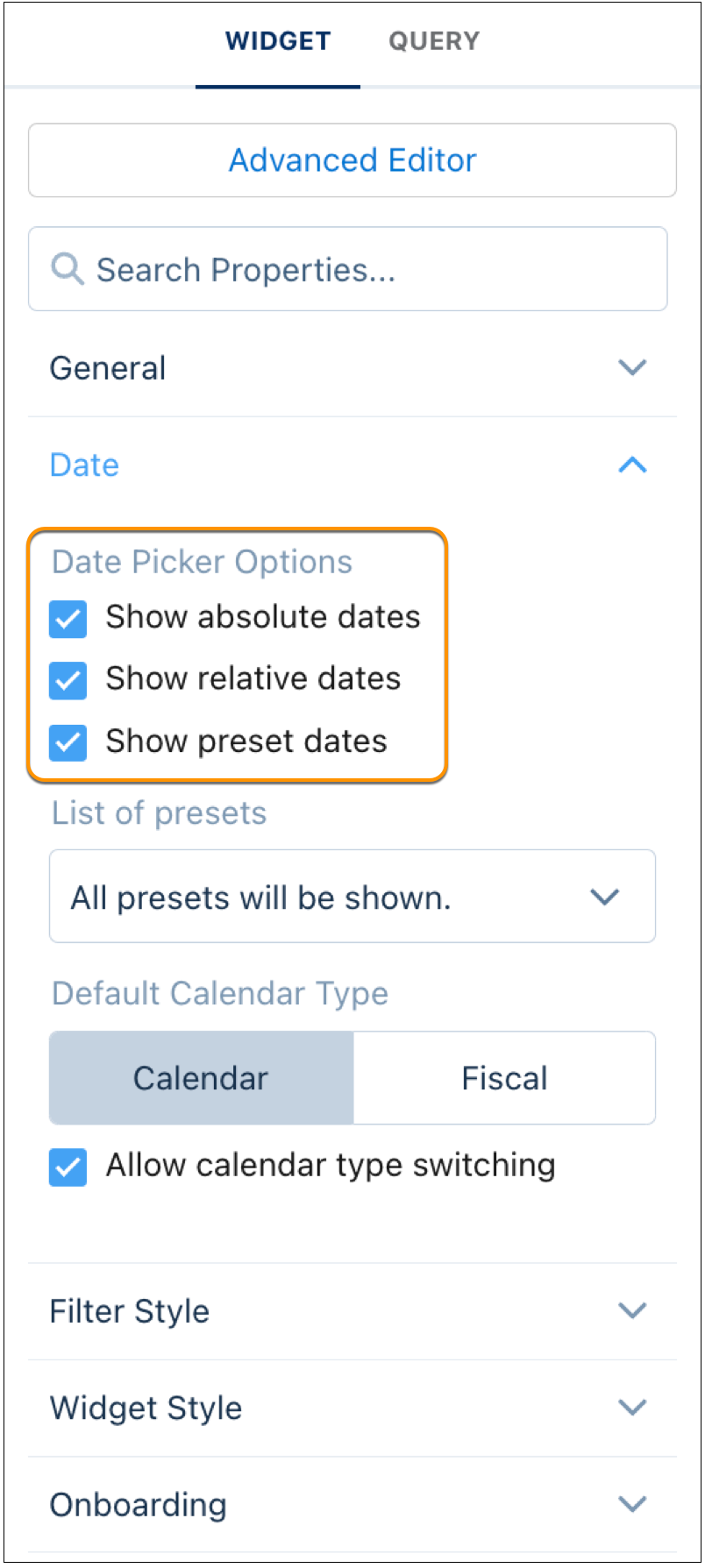 Note If you enable absolute and relative dates, absolute dates show by default. To show relative dates, by default, set an initial selection based on a relative date.
 -
To show and set the query properties, click
Query in the right panel.
For example, to enable this widget to filter other faceted widgets, select Broadcast selections as facets.
- To preview your changes to the dashboard, click the Preview button.
-
Select applicable intervals. Use the Custom interval to switch calendar type or apply
custom intervals, such as 60 days ago.
Note By default, Custom interval converts selected presets, such as Previous Fiscal Year, to a standard calendar date range in the Absolute tab, which may not match your org’s fiscal year setting. To customize a fiscal preset, manually adjust the absolute start and end dates in the Absolute tab or use settings in the Relative tab.
- Save the dashboard.
You can set an initial selection that applies when the dashboard opens. The selected range filters other faceted widgets. While viewing the dashboard, viewers can change the selection to filter the results differently. For information about setting an initial selection, see Set Initial Selections in the Dashboard.
