Choose the Default Dataset Columns That Appear in a Table
Make tables your own by choosing the default columns. For example, show the most
commonly used columns in a particular order. If you don’t set the defaults, the first five
measures and five dimensions are selected in alphabetical order.
Required Editions
Available in Salesforce Classic and Lightning Experience.
Available with CRM Analytics, which is available for an extra cost in
Enterprise, Performance, and Unlimited Editions. Also available in
Developer Edition.
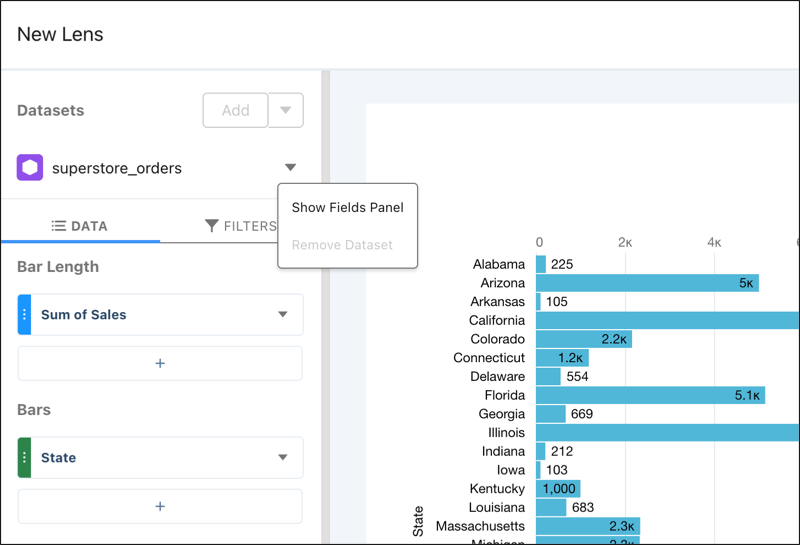
To configure the dataset columns, click Fields while exploring the
dataset.
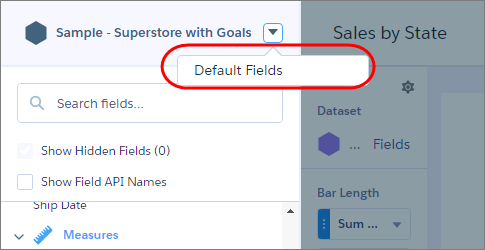
Click the dropdown arrow next to the dataset name, and click Default
Fields.
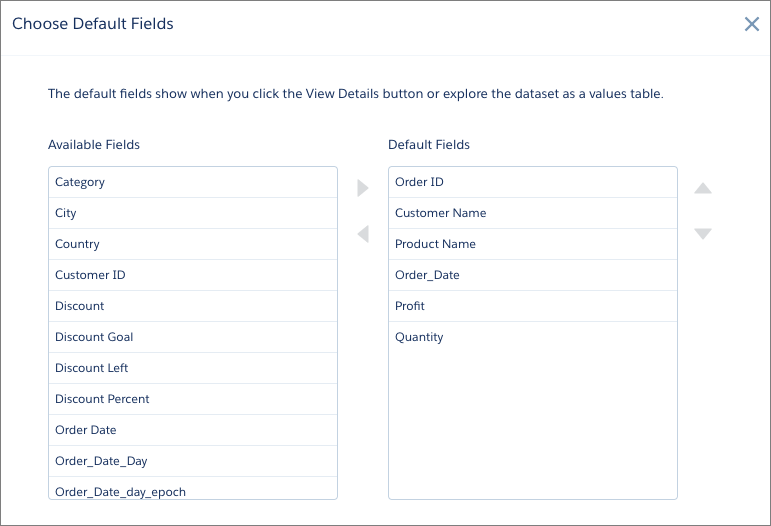
Select the columns to show by default, use the up and down arrows to reorder them, and
click Update.
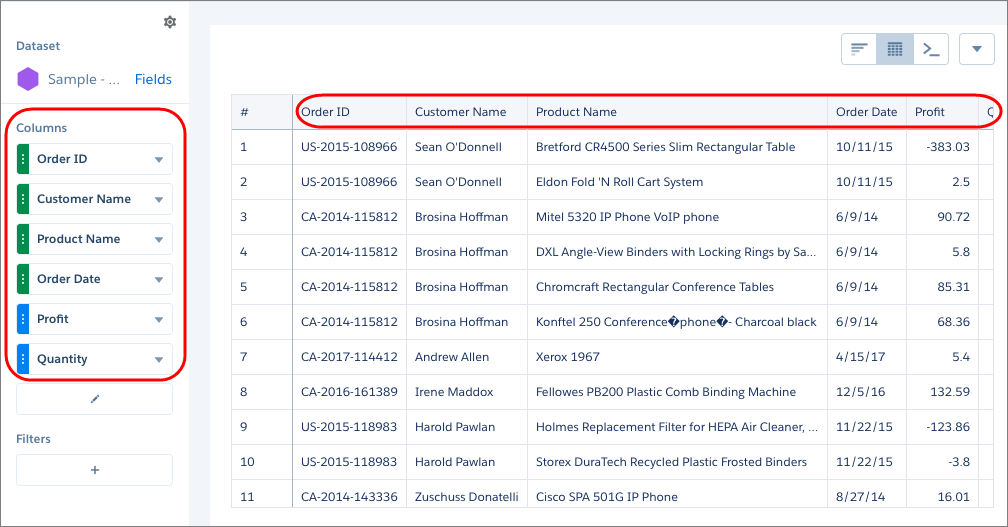
When you explore the dataset as a values table, the selected columns appear in the specified
order.
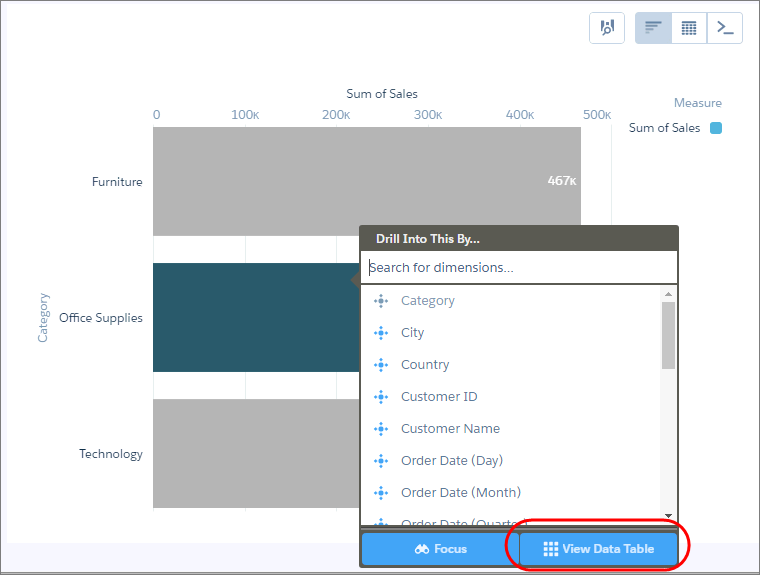
You see the same table columns and order when you click View Data Table
to view the data in a tabular format.
Did this article solve your issue?
Let us know so we can improve!
Loading
Salesforce Help | Article
Cookie Consent Manager
General Information
Required Cookies
Functional Cookies
Advertising Cookies
General Information
We use three kinds of cookies on our websites: required, functional, and advertising. You can choose whether functional and advertising cookies apply. Click on the different cookie categories to find out more about each category and to change the default settings.
Privacy Statement
Required Cookies
Always Active
Required cookies are necessary for basic website functionality. Some examples include: session cookies needed to transmit the website, authentication cookies, and security cookies.
Functional Cookies
Functional cookies enhance functions, performance, and services on the website. Some examples include: cookies used to analyze site traffic, cookies used for market research, and cookies used to display advertising that is not directed to a particular individual.
Advertising Cookies
Advertising cookies track activity across websites in order to understand a viewer’s interests, and direct them specific marketing. Some examples include: cookies used for remarketing, or interest-based advertising.