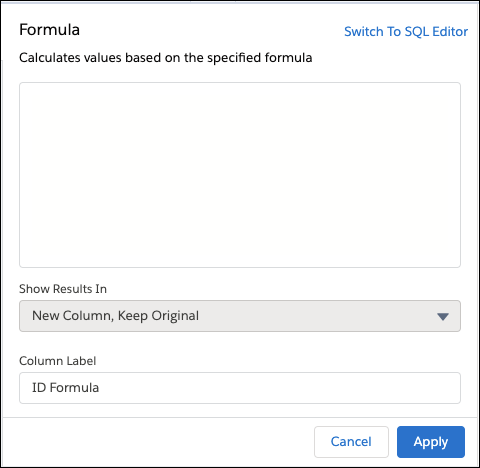
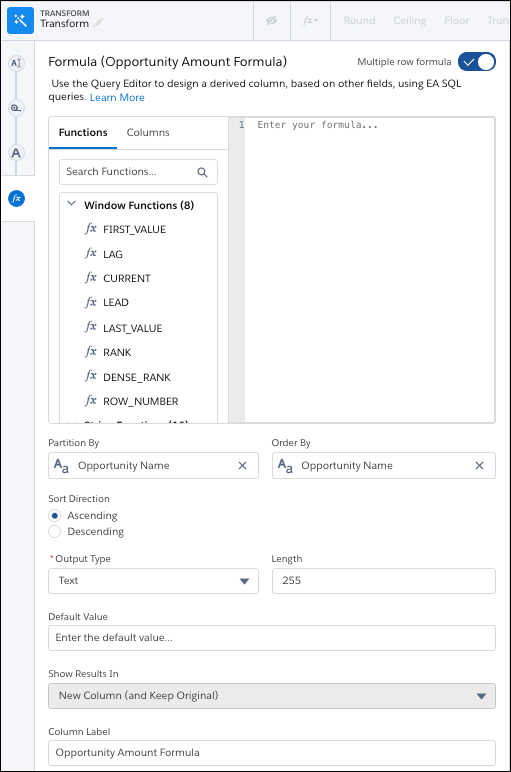
You see a different formula editor if your recipe was converted from Data Prep Classic
to Data Prep and your formulas couldn’t automatically upgrade. You’re still able to edit and use
these formulas, but to get the most formula options through EA-SQL and best experience, recreate
the formula in the Data Prep recipe editor.
Required Editions
User Permissions
Needed
To create a recipe:
Edit CRM Analytics Dataflows OR Edit Dataset Recipes
In a Data Prep recipe that was converted from Data Prep Classic to Data Prep, select a
transformation with a formula.
A formula that was not converted automatically looks like this. Continue to use
these instructions to upgrade or edit your formula.
To edit your formula without upgrading, make your edits following the same syntax used
when the formula was originally written. Do not select to switch to the SQL editor.
If needed, change the label of the calculated column.
When you have completed the formula, click Apply to add the
transformation to the Transform node.
The new formula column appears in the recipe preview.
To view the Graph area, click the Collapse button ().
Save the recipe.
Numeric Operators and Functions for Unconverted Formulas Use numeric functions to calculate values from measures in your recipe. For example, you can round, truncate, and determine the absolute value of a number. The arguments for numeric functions can be numbers or measure columns. If your recipe was upgraded to Data Prep, but your recipe doesn’t convert, this topic is for your unconverted recipe.
String Functions for Unconverted Formulas Use string functions to create values based on other strings. For example, you can change the casing of text strings, concatenate values from multiple columns, and replace values. The arguments for string functions must be text strings or dimension columns. If your recipe was upgraded to Data Prep, but your recipe doesn’t convert, this topic is for your unconverted recipe.
Did this article solve your issue?
Let us know so we can improve!
Loading
Salesforce Help | Article
Cookie Consent Manager
General Information
Required Cookies
Functional Cookies
Advertising Cookies
General Information
We use three kinds of cookies on our websites: required, functional, and advertising. You can choose whether functional and advertising cookies apply. Click on the different cookie categories to find out more about each category and to change the default settings.
Privacy Statement
Required Cookies
Always Active
Required cookies are necessary for basic website functionality. Some examples include: session cookies needed to transmit the website, authentication cookies, and security cookies.
Functional Cookies
Functional cookies enhance functions, performance, and services on the website. Some examples include: cookies used to analyze site traffic, cookies used for market research, and cookies used to display advertising that is not directed to a particular individual.
Advertising Cookies
Advertising cookies track activity across websites in order to understand a viewer’s interests, and direct them specific marketing. Some examples include: cookies used for remarketing, or interest-based advertising.