When you first run a recipe, Data Prep caches the input data, storing a copy of the
source data in cached files, by default. To save time during subsequent recipe runs, Data Prep
uses the cached data instead of extracting the same data again. To use input caching, the recipe
must extract data from all fields in the source.
Required Editions
Available in Salesforce Classic and Lightning Experience.
Available for an extra cost in Enterprise, Performance, and
Unlimited Editions. Also available in: Developer Edition
When the option is enabled, recipe runtime varies based on whether the source data is cached
and the cache is used. If the recipe doesn’t extract data from all fields in the source, caching
doesn’t happen. If the data is older than 45 days, the disk usage exceeds 70%, or the source
data changed since the last recipe run, cached data isn’t used. If needed, you can disable input
caching to get more consistent recipe runtimes.
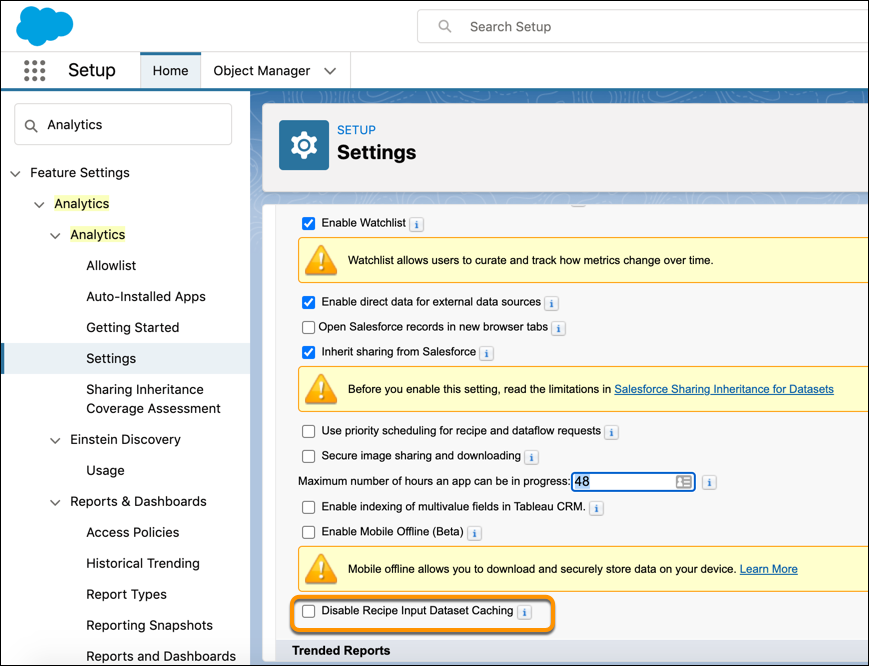
From Setup, enter Analytics in the Quick Find
box, then select Settings.
Select Disable Recipe Input Dataset Caching.
To have more consistent recipe runtimes, you can disable this option.
Click Save.
Did this article solve your issue?
Let us know so we can improve!
Loading
Salesforce Help | Article
Cookie Consent Manager
General Information
Required Cookies
Functional Cookies
Advertising Cookies
General Information
We use three kinds of cookies on our websites: required, functional, and advertising. You can choose whether functional and advertising cookies apply. Click on the different cookie categories to find out more about each category and to change the default settings.
Privacy Statement
Required Cookies
Always Active
Required cookies are necessary for basic website functionality. Some examples include: session cookies needed to transmit the website, authentication cookies, and security cookies.
Functional Cookies
Functional cookies enhance functions, performance, and services on the website. Some examples include: cookies used to analyze site traffic, cookies used for market research, and cookies used to display advertising that is not directed to a particular individual.
Advertising Cookies
Advertising cookies track activity across websites in order to understand a viewer’s interests, and direct them specific marketing. Some examples include: cookies used for remarketing, or interest-based advertising.