
You are here:
Customer Health Score (CHS)
Integrates usage, adoption, and support signals to reflect the overall vitality of the customer relationship. It aggregates adoption, support, and relationship signals to predict renewal likelihood, blending behavioral and operational data to quantify customer dependence and value.
Required Editions
| View supported editions |
CHS Use Cases
- To predict renewal outcomes by assessing the combined impact of support cases and product adoption.
- To identify at-risk revenue where poor support experiences such as low fix rates are dragging down account health.
- To launch proactive success interventions when the health score drops below a defined threshold.
CHS KPIs
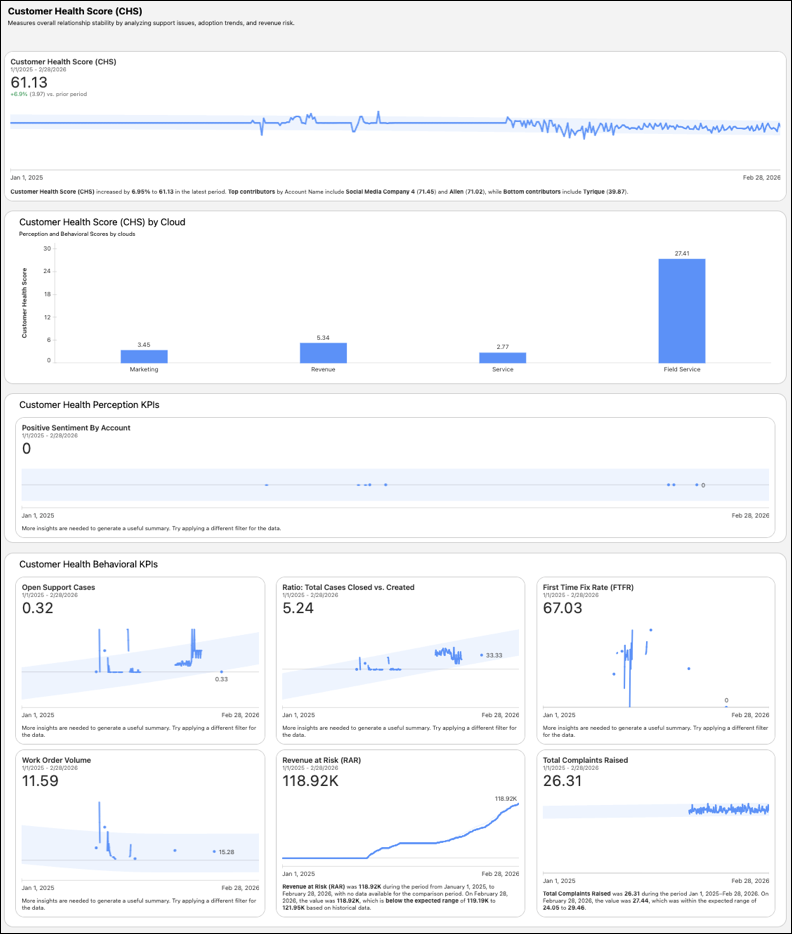
| KPIs | KPI Purpose |
|---|---|
| Customer Health Score (CHS) by Cloud | Isolates account health by the department to reveal exactly which business unit such as sales, service, or revenue is destabilizing the relationship. It prevents average scores from hiding specific functional failures, enabling targeted remediation where the customer is struggling most. |
| Open Support Cases | Tracks the volume of unresolved customer issues to serve as a leading indicator of relationship friction. A rising count signals deteriorating trust and potential churn risk, prompting immediate service intervention before the relationship becomes unsalvageable. |
| Ratio: Total Cases Closed vs. Created | Measures the velocity of support resolution relative to incoming demand, identifying if support teams are falling behind or keeping up. A low ratio indicates a growing backlog that threatens long-term customer confidence, signaling a need for increased capacity or efficiency. |
| First Time Fix Rate (FTFR) | Measures service quality by tracking the percentage of issues resolved on the first interaction, directly influencing customer trust. High FTFR reduces customer effort and frustration, acting as a stabilizer for overall account health and a driver of renewal. |
| Work Order Volume | Gauges the level of operational dependency and activity a customer has with your services. Significant fluctuations can signal either upsell potential or disengagement, alerting account managers to changing customer needs. |
| Revenue at Risk (RAR) | Connects health scores directly to financial outcomes by quantifying the specific revenue tied to accounts showing distress signals. It helps leaders prioritize interventions based on potential financial loss rather than just sentiment, ensuring high-value accounts are protected. |
| Total Complaints Raised | Accumulates distinct negative feedback events to act as a definitive "red flag" for immediate churn risk. It cuts through other noise to highlight customers who have explicitly expressed dissatisfaction, requiring urgent executive attention to resolve. |
| Account Watchlist | Aggregates accounts with a deteriorating overall health profile driven by a mix of high support volume, complaints, and low sentiment. It identifies customers who are structurally unhealthy and require a holistic get-well plan to prevent non-renewal. |
