
You are here:
Hypernyms and Hyponyms
A hypernym is a broad term for a group of products. A hyponym is a term for an item in the group that the hypernym describes. A hypernym returns the results of all of its hyponyms, but the hyponyms only return their own results. You can exclude specific hypernyms using negative hypernyms. This topic applies to B2C Commerce.
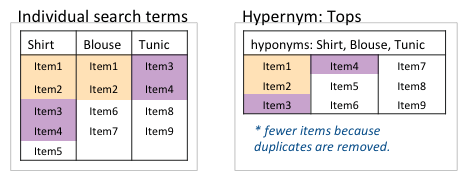
The total number of search results on the hypernym might be less than for each of the hyponyms if there’s overlap in the categories you’re searching on. In the following example, if you search for Tunic, Shirt, and Blouse individually, the sum of the search hits is 13. However, when you search for the hypernym "Tops", which has Tunic, Shirt, and Blouse as hyponyms, only nine search hits are returned. This is because several of the search hits contain more than one of the hyponyms. This is because the hypernym search removes duplicate results returned in the individual searches.

For example, consider the hypernym rule where the hypernym is footwear,
and the hyponyms are [shoes, boots, sandals, sneakers].
| Shopper Searches for... | Actual B2C Commerce Query |
|---|---|
| sneakers | sneakers OR footwear |
| boots | boots OR footwear |
| footwear | footwear |
In case of the hypernym footwear, if the shopper searches for
footwear, the search results for only footwear are displayed and
not results for shoes, boots, sandals, or sneakers.
Negative Hypernyms
If you enter hypernyms (single or multi-word) with the '-' negative operator in front of it, products containing the negative hypernym are not returned in the search results.
If handbag is a hyponym of the bag hypernym, a user search that must not include bag is expanded into a search that must not include either the handbag or bag keywords.
| User Query | Actual B2C Commerce Store Query |
|---|---|
| -bag | NOT handbag AND NOT bag |
