
You are here:
Create Configurable Bundles in a B2B Store
Create configurable bundles that buyers can customize. Define required and optional items, define rules, and enable real-time pricing updates.
Required Editions
Set up Product Configurator before creating configurable bundles. For details, see Set Up Product Configurator for B2B Stores.
| View supported editions. |
Create a Configurable Bundle in Revenue Cloud
Create configurable bundles in Revenue Cloud so buyers can configure and purchase them from your B2B store.
- From the App Launcher, find and select Product Catalog Management.
-
Create a configurable bundle following the instructions in Create Bundled Products in Revenue Cloud.
 Note Configurable bundles don't support quantity changes for the child products. Make sure that Allow Quantity Changes is deselected and Quantity Scaling Methods is set to Proportional for all child products.Note You can add configurable products as child products in a configurable bundle. For details on creating configurable products, see Create Configurable Products with Dynamic Attributes in a B2B Store.
Define Constraints for a Configurable Bundle
(Optional) To manage complex product configurations and ensure valid combinations, use the Constraint Rules Engine.
- Set up the Constraint Rules Engine. For instructions, see Set Up Constraint Rules Engine for Product Configurator.
- Create a constraints model, add your bundle to it, and configure and activate the constraints. For detailed steps, see Rules and Constraints in Configurator With Constraint Rules Engine.
Assign Category, Entitlement Policy, and Pricing to a Configurable Bundle
To make your configurable bundle discoverable by buyers, assign the bundle to a category. To make sure that buyers can see and purchase the bundle, assign entitlement policies and pricing directly to the parent product of the bundle. Child products inherit these settings. Any entitlements or promotions applied directly to child products are ignored.
- From the App Launcher, find and select Commerce.
- In the navigation sidebar, select a store from the Store dropdown.
- Select Merchandising | Products.
- In the Product Workspace, select the bundle that you want to configure.
- Open the global product record by using the link at the bottom of the Edit Product page.
-
Assign categories.
- On the Related tab, in the Categories section, click Assign.
- Select the category, and save your changes.
-
Assign one or more entitlement policies.
- On the Related tab, in the Commerce Entitlement Policies section, click Assign.
- Select the policy, and save your changes.
-
Add pricing.
- On the Related tab, in the Price Books section, click New.
- For Price Book, select your store’s standard price book.
- Enter a list price.
- (Optional) Select a currency.
- Save your changes.
- Make sure that the bundle is active so buyers can view it in your store.
Create Bundle-Based Price Adjustments
Define and manage bundle-based discounts for a configurable bundle.
-
Configure bundle-based adjustments to calculate discounts. For details, see Bundle-Based Price.
Note Pricing adjustments apply only to transactions that occur within the effective date range defined in the Price Adjustment Schedule. Transactions outside this range don't reflect these adjustments.
-
After configuring the bundle-based adjustments and discounts, refresh the decision
tables.
- From the App Launcher, find and select Lookup Tables.
- In the list of decision tables, click Bundle Based Adjustment Entries.
- Refresh the decision table.
Create a Constant for a Bundle-Based Adjustment Variables
To adjust the bundle price based on buyer configurations, complete this step. This is a one-time setup for bundle-based adjustments.
- From App Launcher, find and select Pricing Procedures.
- Click the Commerce pricing procedure for your org.
-
On the Pricing Procedure builder canvas, click
 .
.
- On the Resource Manager panel, click Add Resource.
-
In the Add New Resource page, specify these details.
- Resource Type: Constant
- Resource Name: BundleBasedAdjustmentId
- Data Type: Text
-
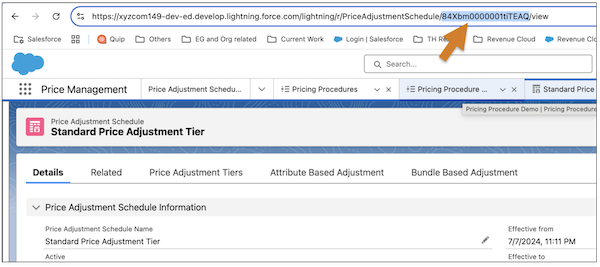
Default Value: Enter the Price Adjustment Schedule ID of the bundle-based adjustment.
You can locate the value of your variable by going to the associated record. For example, to locate a price adjustment schedule ID, from App Launcher, find and select From App Launcher, find and select Price Adjustment Schedules. Open the price adjustment schedule record page. The price adjustment schedule ID is shown in the browser’s URL.
- Save your changes.
