
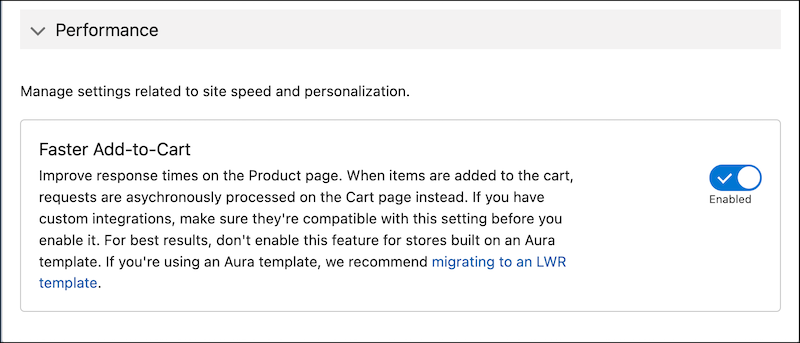
To speed up the shopping experience in your LWR store, turn on the Faster Add-to-Cart
feature. By splitting processing time across Product and Cart pages, Faster Add-to-Cart improves
the response time on a Product page when a customer adds an item to their cart. This setting is
enabled by default for B2B stores created in Winter ’24 or later and D2C stores created between
Winter ’24 and Spring ’25.
If you have custom components that use cart APIs, make sure that they don’t rely on an
add-to-cart response when returning cart item IDs, cart item prices, or promotions. If
they do, change the components before enabling Faster Add-to-Cart.
When Faster Add-to-Cart is enabled, the Cart Badge shows only the total number of
items in a cart and not the total number of unique products. Also, for stores created in
Spring ’25 or later, inventory checks occur when a shopper tries to add an item to cart or
update a cart item's quantity. If the inventory is unavailable, the cart item isn't added
or updated, and an error message is displayed to the shopper.
In the navigation sidebar, select a store from the Store dropdown.
Select Settings | Store.
On the General Settings tab, in the Performance section, enable Faster
Add-to-Cart.
We use three kinds of cookies on our websites: required, functional, and advertising. You can choose whether functional and advertising cookies apply. Click on the different cookie categories to find out more about each category and to change the default settings.
Privacy Statement
Required Cookies
Always Active
Required cookies are necessary for basic website functionality. Some examples include: session cookies needed to transmit the website, authentication cookies, and security cookies.
Functional Cookies
Functional cookies enhance functions, performance, and services on the website. Some examples include: cookies used to analyze site traffic, cookies used for market research, and cookies used to display advertising that is not directed to a particular individual.
Advertising Cookies
Advertising cookies track activity across websites in order to understand a viewer’s interests, and direct them specific marketing. Some examples include: cookies used for remarketing, or interest-based advertising.