Use segments to associate your promotion with specific stores or buyer groups. Then
only customers who are a member of the store or buyer group can see the promotion. You can apply
one promotion segment at a time to a store. A promotion segment can have up to 50 automatic and
50 manual active promotions.
When you assign a promotion segment to a buyer group, you can’t assign the same segment to
a store. Instead, associate the buyer group to the store. You can associate a promotion to
multiple buyer groups.
You can’t change the association between a promotion and a promotion segment. Instead,
delete the promotion segment and create a new one.
You can’t change the association between a promotion segment and a buyer group. Instead,
delete the buyer group and assign a different one to the promotion segment.
In the navigation sidebar, select a store from the Store
dropdown.
Select Promotions, and select the promotion.
On the Segments tab, click Add Promotion Segment.
To create a segment, click the Promotion Segment field and select New
Promotion Segment.
To use an existing segment, select it, save your work, and you’re done.
Enter a name for the segment, and click Save.
Click Save again.
Go to your segment, and select the Related tab.
Next to the stores or buyer groups option, click Assign.
Select at least one store or buyer group. If you’re selecting a buyer group, make sure
that it’s assigned to the store. You can associate a promotion segment with either a store
or a buyer group, but not both.
If you have an existing Commerce store that has buyer groups and store segments,
delete either the store or the buyer groups to create the promotion. No changes are
required for new B2B stores.
Click Save.
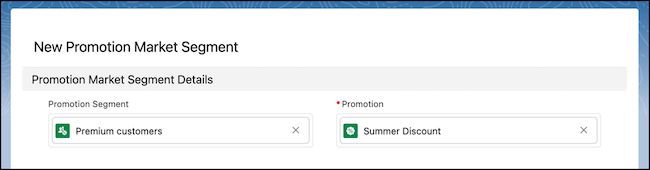
Example To kick off the summer shopping season this May, you want to offer a 30% discount to
the Premium customers buyer group in your D2C store. When you create a promotion segment:
From the Promotion Segment dropdown menu, select Premium
customers. This segment includes your D2C store and your Premium customers
buyer group.
From the Promotion dropdown menu, select Summer Discount.
We use three kinds of cookies on our websites: required, functional, and advertising. You can choose whether functional and advertising cookies apply. Click on the different cookie categories to find out more about each category and to change the default settings.
Privacy Statement
Required Cookies
Always Active
Required cookies are necessary for basic website functionality. Some examples include: session cookies needed to transmit the website, authentication cookies, and security cookies.
Functional Cookies
Functional cookies enhance functions, performance, and services on the website. Some examples include: cookies used to analyze site traffic, cookies used for market research, and cookies used to display advertising that is not directed to a particular individual.
Advertising Cookies
Advertising cookies track activity across websites in order to understand a viewer’s interests, and direct them specific marketing. Some examples include: cookies used for remarketing, or interest-based advertising.