
You can build, train, and deploy sophisticated custom machine learning (ML) models with
Google Cloud Vertex AI and data in Salesforce. After registering a model in Vertex AI, define your
prediction criteria and connect the model with Data 360 to get predictions and
insights for your use case. Use the insights to enrich customer profiles, create segments, and
customize experiences across various channels.
Required Editions
Available in: Developer, Enterprise, Performance, and Unlimited editions.
Here are some benefits of using Vertex AI models with Salesforce data.
Access highly curated, harmonized, and near real-time data across Customer 360. This
capability leads to expert models that deliver more intelligent predictions.
Build models in Vertex AI and easily connect them with Data 360 to consume
predictive insights for business process optimization. Use cases include propensity to buy, lead
conversion, product interest, and more.
Operationalize models and inferences easily in Salesforce.Data 360
simplifies the consumption of results from business processes and drives value.
Eliminate tedious, costly, and error-prone Extract, Transform, and Load (ETL) jobs from
Google Cloud because of the zero-copy approach to data. This approach also improves efficiencies
for businesses.
Integrate Vertex AI models and get predictions in Salesforce. Use Flow, a workflow automation
suite, to enable AI-driven decision-making that can evolve based on real-time updates to
data.
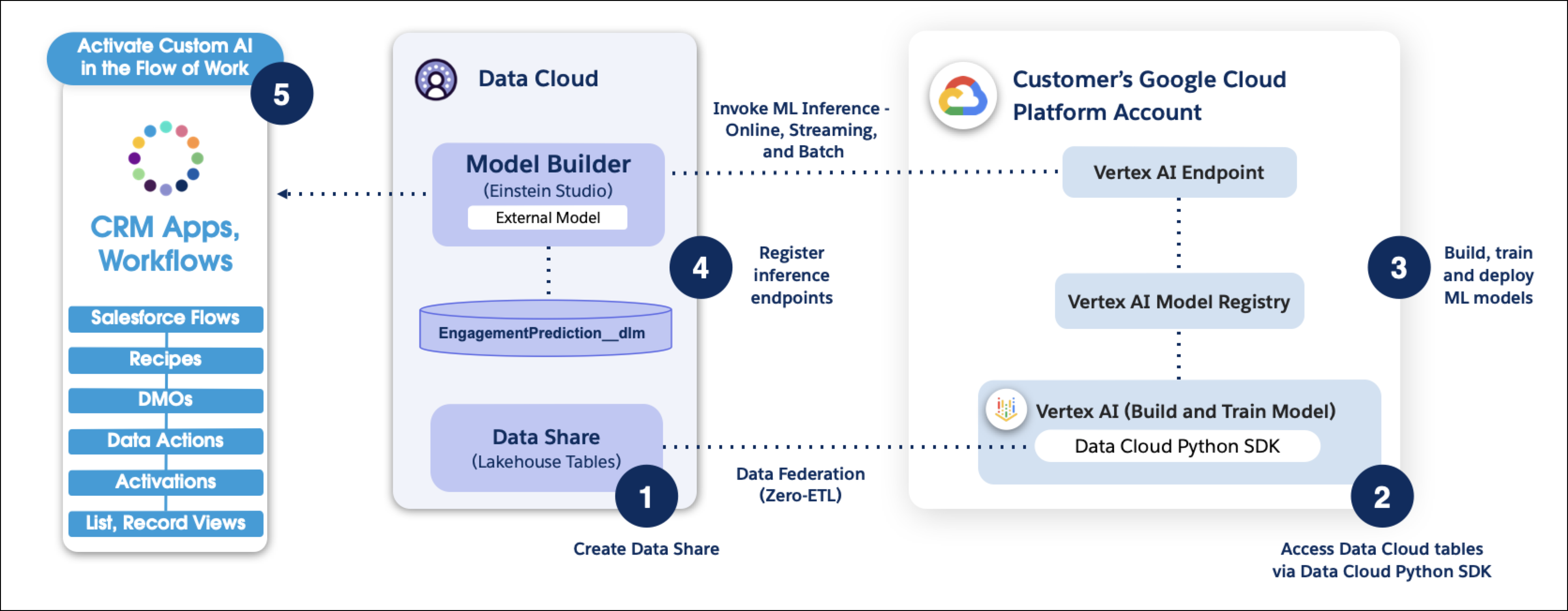
To use a Vertex AI model with Salesforce:
Access your Data 360 data in Vertex AI to build, train, and deploy a
model.
Connect your Vertex AI model in Data 360 to consume the inferences for
predictions and insights in various workflows across Salesforce.
Set Up Your Data in Vertex AI Access Salesforce data in a Google Cloud Vertex AI notebook using a Python connector. The user-friendly interface lets you quickly query your data in Data 360 so you can extract the data that you need into Python.
Connect a Vertex AI Model To consume predictions from a Vertex AI model in Salesforce, connect it with Data 360 and define the prediction criteria for your use case.
We use three kinds of cookies on our websites: required, functional, and advertising. You can choose whether functional and advertising cookies apply. Click on the different cookie categories to find out more about each category and to change the default settings.
Privacy Statement
Required Cookies
Always Active
Required cookies are necessary for basic website functionality. Some examples include: session cookies needed to transmit the website, authentication cookies, and security cookies.
Functional Cookies
Functional cookies enhance functions, performance, and services on the website. Some examples include: cookies used to analyze site traffic, cookies used for market research, and cookies used to display advertising that is not directed to a particular individual.
Advertising Cookies
Advertising cookies track activity across websites in order to understand a viewer’s interests, and direct them specific marketing. Some examples include: cookies used for remarketing, or interest-based advertising.