
Identify Your Preferred Domain to Improve SEO Results
By default, your site is available on the *.my.site.com or
*.force.com domain, but you can add a custom domain so that your site URLs reflect your
company brand. However, multiple domains for the same site, meaning *.my.site.com,
*.force.com, and custom domains, can dilute search engine results and lower page ranking. If
you have multiple domains, identify which domain to use for crawling and indexing your site’s
pages.
Required Editions
Available in: Salesforce Classic and Lightning Experience
Available in: Enterprise, Performance, and Unlimited
Editions
Create and Set Up Experiences AND View Setup and Configuration AND be a member
of the site
OR
View Setup and Configuration AND be a member of the site AND have appropriate
role-based site access
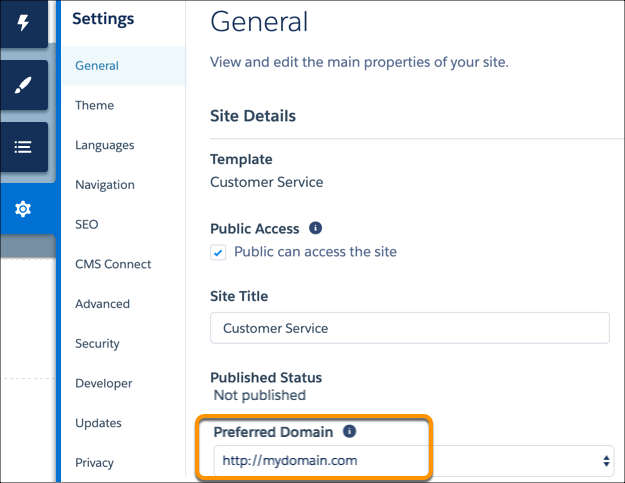
The Preferred Domain setting appears in Experience Builder only if you have multiple
domains associated with your Aura or LWR site. For an enhanced LWR site, or for an Aura or
LWR site with multiple domains where you haven’t identified a preferred domain, the site’s
first custom domain alphabetically is the preferred domain.
In Experience Builder, go to Settings | General.
Select your preferred domain.
Note
Make sure that you configure your preferred domain before submitting the sitemap to a
search engine. After your site is public, the search engine shows all the custom URLs
that you added to the sitemap.
You can set only HTTPS preferred domains.
Issues can occur if you configure preferred domains for two LWR or Aura sites that use
the same custom domain with different path prefixes. For example, let’s say you have two
sites, https://example.com/site1 and
https://example.com/site2. If you configure preferred domains for
both sites, then site2 uses the preferred domain for site1. To avoid problems in this
scenario, set the Preferred Domain field to None for both sites.
We use three kinds of cookies on our websites: required, functional, and advertising. You can choose whether functional and advertising cookies apply. Click on the different cookie categories to find out more about each category and to change the default settings.
Privacy Statement
Required Cookies
Always Active
Required cookies are necessary for basic website functionality. Some examples include: session cookies needed to transmit the website, authentication cookies, and security cookies.
Functional Cookies
Functional cookies enhance functions, performance, and services on the website. Some examples include: cookies used to analyze site traffic, cookies used for market research, and cookies used to display advertising that is not directed to a particular individual.
Advertising Cookies
Advertising cookies track activity across websites in order to understand a viewer’s interests, and direct them specific marketing. Some examples include: cookies used for remarketing, or interest-based advertising.