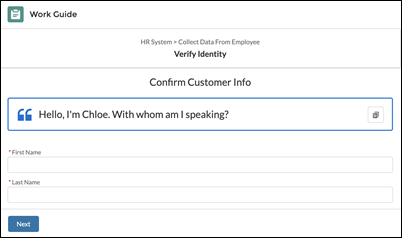
Use the Flow Orchestration Work Guide component to allow site visitors the ability to
complete the screen flows that they’re assigned. An orchestration is a sequence of stages,
each containing steps. When an orchestration runs, it assigns work items to specified users,
groups, or queues. Each work item is a flow that the assignee runs.
Required Editions
User
Permissions Needed
To create an Experience Cloud site:
Create and Set Up Experiences AND View Setup and
Configuration
To customize an Experience Cloud site:
Be a member of the site AND Create and Set Up
Experiences
OR
Be a member of the site AND an experience admin, publisher,
or builder in that site
To publish an Experience Cloud site:
Be a member of the site AND Create and Set Up
Experiences
OR
Be a member of the site AND an experience admin or publisher
in that site
To run a flow in an Experience Builder site
Run Flows
Your org must have Flow Orchestration enabled.
Build an orchestration in Flow Builder with at least one step assigned to a
credentialed site visitor.
Activate the flow.
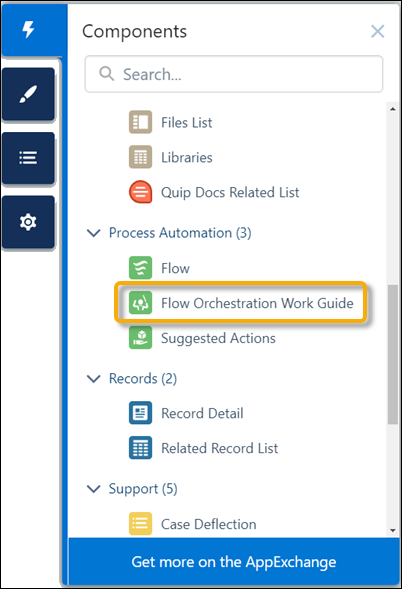
Drag the Flow Orchestration Work Guide component into position on a record page
in your site.
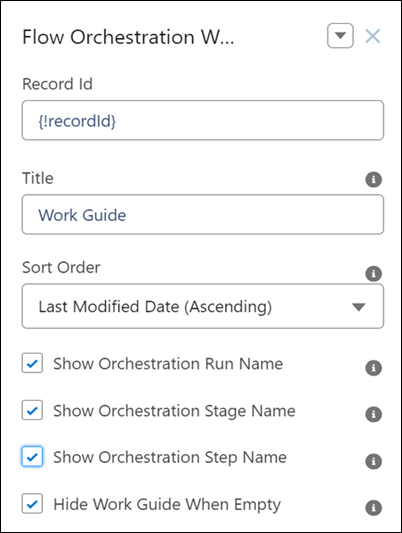
Configure the component to affect how it appears to site visitors.
Important The Record ID is automatically set. Don’t change the
field value.
Tip Changes you make don’t affect how the
component appears in Experience Builder.
We use three kinds of cookies on our websites: required, functional, and advertising. You can choose whether functional and advertising cookies apply. Click on the different cookie categories to find out more about each category and to change the default settings.
Privacy Statement
Required Cookies
Always Active
Required cookies are necessary for basic website functionality. Some examples include: session cookies needed to transmit the website, authentication cookies, and security cookies.
Functional Cookies
Functional cookies enhance functions, performance, and services on the website. Some examples include: cookies used to analyze site traffic, cookies used for market research, and cookies used to display advertising that is not directed to a particular individual.
Advertising Cookies
Advertising cookies track activity across websites in order to understand a viewer’s interests, and direct them specific marketing. Some examples include: cookies used for remarketing, or interest-based advertising.