Define Custom Fiscal Years for Advanced Account Forecasting
If your fiscal year follows a different structure from the Gregorian calendar, you can
define a custom fiscal year. You can calculate, roll over, and show forecasts based on custom
fiscal years. You must define a custom fiscal year if you want to use the weekly forecast
frequency.
Required Editions
Available in: Lightning Experience
Available in: Enterprise, Unlimited, and Developer
Editions
User Permissions
Needed
To change fiscal year
Customize Application
Warning After you enable custom fiscal years, you can’t
disable the feature. However, to revert to standard fiscal years, you can define custom
fiscal years that follow the same Gregorian calendar structure as the Salesforce standard
fiscal years.
Warning If you have an existing implementation of Account
Forecasting or Advanced Account Forecasting, after you enable custom fiscal years, sometimes
all your forecasts data gets corrupted. To fix this issue, run the Recalculate All option
for Account Forecasting or the Regenerate Account Forecast data processing engine definition
for Advanced Account Forecasting.
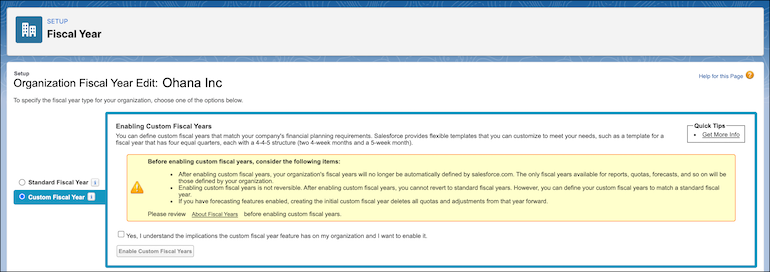
From Setup, in the Quick Find box, enter Fiscal Year, and then
select Fiscal Year.
To create a custom fiscal year, select Custom Fiscal Years.
Select Yes to acknowledge the implications.
Click Enable Custom Fiscal Years, and define your fiscal
year.
We use three kinds of cookies on our websites: required, functional, and advertising. You can choose whether functional and advertising cookies apply. Click on the different cookie categories to find out more about each category and to change the default settings.
Privacy Statement
Required Cookies
Always Active
Required cookies are necessary for basic website functionality. Some examples include: session cookies needed to transmit the website, authentication cookies, and security cookies.
Functional Cookies
Functional cookies enhance functions, performance, and services on the website. Some examples include: cookies used to analyze site traffic, cookies used for market research, and cookies used to display advertising that is not directed to a particular individual.
Advertising Cookies
Advertising cookies track activity across websites in order to understand a viewer’s interests, and direct them specific marketing. Some examples include: cookies used for remarketing, or interest-based advertising.