
You are here:
How Are Slot Results Optimized in Advanced Therapy Management?
To offer the most optimized search results for available appointment slots, Advanced Therapy Management’s Multi-Step Scheduling filters slot results through a combination of internal and external checks.
Required Editions
Available in: Lightning Experience Available in: Enterprise and Unlimited Editions with Health Cloud or Life Sciences Cloud |
Multi-Step Scheduling is built on top of Lightning Scheduler APIs to efficiently retrieve search results. Using a number of search criteria, such as date ranges, lead time, service territory relationships, restrictions on the number of work types and locations, Multi-Step Scheduling provides the most optimal slot results for your appointments.
External Checks
- For each work type that’s part of a work procedure, we optimize slot results using a given date range for the work type. In the Schedule Appointments tab, under basic search, you can select a work type and its start and end dates. Only the slots that fall in the selected date range are retrieved.
- Slot results are also filtered by the work type’s lead time. Lead time refers to the time required to complete a work type in days. For example, if the lead time for apheresis is 20, the next work type, that is, manufacturing can only be scheduled after 20 days or more. Accordingly, slot results are filtered by the availability of the manufacturing work type at an interval of 20 days or more.
- Service territory relationships defined for each work type also help filter the slot results. A service territory relationship sets up site-to-site mappings that determine the locations where subsequent work types are performed. For example, if apheresis is performed at Goodly Healthification Apheresis Center, you can set up a service territory relationship so that the next step of manufacturing takes place at Goodly Healthification Manufacturing Center. Similarly, you can create another service territory relationship between Goodly Healthification Manufacturing Center and Goodly Healthification Infusion Center where infusion is performed. Service territory relationships help users find slots based on the locations where work types are performed.
- Slots results are filtered through search criteria restrictions set up for work types and their corresponding locations. In the Schedule Appointments tab, under advanced search, you can search up to 5 work types, and select 3 locations for each work type. These restrictions help reduce the available slot results so that you can select the most optimal slot chain.
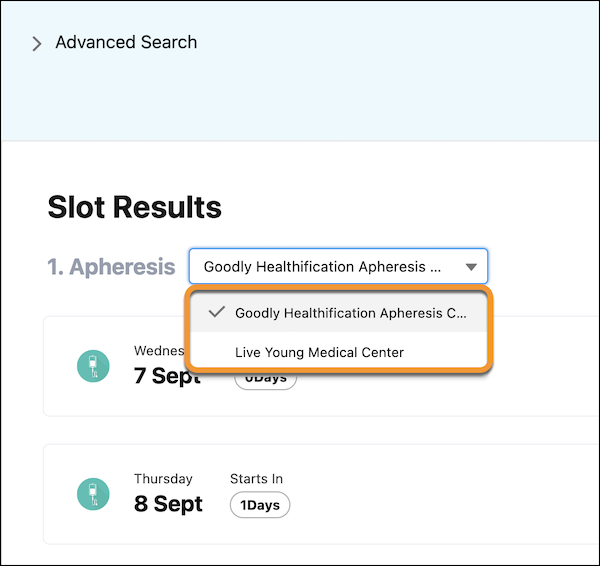
- In the Schedule Appointments tab, you can view search results for one service territory
for a work type at a time. For example, if apheresis is performed at Goodly
Healthification Apheresis Center and Live Young Medical Center, you can select the service
territory for which you want to view the slot results.
- Slot results are optimized by the work procedure organization the service territories are part of. In the search results, you can view slots results for only those service territories that are affiliated to a work procedure organization, that is, a parent service territory.
- When you enable Advanced Scheduling settings, override the default work type step lead time, and set up service territory prioritization rules, the slot formation logic searches for the shortest lead time by comparing the lead time configured for the work procedure step and the total lead time calculated using work type steps’ lead time override. The work procedure step must be held at the combination of child service territories that has the highest priority number. If the total lead time calculated using the work type steps is more than the configured work procedure step lead time, the slot formation logic discards the slot results and searches for slots in the combination of child service territories that has the second-highest priority.
Internal Check
The slot formation logic uses an internal check to find the most optimal results for the slot chain. Slot formation starts from the work type with the least number of available appointment slots. For example, if apheresis and infusion both have 1000 available slots, and manufacturing has only 3, the slot formation logic picks manufacturing as the starting point, and creates the permutations accordingly. This logic minimizes duplication of effort, as incomplete slot chain permutations are eliminated right at the start.
All the checks help reduce the number of available slots and optimize the search to offer the most appropriate slots.
