An original equipment manufacturer (OEM) can have multiple product offerings associated
with different customer-facing brands. Typically, brands are used to capture the customer’s
interest and provide key differentiators for the various types of vehicles and accessories sold by
an automotive company. Create Business Brand records to capture brand information. You can also
create a parent brand and associate multiple brands with it.
Required Editions
Available in: Enterprise, Unlimited, and Developer
Editions.
From the App Launcher, find and select Business Brands.
Enter a name.
Enter an Org ID that helps you identify the brand internally.
Search for and select a parent brand.
Click Save & New, and create similar records for multiple
brands.
Example
Neo Cars is an OEM that wants to track multiple brands in their org. They have multiple
product offerings under each brand that includes vehicles, parts, and accessories.
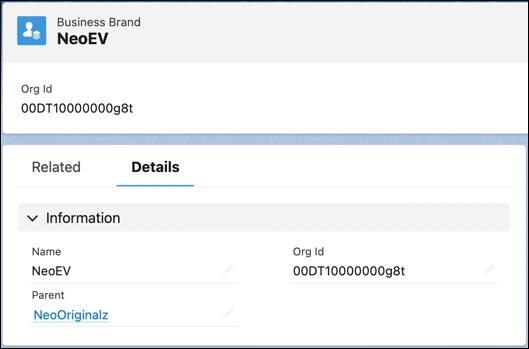
Neo Cars creates these records.
Parent Brand: Neo EV Cars
Parent Brand: Neo Original Cars
Neo Original Sports
Neo Original Utility
Parent Brand: Neo Luxury Cars
Parent Brand: Neo Ultra Luxury Cars
When you create Product records, you can specify the Business Brand for those records. If
your admin sets up sharing rules, you can selectively share brand-specific product information
with specific stakeholder groups such as dealers and customers.
Did this article solve your issue?
Let us know so we can improve!
Loading
Salesforce Help | Article
Cookie Consent Manager
General Information
Required Cookies
Functional Cookies
Advertising Cookies
General Information
We use three kinds of cookies on our websites: required, functional, and advertising. You can choose whether functional and advertising cookies apply. Click on the different cookie categories to find out more about each category and to change the default settings.
Privacy Statement
Required Cookies
Always Active
Required cookies are necessary for basic website functionality. Some examples include: session cookies needed to transmit the website, authentication cookies, and security cookies.
Functional Cookies
Functional cookies enhance functions, performance, and services on the website. Some examples include: cookies used to analyze site traffic, cookies used for market research, and cookies used to display advertising that is not directed to a particular individual.
Advertising Cookies
Advertising cookies track activity across websites in order to understand a viewer’s interests, and direct them specific marketing. Some examples include: cookies used for remarketing, or interest-based advertising.