
You are here:
Automotive Cloud Data Model
Learn about the objects in the Automotive Cloud data model.
Required Editions
| Available in: Enterprise, Unlimited, and Developer Editions. |
Appraisal Management | Captive Finance Information | Fleet Management | Groups and Households | Inventory Management | Leads and Opportunity Management | Partner Visit Management | Retail Sales Information | Stakeholder Management | Test Drive and Vehicle Service Appointments | Vehicle Information | Warranty Claims | Warranty Terms and Service Standards | Warranty Supplier Recovery
Appraisal Management
Use these objects to process appraisals and estimate vehicle valuations.
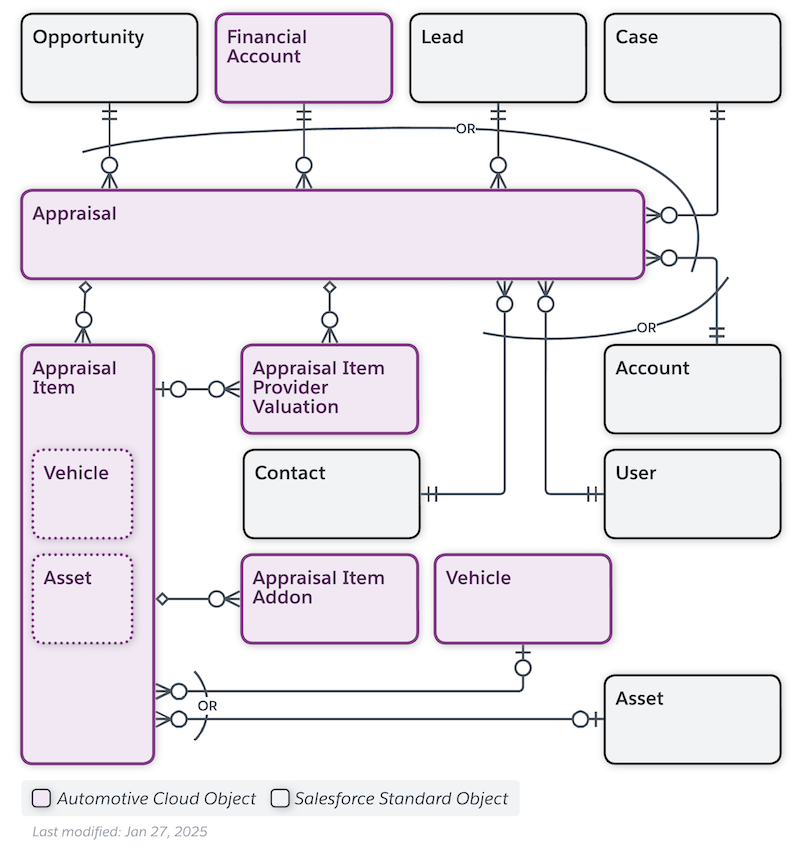
- Appraisal
- Stores the information for a vehicle appraisal requested by a customer, such as the appraisal purpose, the validity end date, and the appraisal fee.
- Appraisal Item
- Stores information about a vehicle that's appraised, such as its model year, make name, model name, and trim type.
- Appraisal Item Add On
- Stores information about any modifications done and additional accessories added to a vehicle that's appraised.
- Appraisal Item Provider Valuation
- Stores information about the appraisal valuations generated by external market sources.
Captive Finance Information
Use these objects to track the financial information about your customers and partners.
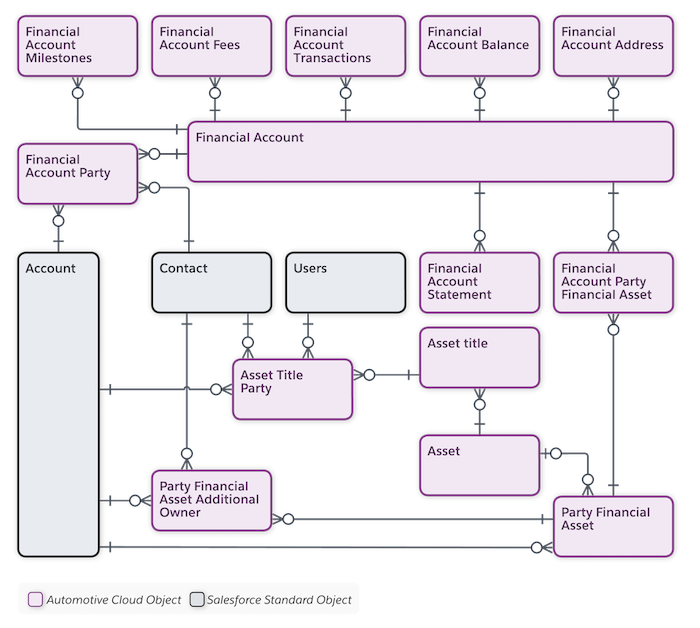
- Financial Account
- Stores information about different financing and investment options, such as vehicle loans or leases.
- Financial Account Party
- Stores information about the role assumed by a person or organization involved with a financial account, such as a beneficiary or a trustee.
- Party Financial Asset
- Stores information about the relationship between an account or contact and an asset that’s covered under a lease or loan.
- Financial Account Party Financial Asset
- Stores information about the relationship between a party financial asset and a financial account, such as a trade-in vehicle related to a customer’s lease, or a collateral asset related to a customer’s loan.
- Party Financial Asset Additional Owner
- Stores information about the relationship between additional or secondary people and an asset that’s covered under a lease or loan.
- Financial Account Balance
- Stores information about the total balance, principal balance, or the available credit for a loan or lease.
- Financial Account Transaction
- Stores information about each debit or credit transaction related to a loan or a lease.
- Financial Account Address
- Stores information about each address related to a loan or lease, such as a communication address, a billing address, or a statement address.
- Financial Account Statement
- Stores information about each periodic or account closure statement related to a loan or a lease.
- Financial Account Fee
- Stores information about different types of fees levied on a loan or lease account, such as processing fees, late payment fees, or wear and tear fees.
- Financial Account Milestone
- Stores information about key events or moments in a loan or lease account’s lifecycle, such as vehicle title transfer, deferred payments, or delinquency.
- Asset Title
- Stores information about the legal ownership of a vehicle or an asset.
- Asset Title Party
- Stores information about the relationship between an account, a contact, or a user and a vehicle or asset title.
Fleet Management
Use these objects to track and monitor fleets of vehicles or other assets.
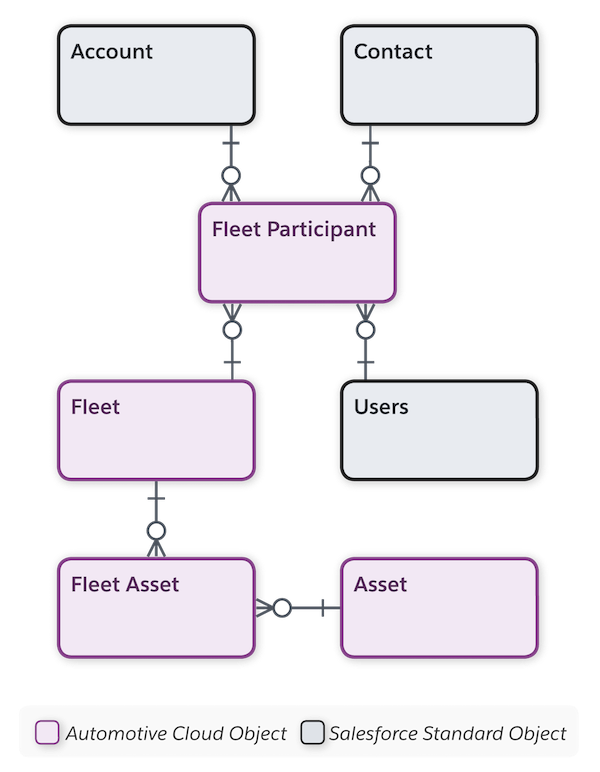
- Fleet
- Stores information about a group of assets or vehicles used in commercial or transport operations.
- Fleet Asset
- Stores information about the relationship between an asset or a vehicle and the fleet to which it belongs.
- Fleet Participant
- Stores information about the relationship between a fleet and a participant, such as an account, a contact, or a user.
Groups and Households
Use these objects to manage groups and households.
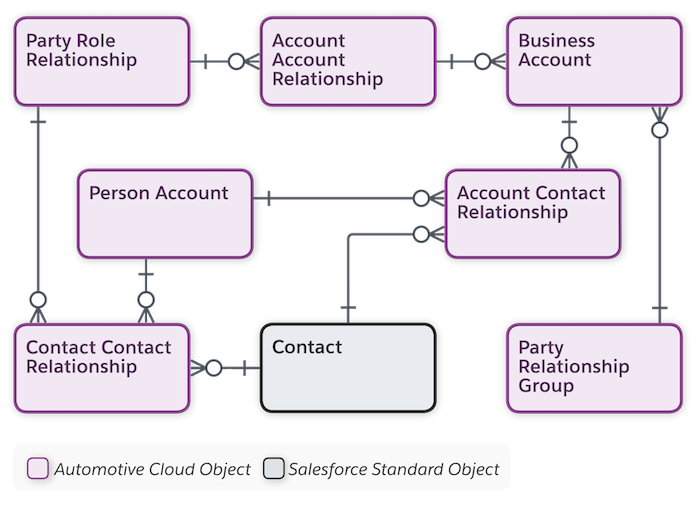
- Account Contact Relationship
- Stores information about the relationship of a contact with multiple accounts. For example, a members belonging to multiple households.
- Account Account Relationship
- Stores information about the relationship between two business accounts. For example, a household and its preferred dealership.
- Contact Contact Relationship
- Stores information about the relationship between two contacts or two person accounts. For example, a customer and a lawyer at a law firm.
- Party Role Relationship
- Stores information about the roles of two accounts or two contacts that are related to each other. For example, the wife and husband relationship between two contacts.
Inventory Management
Use these objects to track inventory and product movement.
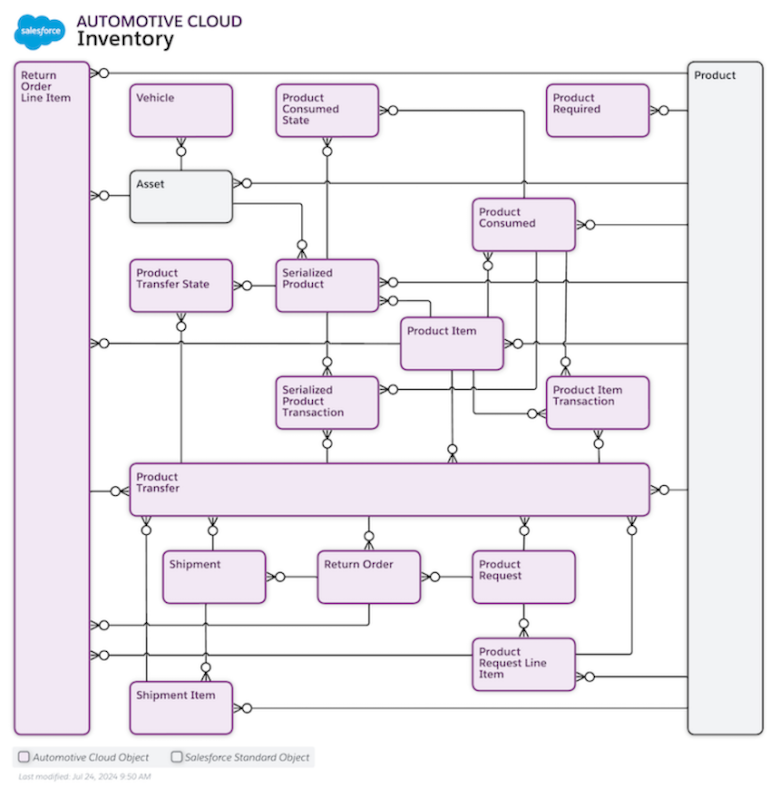

- Product Item
- Stores information about the stock of a product at a particular location. A product item is associated with an inventory location, such as a warehouse or a distribution lot, and a product.
- Product Item Transaction
- Stores information about an action taken on a product item. Product item transactions are auto-generated records that help you track when a product item is consumed, replenished, adjusted, or transferred.
- Product Request
- Stores information about an order or a request for a part or parts.
- Product Request Line Item
- Stores information about each product that’s a part of a product request. Product request line items are components of product requests.
- Product Transfer
- Stores information about the transfer or the movement of inventory between two inventory locations.
- Product Transfer State
- Stores information about an action taken to associate a serialized product to a product transfer and indicates the action done to the serialized product. The new state is a result of the action. The product transfer state is created when serialized products are attached to the product transfer.
- Shipment
- Stores information about the transport or shipment of inventory between two inventory locations.
- Shipment Line Item
- Stores information about a product that is included in a shipment.
- Product Required
- Stores information about a product that you need to complete a work order or work order line item.
- Product Consumed
- Stores information about a product that is used to complete a work order or work order line item.
- Product Consumed State
- Stores information about the new state of the product after it’s consumed.
- Return Order
- Stores information about the return, recall, or repair of products.
- Return Order Line Item
- Stores information about a product that is returned or repaired as part of a return order.
- Return Order Item Adjustment
- Stores information about a price adjustment on a return order line item.
- Serialized Product
- Stores information about the serial number for a product in an inventory.
- Serialized Product Transaction
- Stores information about a transaction that is performed on a serialized product.
Leads and Opportunity Management
Use these objects to access enhanced lead management features.
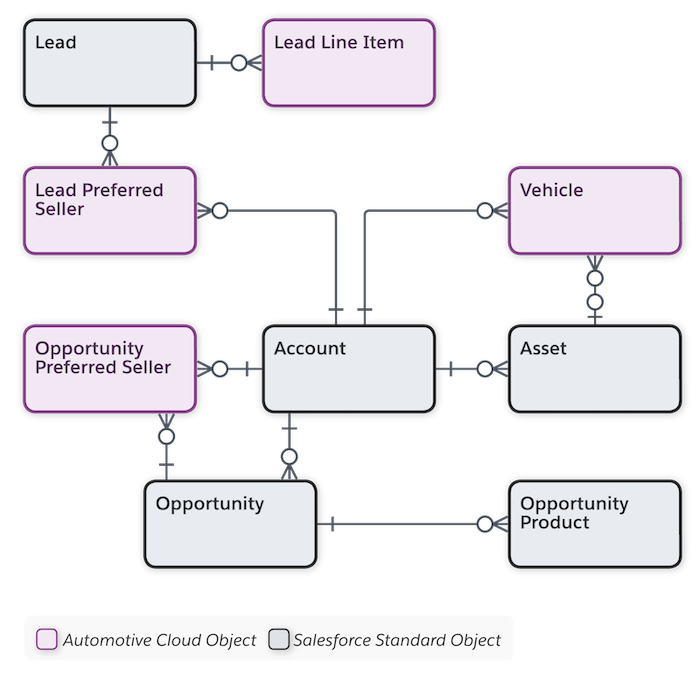
- Lead
- Stores information about prospective customers who are interested in buying, selling, or trading-in vehicles or other parts ad accessories.
- Lead Line Item
- Stores information about products related to a lead, such as vehicles, parts, or accessories. Multiple lead line items can be related to a Lead record. Each lead line item is related to one Product record.
- Lead Preferred Seller
- Stores information about the preferred dealer or provider account of a lead. Multiple lead preferred sellers can be related to one Lead record. Each lead preferred seller is related to one Account record.
- Opportunity
- Stores information about potential customers, converted from leads, who are interested in price negotiations, test drives, and dealer interactions.
- Opportunity Product
- Stores information about products related to an opportunity, such as vehicles, parts, or accessories. Multiple opportunity products can be related to one Opportunity record. Each opportunity product is related to one Product record.
- Opportunity Preferred Seller
- Stores information about the preferred dealer or provider account of an opportunity. Multiple opportunity preferred sellers can be related to one Opportunity record. Each opportunity preferred seller is related to one Account record.
Partner Visit Management
Use these objects to plan and execute visits.
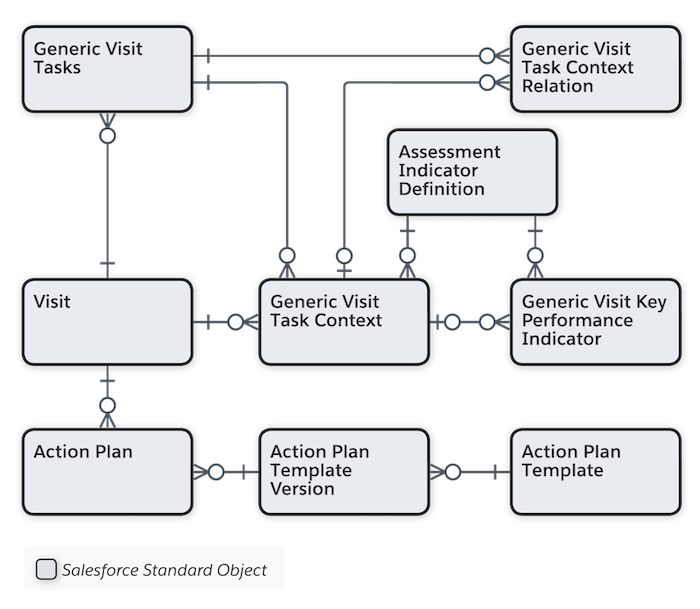
- Action Plan Template
- Stores information about a set of frequently performed generic visit tasks and associated assessment indicator definitions. Each action plan template can be used to create multiple action plans.
- Action Plan
- Stores information about the list of tasks related to a specific visit, along with information on which tasks are mandatory. Each action plan is related to a visit and an action plan template.
- Visit
- Stores information about visit data, such as the account, location, time, priority, and visitor. Each visit is related to one or more action plans and one or more generic visit tasks.
- Generic Visit Task
- Stores information about an audit task to be performed during a visit, such as status, time, and sequence of the task.
- Generic Visit Task Context
- Stores information about common attributes that are used for different types of contexts for the tasks that can be performed during the visit. Generic Visit Task and Generic Visit Task Context have a many-to-many relationship.
- Generic Visit Task Context Relation
- Stores information connecting a specific task with a specific task context. This is a junction object between Generic Visit Task and Generic Visit Task Context.
- Assessment Indicator Definition
- Stores information about the parameters or metrics for each task. Multiple assessment indicator definitions are related to a generic visit task context and a generic visit key performance indicator.
- Generic Visit Key Performance Indicator
- Stores information about the target and actual values for the assessment indicator definitions related to a visit. Generic Visit Key Performance Indicator and Generic Visit Task Context have a many-to-many relationship.
Retail Sales Information
Use these objects to submit sales reports for vehicles and parts.
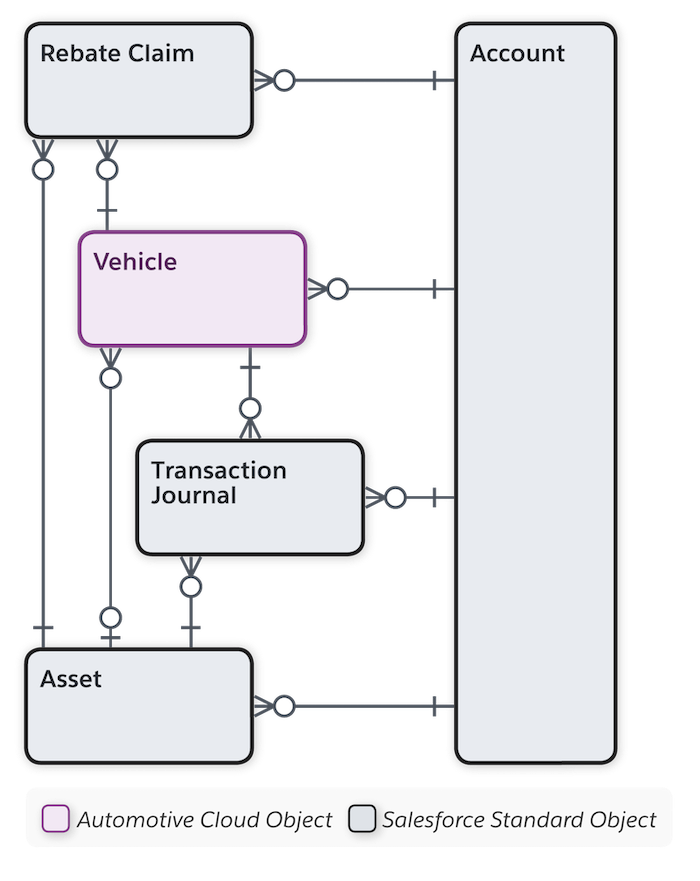
- Rebate Claim
- Stores information about the vehicle that’s sold by a dealer, such as odometer reading at the time of delivery, delivery status, processing status, and sale approval date. Rebate Claim has a many-to-many relationship with both Asset and Vehicle records.
- Transaction Journal
- Stores information about the product or product category of the parts that are sold by a dealer along with other details, such as the asset or vehicle reference number, the traded-to and traded-from accounts, and the quantity sold. The polymorphic field Reference record can be related to an Asset or a Vehicle record.
Stakeholder Management
Use these objects to manage stakeholders.
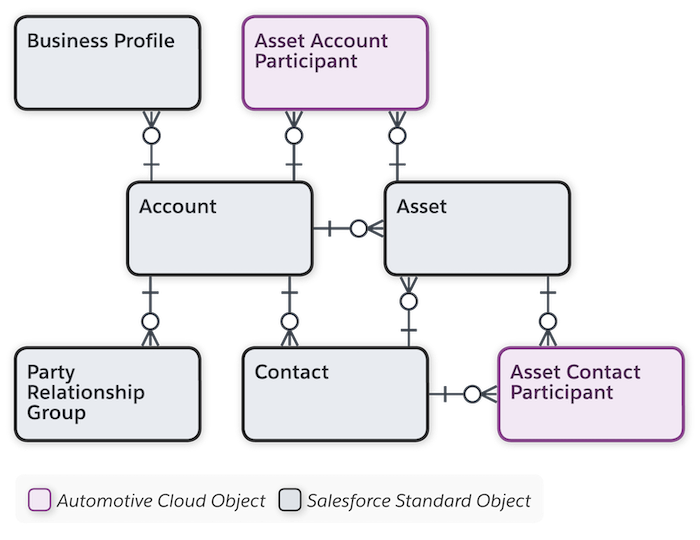
- Asset Account Participant
- Stores information about accounts related to an asset. Each asset can have multiple related stakeholder accounts, each with a different role.
- Asset Contact Participant
- Stores information about contacts related to an asset. Each asset can have multiple related stakeholder contacts, each with a different role.
- Internal Organization Unit
- Stores information about internal department structures with multiple accounts related to a single internal organization unit.
- Business Profile
- Stores detailed information about an account, such as the registered name of the partner, type of services offered by the partner, and the associated region. Each business profile is related to one Account record.
- Party Relationship Group
- Stores information about groups of people related to an account such as a customer household, or a dealer group that purchases vehicles and services. Multiple party relationship groups can be related to an Account record.
Test Drive and Vehicle Service Appointments
Use these objects to plan and execute test drive and vehicle service appointments.
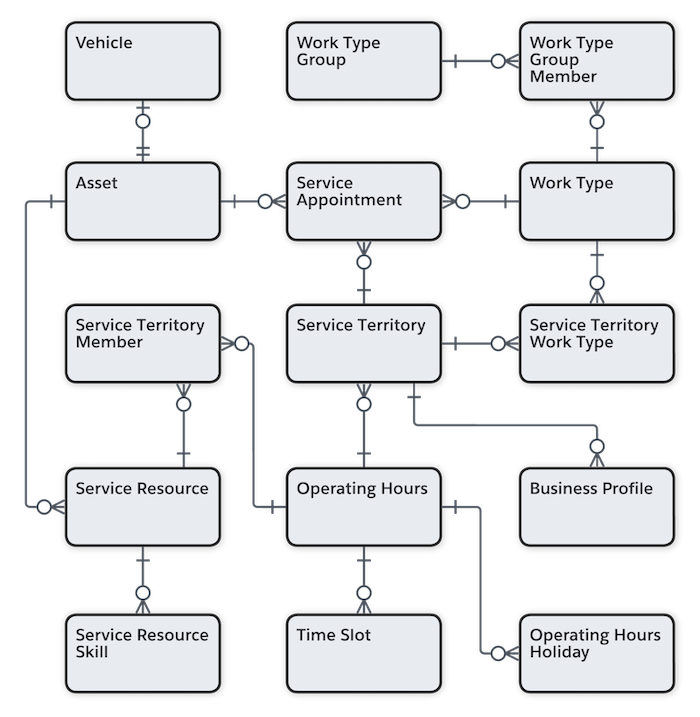
- Service Territory
- Stores information about a dealer’s geographical territory. Service appointments are scheduled for a specific service territory.
- Service Resource
- Stores information about the users who can be added to service appointments, and the assets such as vehicles used in test drive appointments.
- Skill
- Stores information about the expertise and competencies of service resources.
- Work Type
- Stores information about the key parameters for a specific type of service provided by a dealer, such as the estimated duration taken to perform the task, the prep and wrap-up buffer timings, and appointment category.
- Work Type Group
- Stores information about a type of service offered by a dealer such as periodic vehicle checkup, test drive appointment, or body and paint work. Each work type group is related to a service territory by a work type.
- Operating Hours
- Stores information about the timezone and hours in which a service territory, service resource, or work type is available for appointments.
- Time Slot
- Stores information about the period of time on a specified day of the week during which appointments can be scheduled.
- Service Resource Skill
- Stores information about the relationship of a service resource and their skills. A service resource can be related to multiple skills.
- Skill Requirement
- Stores information about the relationship of a work type and the skills required to perform the work. A work type can have multiple skill requirements.
- Work Type Group Member
- Stores information about the relationship of a work type and the work type group it belongs to.
- Service Territory Member
- Stores information about the relationship of a service resource with a service territory. Multiple service resources of type Technician and Asset can be assigned to a service territory.
- Service Appointment
- Stores information about a test drive or a vehicle service appointment such as the status, the associated service territory, estimated duration, and comments.
Vehicle Information
Use these objects to manage products and assets.
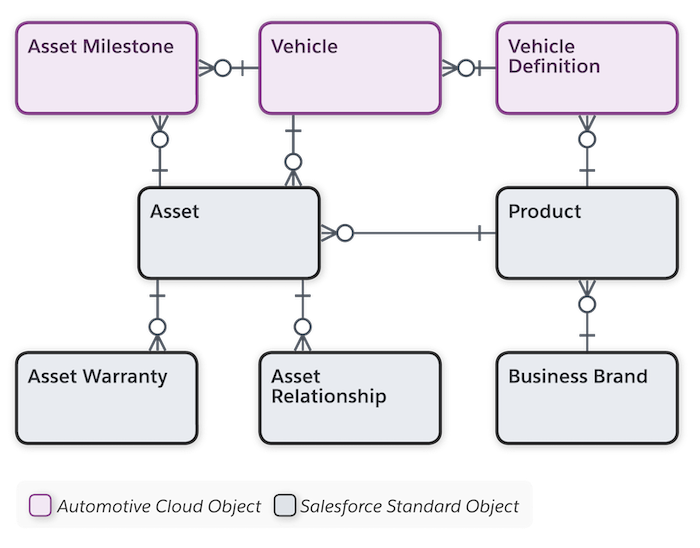
- Business Brand
- Stores information about brands of products that help with customer engagement. Multiple products can be related to one business brand.
- Product
- Stores information about each item in the product portfolio, such as a vehicle model
or a part type. Use automotive-specific fields on Product to define parts or vehicle
models.Note To learn about other objects related to Product that you can use to store information about inventory, see the Field Service data model. To learn about other objects related to Product that you can use to store information about retail commerce, see the B2C Commerce data model.
- Asset
- Stores information about a built or sold physical asset instance, such as a vehicle or a part. An asset can have multiple related child assets.
- Asset Milestone
- Stores information about key events or moments in an asset’s lifecycle, such as the milestone type, milestone location, milestone date, and stage. Each asset can have multiple related asset milestones.
- Asset Warranty
- Stores information about warranties related to an asset, such as the warranty type, warranty date, and details of parts and labor covered. Each asset can have multiple related asset warranties.
- Asset Relationships
- Stores information about replacement, upgrade, or cross-grade assets related to an asset. Each asset can have multiple asset relationships.
- Vehicle Definition
- Stores information about a typical vehicle model, such as stylistic specifications, battery and engine specifications, and fuel economy specifications.
- Vehicle
- Stores information about a specific vehicle instance, such as registration details,
vehicle identification number, and odometer readings. Each vehicle has one related Asset
record.Note First, create records in the Asset object and then, create Vehicle records for assets that are vehicles. Use the Vehicle field on Asset to relate the asset with a vehicle.
Warranty Claims
Use these objects to track and adjudicate dealer claims.
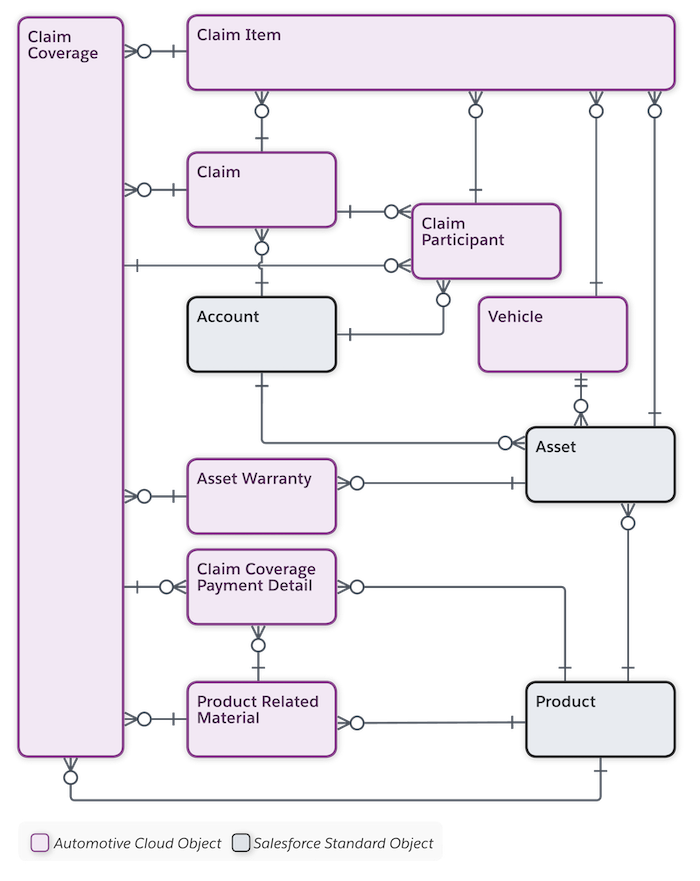
- Claim
- Stores information about a claim to request a manufacturer to repair, replace, or refund for a defective asset, such as its status, type, reason, and account.
- Claim Item
- Stores information about a defective asset related to a claim, such as its usage, fault date, and repair date.
- Claim Coverage
- Stores information about a casual part in a defective asset, such as its fault code and coverage type.
- Claim Coverage Payment Detail
- Stores information about the labor services, part replacements, or expenses claimed to rectify a causal part.
- Claim Participant
- Stores information about stakeholders related to a claim.
Warranty Terms and Service Standards
Use these objects to establish service standards and define warranty terms.
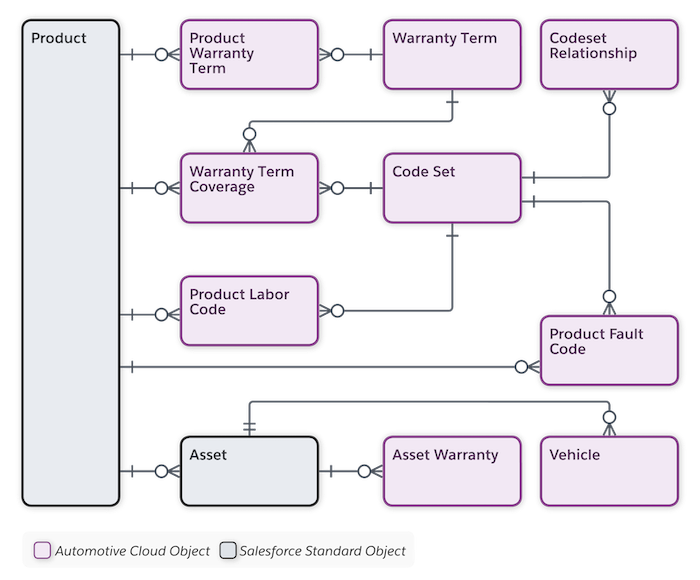
- Warranty Term
- Stores information about warranty terms with the labor, parts, expenses, and exchange options you offer to rectify issues with products.
- Product Warranty Term
- Stores information about warranty terms related to a product or a product family.
- Asset Warranty Term
- Stores information about warranty terms related to an asset. You can specify extensions or exclusions for the assigned warranty term.
- Warranty Term Coverage
- Stores information about extensions or restrictions for a warranty term based on a code set or a product part.
- Code Set
- Stores information about unique codes in the context of their systems and versions of those systems. Code sets store standard definitions of a situation or an activity.
- Product Fault Code
- Stores information about the relationship between a product or product family and the fault code.
- Product Labor Code
- Stores information about the relationship between the labor code that's applicable to a product or product family and the required standard operation time.
- Codeset Relationship
- Stores information about the relationship between a code set and its related code set. For example, a labor code associated with a fault code.
Warranty Supplier Recovery
Use these objects to manage warranty supplier recovery contracts and claims.
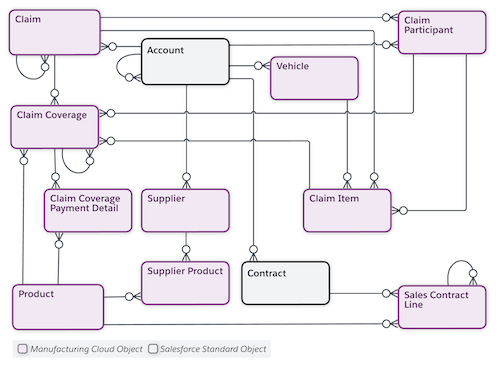
- Supplier
- Stores information about the suppliers that automotive manufacturers procure vehicle parts and components from.
- Supplier Product
- Stores information about the vehicle parts and components that automotive manufacturers procure from suppliers
- Contract
- Stores information about the supplier recovery contracts between automotive manufacturers and their suppliers to reimburse automotive manufacturers for the expenses incurred for replacing or repairing faulty vehicle parts.
- Sales Contract Line
- Stores information about vehicle parts that are covered under supplier recovery contracts with details such as total price, unit price, product code, and status.
See Also
- Salesforce Help: How Are Groups of People Represented in Automotive Cloud?
- Salesforce Help: How Product Information Is Represented In Automotive Cloud
- Salesforce Help: Manage Leads and Opportunities in Automotive Cloud
- Salesforce Help: Manage Dealer Performance in Automotive Cloud
- Salesforce Help: How Assets and Vehicles Are Related in Automotive Cloud
- Salesforce Help: How Inventory Is Tracked with Automotive Cloud
- Salesforce Help: How Are Groups and Households Modeled in Automotive Cloud?
