
You are here:
Enterprise Product Catalog (EPC)
Salesforce' s Enterprise Product Catalog (EPC) enables you to introduce and effectively manage a portfolio of products that are relevant to customers, released at the most opportune time, and at a low cost. EPC helps you manage the end-to-end processes and product data relevant to the product development, product launch, and in-life product management activities of your organization.
EPC provides the core components necessary to centralize, configure, integrate, and maintain the product and service portfolio across the enterprise. EPC, a centralized catalog, contains all of the commercial and technical elements you use to define reusable product and service building blocks and resulting offers.

The following diagram shows where EPC fits into the enterprise. The catalog consists of a commercial and a technical catalog.
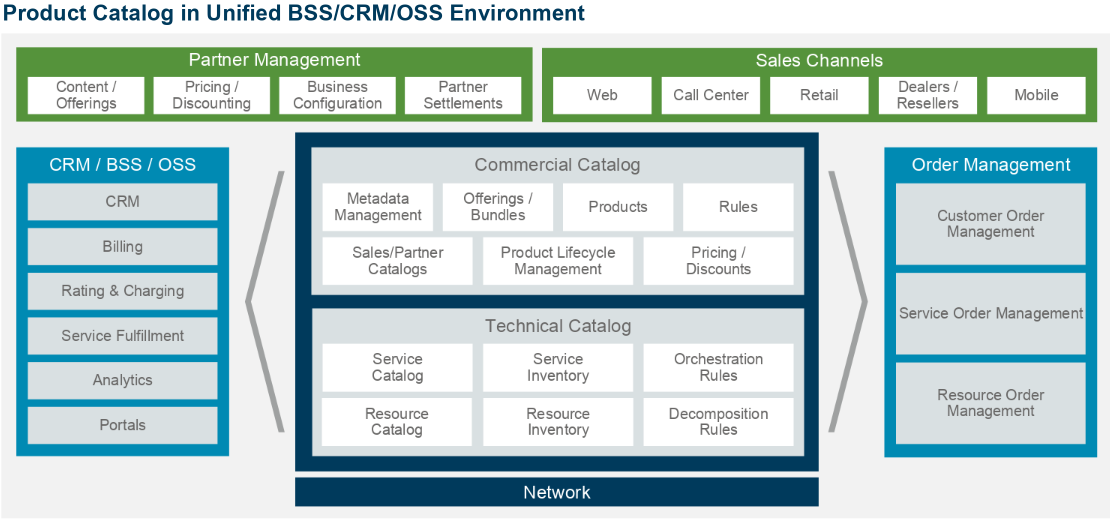
Enterprise Product Catalog uses the IDX Workbench build tool to synchronize the product management process and corresponding data into a single, automated, error-resilient stream through reuse, shared resources and common tools:
-
Through an enterprise scope, enables the definition of a single product catalog on one place, with multiple subscribers and systems that consume the product catalog.
-
Enables the creation of products once, making them available for reuse across the enterprise by different systems.
-
Gives you a unified UI with common tools, enabling your teams to collaboratively and rapidly create, manage, and deliver product offers to the market.
-
Once implemented, eliminates data silos and includes both commercial and technical entities in a single model.
-
Allows you to import products from other systems. For example, if you want to move from a development to a production environment, you can use Vlocity DataPacks and document the import process.
-
EPC can be leveraged by different types of users, such as product administrators, product managers, system administrators, and developers.
EPC gives your business an industry-leading, catalog-driven platform that revolutionizes the CPQ and order management space by:
-
Using a metadata-driven approach to accommodate the incarnations of a product as it travels from twinkle in the eyes of customer to physical implementation customer’s hands.
-
Integrating with your end-to-end ecosystem using a product-service-resource (PSR) model to drive sales, configure-price-quote (Industries CPQ) and Order-Management capabilities.
-
Using an evolutionary approach to transform both front-office and back-office systems into a shared-catalog-driven architecture.
Business Benefits
Communications, media, and energy companies gain significant benefits through the adoption of an enterprise-wide, centralized, product-management capability. An enterprise product-management solution yields more highly competitive products with stronger profit margins and greater customer satisfaction. Enterprise Product Catalog delivers these benefits, improving the bottom line through faster time-to-market and lower cost-to-market, enabling innovation and improving quality across product lifecycle management.
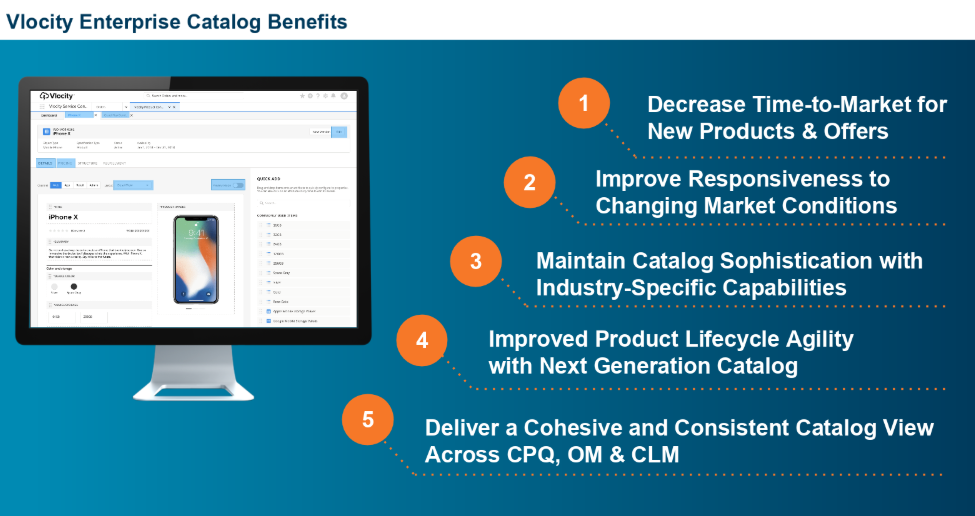
Decrease Time-to-Order for New Products and Offers: Deliver a unified catalog across CPQ, CLM and OM for all products & services to reduce sales cycle and order orchestration times.
Accelerate Responsiveness to Changing Market Conditions: Centralize product catalog management within an agile, cloud platform to improve responsiveness and flexibility for changing business needs.
Improve Product Lifecycle Agility and Efficiency: Leverage next-generation catalog capabilities. View customer assets across all product or service stacks. Automate notifications to appropriate teams for order fallouts or manual intervention requirements.
Deliver a Cohesive and Consistent Catalog: Eliminate reliance on legacy systems and deliver a unified catalog for centralized lifecycle product management.
Faster time-to-market means:
-
Reduced design, build, test and launch time for products through component reuse.
-
A reduced volume of data required to assemble and establish new offerings in the architecture.
-
A first-mover advantage.
-
Simplified and accelerated new product and service introduction through improved clarity around what to offer, which is critical in responding to competitors.
Lower cost-to-market means:
-
Reduced operational and delivery costs through fewer disparate data points to manage.
-
Reduced complexity of business processes.
-
Structured components that maximize compatibility with long-term reference architecture.
Enabling innovation provides:
-
Increased ability to support complex propositions due to simpler set-up from any channel.
-
Rapid monetization of data moving among people and systems through simplified definition of a unified product.
-
Improved customer satisfaction through better understanding of the product purchased.
-
Ability to compete with and support web-application and cloud-based solutions.
Solution Features
Enterprise Product Catalog product provides the core components necessary to centralize, configure, integrate, and maintain the product and service portfolio across the enterprise. Enterprise Product Catalog brings together, into a single catalog, all of the commercial and technical elements that define the reusable product and service building blocks and resulting offers.
The Product Console user interface provides a single point-of-entry and single point-of-access to the product and service data, through which users can perform all the activities necessary to manage the full catalog of product offerings and underlying services, including the creation, modification, reuse, launch, maintenance, and retirement of products and services.
Key features of Vlocity Product Console include:
-
Collaboration environment for both business and IT users.
-
Cross-function, role-based user definitions and security.
-
Centralized Data Management for the product and service catalog:
-
Componentized data model for offers, products, services, devices, pricing, target system rules, and processes.
-
Simple and complex product and service structures.
-
Definition of commercial and technical aspects of product and service components.
-
Sharing of product components across different product and market categories.
-
Cloning and modification of product structures or individual entities to enable rapid product modeling.
-
Business and technical modeling of product offers and underlying component specifications.
-
Highly configurable capability for defining rating attributes for charges and discounts, to support attribute-based, tiered, threshold, and flat rating and discounting, variable across product lines.
-
Channel-, market-, and customer-specific price lists to manage the reuse of products across target markets through different offers.
-
SID-compliant and SID-based XML available.
-
- Learn About Enterprise Product Catalog (EPC)
Learn about the different interfaces for the product catalog, product creation in Energy & Utilities, and support for the TM Forum Framework. - Create Products in the Product Designer
The Product Designer is the administration application for the product catalog. It provides a unified user experience with improved efficiency and agility to launch products quickly to market. It gives both business and IT users access to all the product management capabilities they need. - Pricing Designer
Pricing Designer is a unified user experience to create and maintain product pricing, promotions, associated pricing rules, and related pricing metadata. To make work easier for pricing design staff, it focuses on the EPC features they need. - Enterprise Product Catalog (EPC) REST APIs
The EPC REST APIs enable client application users to manage products, picklists, and promotions. The EPC REST APIs provide a layer of abstraction between client application development and the configuration of these EPC objects. This abstraction layer enables you to easily integrate your applications with EPC. - Product Definition with the Product Console
The Product Console provides a single, contextual interface for managing your EPC elements. Using this interface, you perform product management by defining and maintaining product entities. You can build foundational constructs like attributes and picklists, as well as metadata constructs like product object types. - Product Definition with the Salesforce Interface
A new product must have a description and usually includes attributes. You can exclude and update fields and attributes. A new product may also be a part of a product family. You define the product relationships and product and group cardinality. Decide if the product or offer is a line item. For example, you may want to offer individual television channels, but you don’t want each to be available as a separate line item. You can create order line items that are not necessarily individual assets.
