
You are here:
Multiple Decomposition Relationships in Product Hierarchy
Fulfillment Designers can model multiple levels of decomposition relationships for a commercial product. Industries Order Management recommends that there be a separate product entity (usually a resource) per downstream system callout.
Often, you will need to design one or two levels in between the commercial product entity and the resource entity to ensure that the correct information is available to downstream systems. For example, a commercial product can decompose to a Customer Facing Service (CFS), which can further decompose to a Resource Facing Service (RFS). RFS parameters, for example, can make the callout or activate the service.
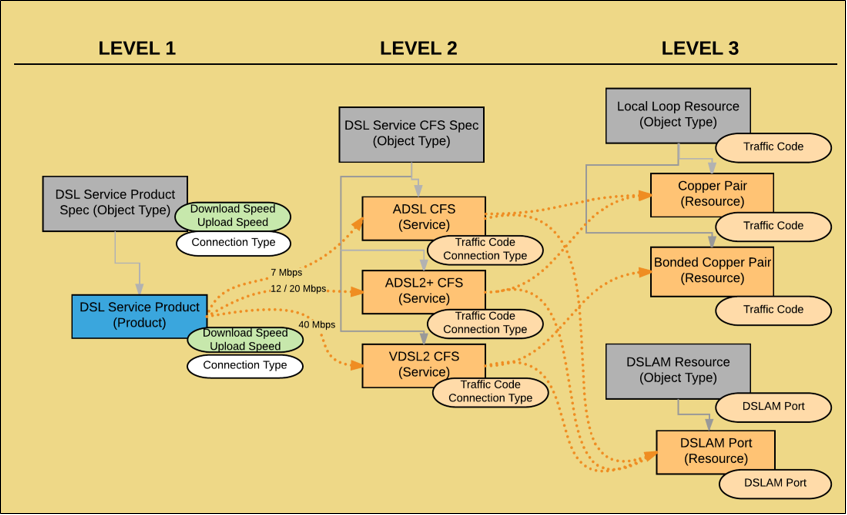
In the diagram above, the commercial product, DSL Service, will decompose to one of three CFS product entities, based upon the Download Speed attribute set in the customer order. The second-level product entities then decompose to resources in the third level.

If you design more than four levels in your decomposition relationships, you may exceed Salesforce Governor limits. To resolve the issue, revisit your decomposition flow to reduce the number of decomposition relationships. To learn more about Salesforce Governor Limits, refer to the appropriate part of the Salesforce Developer Documentation: Execution Governors and Limits.
For a modeling example, see Multi-Level Decomposition Modeling ExampleMulti-Level Decomposition Modeling.
- Multi-Level Decomposition Modeling
A multi-level decomposition is an order decomposition configuration where a sales order is recursively decomposed into lower tiers.
