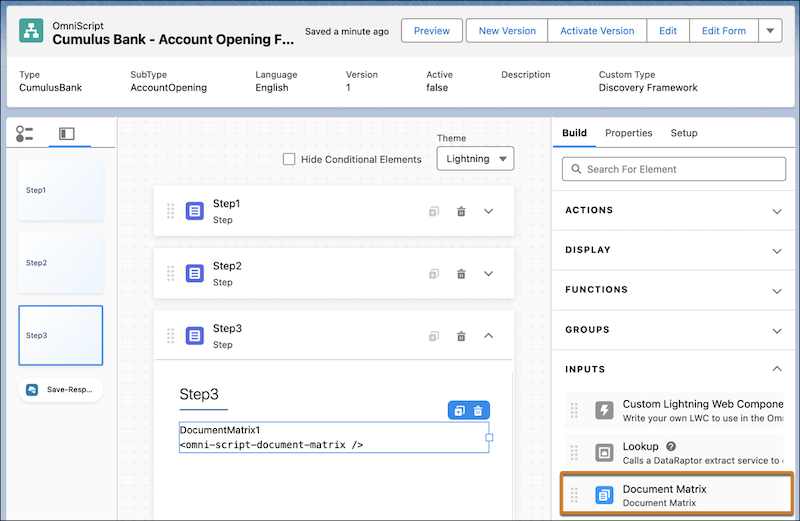
Add a Document Matrix Element to an Assessment Form
The Document Matrix element for Discovery Framework–based Omniscripts uses a decision
table to determine which documents a respondent must upload when submitting an assessment. For
each required document, a File input element is automatically added to the assessment form layout
at runtime.
Note The Document Matrix element works only with
Omniscripts of the Discovery Framework type.
From the Omnistudio Designer Build panel, under Inputs, drag the Document
Matrix element onto the canvas.
Add the Document Matrix element as a separate step, after the questions that determine
which documents respondents must upload.
To configure the Document Matrix element, click the Document Matrix
element on the canvas to open the Properties panel.
Provide a name for the element.
From the Select Decision Table list, select the decision table that
you want to use to dynamically determine which documents the respondents must upload.
Map the output of an Omniscript element to the decision table input.
When defining the mappings, use the developer names for the Omniscript elements.
Save your changes.
File input elements are automatically added to the assessment based on the
decision table outcome. The documents that the respondents then upload are saved as document
checklist items and attached to the assessment record.
Did this article solve your issue?
Let us know so we can improve!
Loading
Salesforce Help | Article
Cookie Consent Manager
General Information
Required Cookies
Functional Cookies
Advertising Cookies
General Information
We use three kinds of cookies on our websites: required, functional, and advertising. You can choose whether functional and advertising cookies apply. Click on the different cookie categories to find out more about each category and to change the default settings.
Privacy Statement
Required Cookies
Always Active
Required cookies are necessary for basic website functionality. Some examples include: session cookies needed to transmit the website, authentication cookies, and security cookies.
Functional Cookies
Functional cookies enhance functions, performance, and services on the website. Some examples include: cookies used to analyze site traffic, cookies used for market research, and cookies used to display advertising that is not directed to a particular individual.
Advertising Cookies
Advertising cookies track activity across websites in order to understand a viewer’s interests, and direct them specific marketing. Some examples include: cookies used for remarketing, or interest-based advertising.