Use the composite writeback node to consolidate related records from one or more
writeback object nodes, so you can write back all the interrelated records together to the
target object.
Start the composite writeback flow by adding a composite writeback node from the node canvas.
Configure the composite writeback node by adding one or more writeback nodes with related
records. You can add writeback nodes at multiple levels of hierarchy; the writeback nodes at
the first, second, third, and fourth level of hierarchy in the composite writeback flow are
referred to as Level 1, Level 2, Level 3, and Level 4 nodes, respectively.
Keep in mind these considerations when you configure the composite writeback node.
A writeback node can only be used once within a composite writeback node.
You can add one or more Level 1 writeback nodes in the composite writeback flow. Each
Level 1 node can have up to three levels of child writeback nodes.
All child writeback nodes are deleted when you change or delete the parent writeback
node.
Specify the Group By field in the Level 1 nodes and the
Reference Field value in the child writeback nodes. If you add more
than one Level 1 writeback node, be sure to specify the Group By field for each Level 1
writeback node.
Specify unique writeback sequence numbers for all writeback nodes in the definition,
including the composite writeback nodes.
Specify the same data type for all Level 1 writeback nodes in the composite writeback
flow.
Example
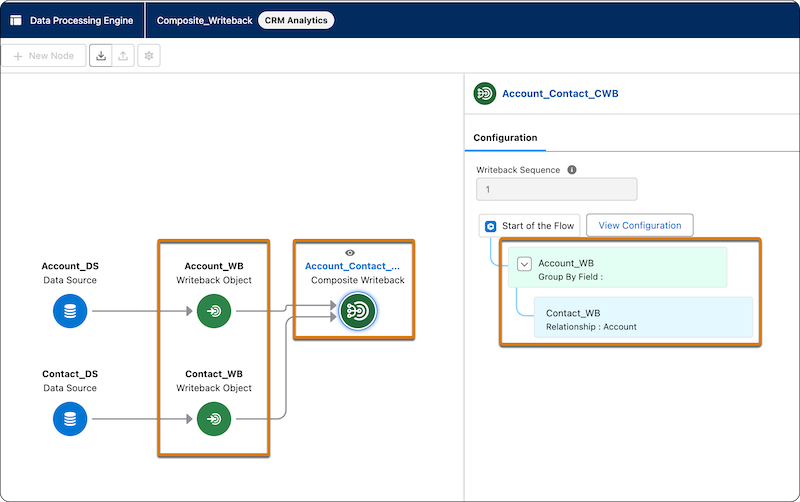
To write account details and related contacts together in the same transaction, add a
composite writeback node (Account_Contact_CWB) to your Data Processing Engine definition.
Add the Account object as the parent writeback node (Account_WB) at Level 1 and Contact
object as the child writeback node (Contact_WB) at Level 2. Define the relationship between
the Account and Contact objects in the Contact object's writeback node configuration using
related field mapping.
Did this article solve your issue?
Let us know so we can improve!
Loading
Salesforce Help | Article
Cookie Consent Manager
General Information
Required Cookies
Functional Cookies
Advertising Cookies
General Information
We use three kinds of cookies on our websites: required, functional, and advertising. You can choose whether functional and advertising cookies apply. Click on the different cookie categories to find out more about each category and to change the default settings.
Privacy Statement
Required Cookies
Always Active
Required cookies are necessary for basic website functionality. Some examples include: session cookies needed to transmit the website, authentication cookies, and security cookies.
Functional Cookies
Functional cookies enhance functions, performance, and services on the website. Some examples include: cookies used to analyze site traffic, cookies used for market research, and cookies used to display advertising that is not directed to a particular individual.
Advertising Cookies
Advertising cookies track activity across websites in order to understand a viewer’s interests, and direct them specific marketing. Some examples include: cookies used for remarketing, or interest-based advertising.