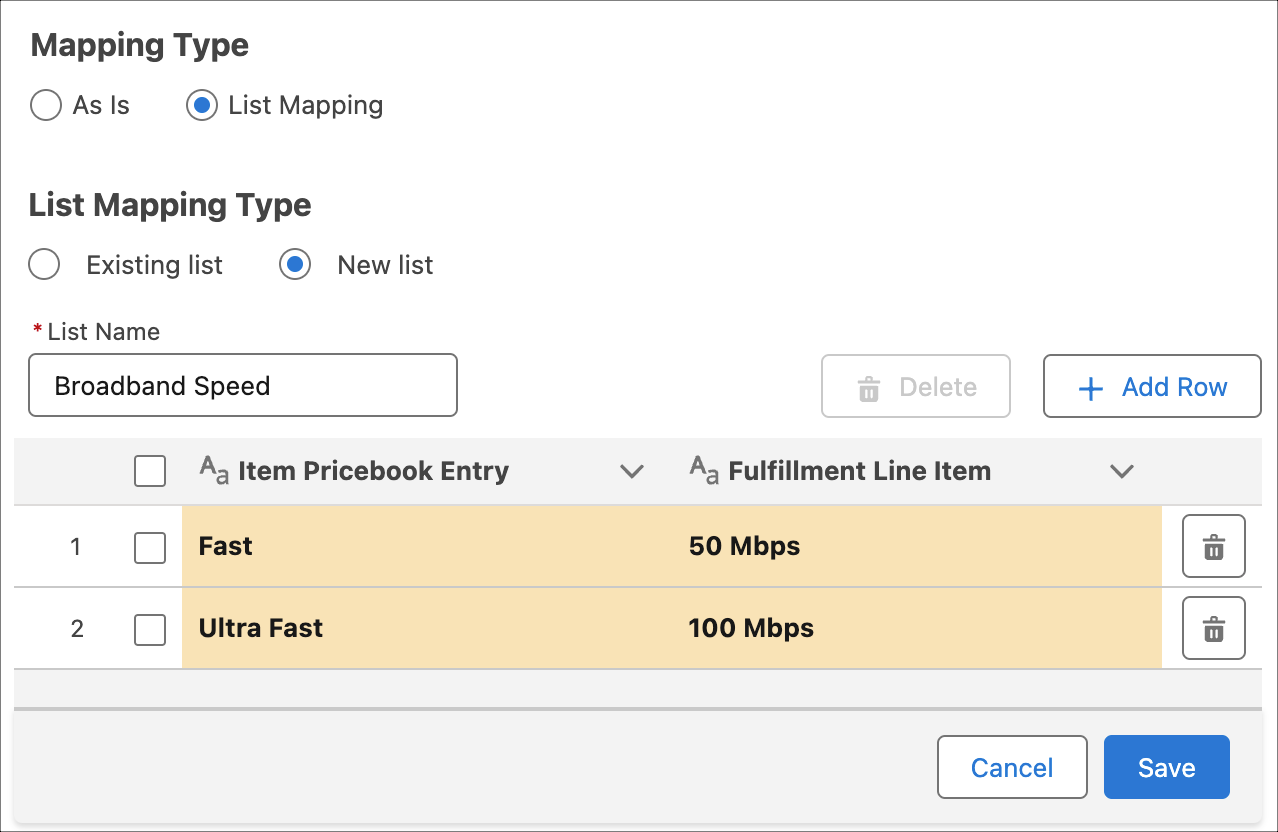
Use list mapping to set up pairs of source and destination values. For example, a list
of cities that pair with post code values. When the source value is a city name, the target
receives the post code of that city. Configure list mapping from the Fields & Attribute
Mapping section of a decomposition rule.
Required Editions
Available in: Salesforce Classic (not available in all orgs) and Lightning
Experience
Available in: Enterprise, Unlimited, and Developer
Editions
Create a Field & Attribute Mapping within a Decomposition Rule.
For Mapping Type, select List Mapping.
Select New List.
You can also use an existing list.
Note If you use an existing list, then any change you make for this mapping affects all
other mappings that use the same list.
Name the list and click Add Row.
In the source product column, click and enter a value that you expect to be in the source product.
Note Boolean attribute types don't work with list mapping.
Add more rows as required. Don't add duplicate source values to a list.
Save your work.
Example
A source commercial product has the attribute Speed with two values:
Fast and Ultra Fast.
The target
technical product has a Bandwidth attribute with two values: 50 Mbps and 100
Mbps.
Create a mapping so that if the source product has a Speed value of
Fast, then the target product has a Bandwidth value of 50 Mbps. And if the
Speed is Ultra Fast, then the Bandwidth is 100 Mbps.
When a user submits an order with a speed attribute of Fast, the Broadband
attribute gets the value of 50 Mbps.
Did this article solve your issue?
Let us know so we can improve!
Loading
Salesforce Help | Article
Cookie Consent Manager
General Information
Required Cookies
Functional Cookies
Advertising Cookies
General Information
We use three kinds of cookies on our websites: required, functional, and advertising. You can choose whether functional and advertising cookies apply. Click on the different cookie categories to find out more about each category and to change the default settings.
Privacy Statement
Required Cookies
Always Active
Required cookies are necessary for basic website functionality. Some examples include: session cookies needed to transmit the website, authentication cookies, and security cookies.
Functional Cookies
Functional cookies enhance functions, performance, and services on the website. Some examples include: cookies used to analyze site traffic, cookies used for market research, and cookies used to display advertising that is not directed to a particular individual.
Advertising Cookies
Advertising cookies track activity across websites in order to understand a viewer’s interests, and direct them specific marketing. Some examples include: cookies used for remarketing, or interest-based advertising.