
You are here:
Data Model for Clean Energy Programs
The Clean Energy Programs Data Model provides the framework that you can use to build, deploy, and manage programs.
-
Use the Clean Energy Programs Data Model as a reference to build your Salesforce solution.
-
For field-level details, see Overview of Salesforce Objects and Fields, and Energy and Utilities Cloud Standard Objects.
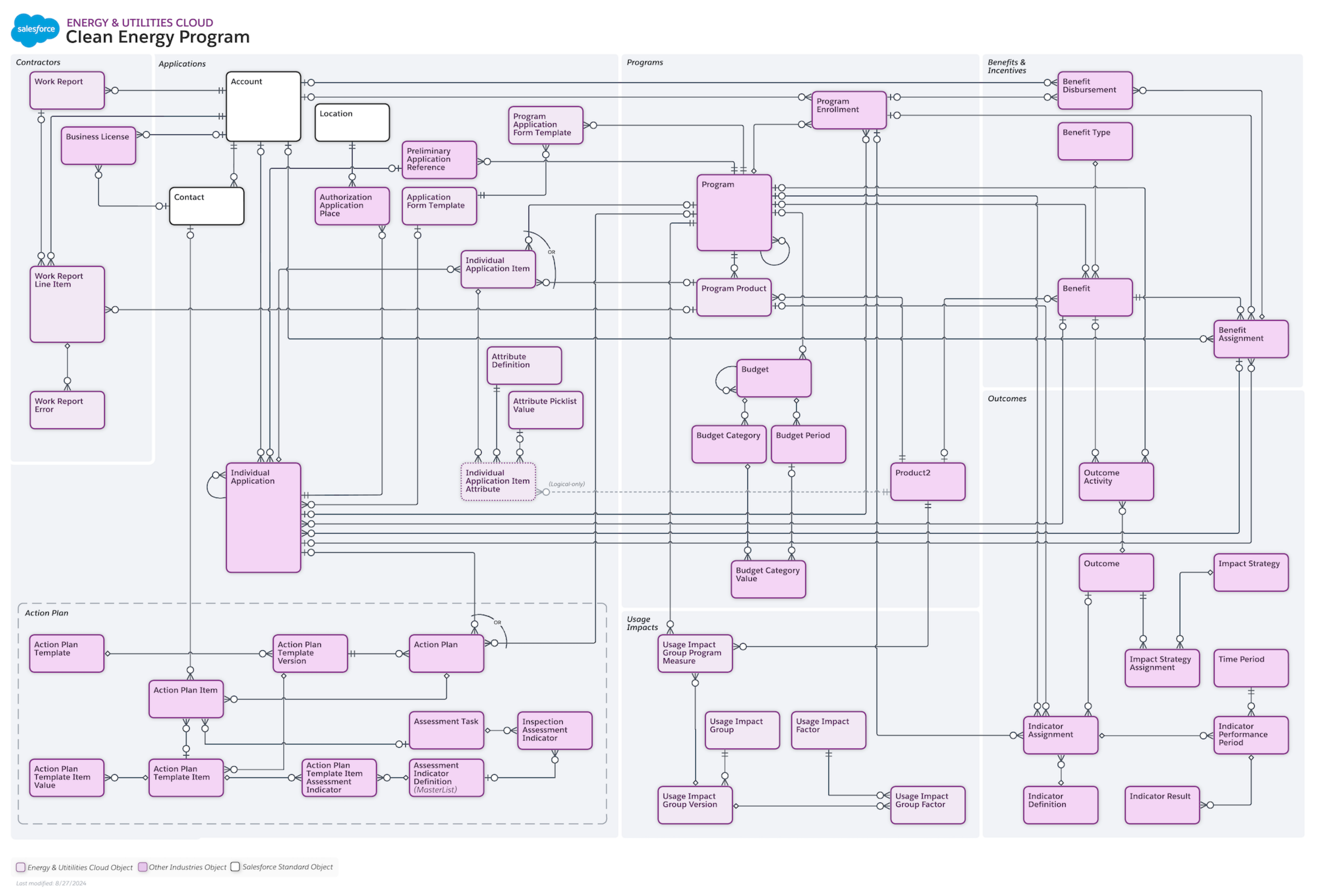
The objects in the Clean Energy Program data model are categorized into these groups:
Programs
Objects that contain the details of all programs and their associated products, services, and benefits.
- Program Product
- Represents a junction between program and product2. This will hold product2 values related to a program.
- Program
- Represents information about the enrollment and disbursement of benefits in a program. A program is composed of one or more products.
- Program Enrollment
- Junction object between Participant (account or contact) and the program.
- Budget
- Represents the total budget and/or child budgets of the program.
- Budget Category
- Represents information about the purpose of the budget that's used in understanding and reporting of budget utilization.
- Budget Period
- Defines a distinct time interval in which the estimate applies. Each period is unique and scoped only to it's parent budget since budgets can be submitted by external users.
- Budget Category Value
- Captures the deconstructed benefit values at the intersection of category and time period.
- Product2
- Product2 is the entity that stores a program's measures such as HeatPump rebate. Every program is made up of one or more measures/product2. A benefit, such as a $50 rebate based on the heatpump attribute of tonnage, is dispatched to the customer (Account) once the Individual Application status is approved, based on the product2 (measure) within that program, such as an energy efficiency program.
Applications
Objects used for deploying, managing, and monitoring applications for programs, new connections, and financing for customers.
- Individual Application
- Represents an application form submitted by an individual, contact or account.
- Individual Application Item
- Captures the user input data during runtime from the Individual Application .
- Individual Application Item Attribute
- Represents a virtual object that stores the product attribute key-value pairs for Individual Application Item.
- Preliminary Application Reference
- Represents the saved applications and pre-screening forms and the URL information stored during runtime as a JSON file.
- Application Form Template
- Use Application Form Template to define application metadata so that the same assets are used for all program and application management use cases that may not require a Program record.
- Location
- Formerly known as premise in EUC managed package, In 246 release the premise entity will be mapped to the Location & Address entity.
- Account
- Standard Salesforce object representing an organization, company, or group.
- Contact
- Standard Salesforce object representing an individual associated with an account.
- Authorization Application Place
- Information related to the association between a location and the application for the license of the location.
- Attribute Definition
- Defines various attributes that may be associated with a product, asset, quote, and possibly other objects.
- Attribute Picklist Value
- Represents values defined within a picklist that can be selected during product configuration.
Benefits & Incentives
Objects that contain information about the rebates, free services, products, introductory rates, and other benefits that are disbursed to an approved applicant.
- Benefit
- Represents information about benefits or incentive associated with the program or the product within the program.
- Benefit Type
- Represents information about the type of benefits available to the program enrollment. Benefit Type Category represents the outcome of the measure being implemented such as Incentive or rebate or calculated energy savings.
- Benefit Assignment
- Represents the enrollment information of an individual or business that is captured in an application. For example, an individual who is unemployed can raise an application requesting help from the utility. If it is approved, the individual is enrolled into or dispatched the benefit.
- Benefit Disbursement
- Represents the allocation of an enrollee's benefit (possibly including one or more adjustments) that can be made as a single payment. Each row represents each account that has had a payout of a benefit.
Usage Impacts
Objects for regulatory reporting of energy or impact savings generated by a program.
- Usage Impact Group
- Stores common definitions for savings groups used across jurisdictions and programs.
- Usage Impact Factor
- Stores reusable definitions for savings factors across jurisdictions and programs. These are used across jurisdictions and programs.
- Usage Impact Group Factor
- Tracks a specific value of a factor. The record is related to the Usage Impact Group Version because Usage Impact Group represents a grouping of several factors and their values.
- Usage Impact Group Version
- Usage Impact Group Versions track groupings of saving factors and association of the grouping to programs. There may be many versions of groups used for different purposes. Savings groups are distinguished by their effectivity dates and types.
- Usage Impact Group Program Measure
- Represents a relationship between Program, Product2 and Savings Group, which can be many-to-many between all three objects. Used when Product2 is a energy efficiency measure.
Actions Plans
Objects for energy and utility companies to manage the tasks associated with each application such as reviewing uploaded documents and approving or rejecting the application.
- Action Plan
- Defines the steps necessary to complete a task and by when it should be completed. For Programs, Action Plans are used to create process around verifying a submitted application, then choosing to accept or deny the Application.
- Action Plan Item
- Represents the instance of an action plan item.
- Action Plan Template
- Represents the instance of an action plan template.
- Action Plan Template Item
- Represents the instance of an item on an action plan template version.
- Action Plan Template Version
- This entity stores information about an Action Plan Template such as when it was last used, updated, if it is active, etc.
- Action Plan Template Item Value
- Represents the value associated with an action plan template item.
- Action Plan Template Item Assessment Indicator
- This entity stores information related to mapping of KPIs to Work Items.
- Assessment Indicator Definition
- This entity stores information related to KPIs defined by Inventory, Facings, Competitor Facings, Share of Shelf etc.
- Assessment Task
- Tasks associated with an assessment.
- Inspection Assessment Indicator
- Represents the assessment response captured during the inspection.
Outcomes
Objects for tracking and reporting energy savings, budgets, benefit disbursement and adoption for programs.
- Outcome
- Represents information about the expected change in participants driven by the organization's activity such as program, benefit, or goal definition. The change can be increasing, decreasing, or maintaining a participant's behavior, knowledge, skills, status, or level of functioning.
- Outcome Activity
- Represents a junction between Outcome and the object that's related to the activity undertaken by an organization to achieve that outcome, such as a program or a benefit. This does not have a measurement component to it. For example, if you want to improve customer happiness but the results are not quantitative, you'll include the activity here that you are doing to drive the outcome.
- Indicator Definition
- Represents an indicator definition that includes information about the indicator assignment and the process of measuring and calculating the indicator results. This entity hosts the lookup to the formulas or calculations necessary to calculate the energy savings, sum the invoices disbursed to contractors, etc. so that you may track your real time results, stored in Indicator results, and compare it to your target or goal, stored in Indicator Performance period.
- Indicator Assignment
- Represents the assignment of an indicator definition that's used to measure the performance of an outcome or a related activity, such as a program or benefit.
- Time Period
- Represents the time period that's used to calculate the indicator performance, the Utility's target or goal such as total KWH saved, and result.
- Indicator Performance Period
- Represents information about the indicator performance for a specified time period including the frequency at which indicator results should be calculated and the baseline value of the indicator. For example, total calculated energy savings, or allocated max budget for rebates disbursements.
- Indicator Result
- Represents the result of an indicator assignment for the specified time period that can be used to track the performance of the indicator. After batch calculation jobs run daily or weekly, the interim results are stored here and type is interim. After batch calculation job over the entire period is run the results type is "final" or "total".
- Impact Strategy
- Represents a high-level strategy to affect change in an individual, population, stakeholder, or the environment. It expresses an expectation that actions will lead to desired outcomes.
- Impact Strategy Assignment
- Represents the connection between the impact strategy and the outcome or other object related to the impact strategy. Impact Strategy Assignment represents the specific desired outcomes an organization expects to elicit as part of the plan. Impact Strategy Assignment creates a many-to-many relationship between a strategy and an outcome.
Contractors
Objects for easy enrollment, bulk uploading work, managing applications, and invoices on the partner portal. For example, once a contractor uploads a work report, the energy or utility company will review each line item before distributing the benefit.
- Work Report
- The total amount of work performed by the contractor with a certain period of time on behalf of one or more Utility customer at one or more locations providing services for one or more measures. The Work Report is a parent to the Work Report Line Item.
- Work Report Line Item
- Every line item represents one measure performed (serviced) by the contractor at one location within one program.
- Work Report Errors
- Errors designating incompleteness or inaccuracies automatically detected in the Work Report Line Item or Work Report.
