An Omniscript gives your users a guided path for completing a business process and
serves as a configurable way of creating a seamless experience for your users. To build your
Omniscripts, go to Omnistudio. Then in an ARC graph, to give your users quick access to processes
they complete often, add the Omniscript to a node.
Note To use this feature, you must have an Omnistudio license, build Flexcards in Omnistudio,
and enable Omnistudio Metadata in Omnistudio Settings in Setup.
From Setup, in the Quick Find box, enter Actionable Relationship
Center, and then select Actionable Relationship
Center.
Click New Relationship Graph or edit an existing graph.
Create a node or select an existing node.
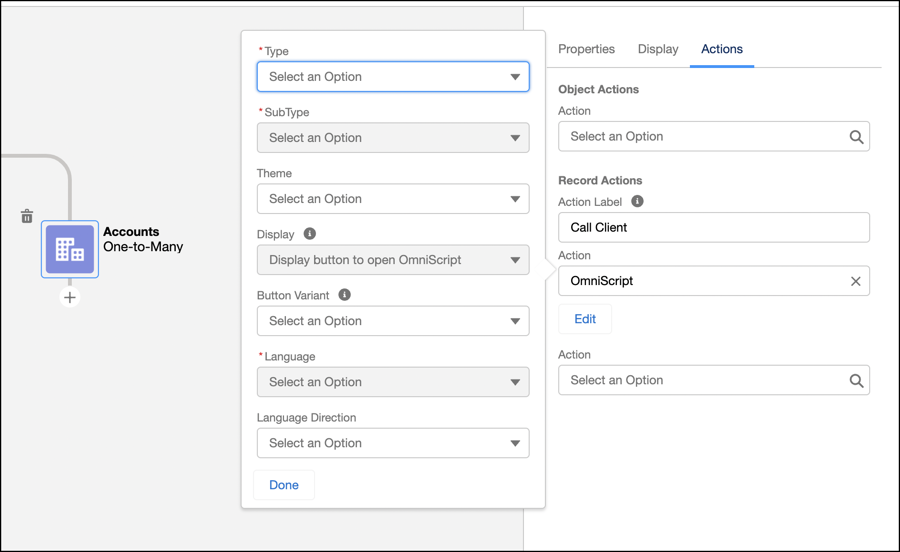
Click the Actions tab.
Click Select an Option and select Omniscript.
Configure the Omniscript.
Select Type.
Select Sub Type.
Select Language.
Select Theme.
Select Display.
Display button to open Omniscript is the only support display
option in ARC.
Select Button Variant.
Select Language Direction.
Click Done.
Save the graph.
Note When a user clicks an Omniscript on an ARC graph, the Omniscript shows in a new window.
The appearance of the Omniscript on an ARC graph is based on how it was configured in
Omnistudio.
We use three kinds of cookies on our websites: required, functional, and advertising. You can choose whether functional and advertising cookies apply. Click on the different cookie categories to find out more about each category and to change the default settings.
Privacy Statement
Required Cookies
Always Active
Required cookies are necessary for basic website functionality. Some examples include: session cookies needed to transmit the website, authentication cookies, and security cookies.
Functional Cookies
Functional cookies enhance functions, performance, and services on the website. Some examples include: cookies used to analyze site traffic, cookies used for market research, and cookies used to display advertising that is not directed to a particular individual.
Advertising Cookies
Advertising cookies track activity across websites in order to understand a viewer’s interests, and direct them specific marketing. Some examples include: cookies used for remarketing, or interest-based advertising.