Salesforce Manufacturing Cloud is a platform that helps you manage your entire
book-of-business and customer service lifecycle, while increasing collaboration and transparency
between sales, operations, and partners.
Required Editions
Available in: Lightning Experience
Available in: Enterprise, Unlimited, and Developer Editions
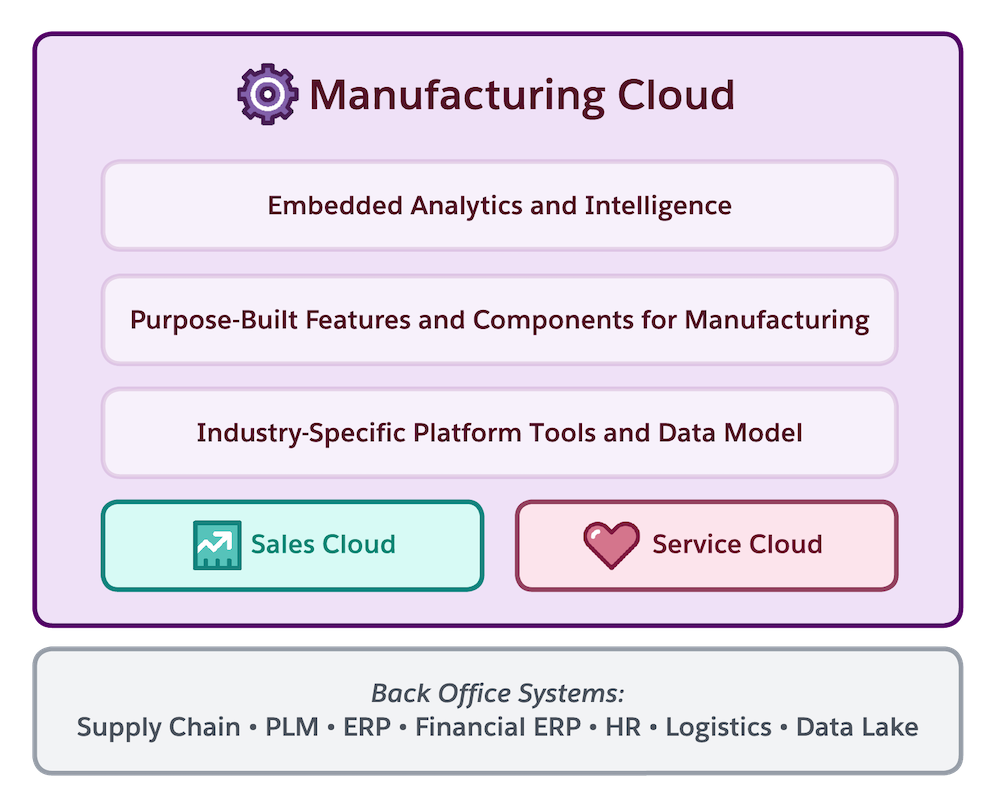
Manufacturing Cloud extends Sales Cloud and Service Cloud with industry-specific
capabilities. It’s built on the Salesforce Customer 360 platform; it’s not a managed package.
Your business can decide how Manufacturing Cloud is implemented in your org. You can implement
Manufacturing Cloud for Sales, Manufacturing Cloud for Service, or Manufacturing Cloud for
both Sales and Service. You can have a mix of Manufacturing Cloud users and standard Sales
Cloud or Service Cloud users.
You can integrate Manufacturing Cloud with your existing Enterprise Resource Planning (ERP)
systems and Order Management Systems (OMS) by using APIs, the MuleSoft Accelerator for
Manufacturing, or other middleware solutions. Think of Manufacturing Cloud as a
system of record, engagement, and innovation that sits on top of your back-office systems.
Manufacturing Cloud Users
Manufacturing Cloud can be used by companies in the manufacturing industry who want to
manage their commercial operations, orchestrate their service experience, and streamline their
partner engagement.
Original equipment manufacturers (OEMs)
Production suppliers
Distribution or aftermarket manufacturers
Process manufacturers
Oil and gas producers
Companies that manage run-rate, on-going, or long-term business
Companies that want to orchestrate their service lifecycle
Companies that want to drive greater partner engagement
Benefits of Manufacturing Cloud
Manufacturing Cloud can help your business in various ways.
Modernize your commercial operations
Manage, grow, and forecast your entire top-line revenue
Transform your service experiences
Consolidate customer interactions into a single source-of-truth
Simplify and strengthen your partner engagements
Make faster, more informed decisions with actionable analytics
We use three kinds of cookies on our websites: required, functional, and advertising. You can choose whether functional and advertising cookies apply. Click on the different cookie categories to find out more about each category and to change the default settings.
Privacy Statement
Required Cookies
Always Active
Required cookies are necessary for basic website functionality. Some examples include: session cookies needed to transmit the website, authentication cookies, and security cookies.
Functional Cookies
Functional cookies enhance functions, performance, and services on the website. Some examples include: cookies used to analyze site traffic, cookies used for market research, and cookies used to display advertising that is not directed to a particular individual.
Advertising Cookies
Advertising cookies track activity across websites in order to understand a viewer’s interests, and direct them specific marketing. Some examples include: cookies used for remarketing, or interest-based advertising.