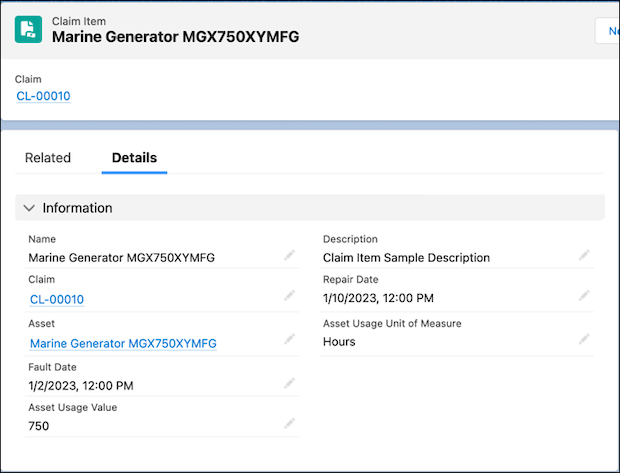
Create Claim Item records to capture information about the work to be performed on a
defective asset related to a claim. Record granular information about a defective asset such as
its usage, fault date, and repair date. Review the fields available on the Claim Item
record.
Required Editions
Available in: Enterprise, Unlimited, and Developer
Editions
Warranty claims adjudicators and partners can use Claim Item records to capture
information for different purposes. To determine the level of access of each persona to
different fields, customize the Claim Item record page layout and field-level security
settings.
Field
Description
Usage
Name
Name of the item that’s included in the claim.
Specified by partners while submitting a claim item.
Description
The description of the claim item.
Specified by partners while submitting a claim item.
Asset
The asset that’s associated with the claim.
Specified by partners while submitting a claim item.
Claim
The parent claim that includes this claim item.
Specified by partners while submitting a claim item.
Claim Participant
The claim participant that’s associated with the claim item.
Specified by partners while submitting a claim item.
Category
Specifies the category of the claim item.
Parent Asset
Claim Asset
Damaged Property
Involved Injury
Specified by partners while submitting a claim item.
Current Address
The location of the claim item.
Specified by partners while submitting a claim item.
Fault Date
The date of occurrence of the fault in the asset.
Specified by partners while submitting a claim item.
Repair Date
The date of repair of the asset.
Specified by partners or claim adjudicators, or auto-populated based on any predefined
rules.
Asset Usage Value
The usage value for the asset at the time of occurrence of the fault.
Specified by partners while submitting a claim item.
Asset Usage Unit of Measure
The unit of measure for the usage value of the asset.
Specified by partners while submitting a claim item.
Did this article solve your issue?
Let us know so we can improve!
Loading
Salesforce Help | Article
Cookie Consent Manager
General Information
Required Cookies
Functional Cookies
Advertising Cookies
General Information
We use three kinds of cookies on our websites: required, functional, and advertising. You can choose whether functional and advertising cookies apply. Click on the different cookie categories to find out more about each category and to change the default settings.
Privacy Statement
Required Cookies
Always Active
Required cookies are necessary for basic website functionality. Some examples include: session cookies needed to transmit the website, authentication cookies, and security cookies.
Functional Cookies
Functional cookies enhance functions, performance, and services on the website. Some examples include: cookies used to analyze site traffic, cookies used for market research, and cookies used to display advertising that is not directed to a particular individual.
Advertising Cookies
Advertising cookies track activity across websites in order to understand a viewer’s interests, and direct them specific marketing. Some examples include: cookies used for remarketing, or interest-based advertising.