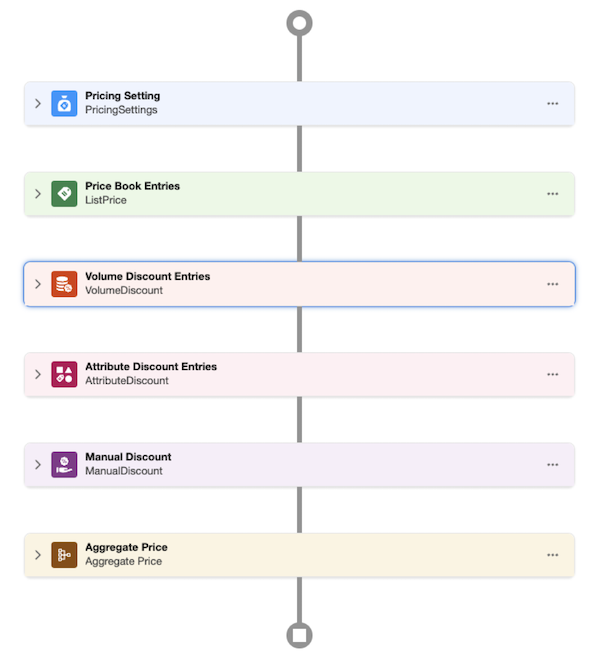
Pricing elements are the primary components that make up a pricing procedure in
Salesforce Pricing within Agentforce Revenue Management. They are the building blocks, where each element
represents a step in the calculation of a product's final price. Understanding pricing elements
is essential for successfully defining and calculating product prices and creating customized
pricing strategies.
Required Editions
Available in: Lightning Experience
Available in: Enterprise, Unlimited, and Developer Editions
of Revenue Cloud where Salesforce Pricing is enabled
A new pricing procedure starts as a blank canvas, and each pricing element added forms a step
in the procedure. These elements contain variables crucial for defining and calculating
product prices. These variables are mapped to context tags, which are dynamic placeholders
that facilitate data transfer between the pricing elements and the overall pricing procedure.
Essentially, pricing procedures are created by combining various pricing elements, with each
element performing a specific calculation or adjustment. The culmination of these calculations
and adjustments applied to the list price results in the net unit price. Salesforce Revenue
Cloud leverages these pricing elements to enable flexible pricing models.
Did this article solve your issue?
Let us know so we can improve!
Loading
Salesforce Help | Article
Cookie Consent Manager
General Information
Required Cookies
Functional Cookies
Advertising Cookies
General Information
We use three kinds of cookies on our websites: required, functional, and advertising. You can choose whether functional and advertising cookies apply. Click on the different cookie categories to find out more about each category and to change the default settings.
Privacy Statement
Required Cookies
Always Active
Required cookies are necessary for basic website functionality. Some examples include: session cookies needed to transmit the website, authentication cookies, and security cookies.
Functional Cookies
Functional cookies enhance functions, performance, and services on the website. Some examples include: cookies used to analyze site traffic, cookies used for market research, and cookies used to display advertising that is not directed to a particular individual.
Advertising Cookies
Advertising cookies track activity across websites in order to understand a viewer’s interests, and direct them specific marketing. Some examples include: cookies used for remarketing, or interest-based advertising.