Set Up External Document Storage by Using Guided Setup
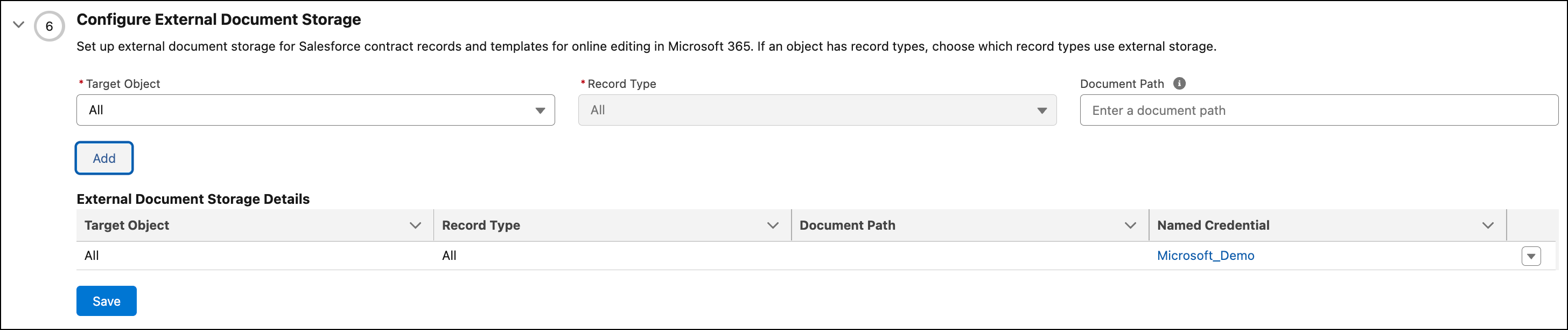
Set up external document storage for Salesforce contract records and templates, which is
used for online editing in Microsoft 365. Specify the target object and record type to determine
which records use external storage. Doing this ensures proper organization and access to the
documents. A target object and record type combination must be unique and can’t be repeated.
Required Editions
Available in: Lightning Experience
Available in: Professional, Enterprise, Unlimited, and
Developer editions.
User Permissions Needed
To access the Microsoft 365 and Azure Integration guided setup
CLM Admin User
Note When you use external document storage with Microsoft 365 and a minimum-privilege access
model, only the docgen designer who creates a Microsoft 365 document can edit the document by
default. To enable shared editing when multiple designers work in the same org, create a
dedicated folder in Microsoft SharePoint, grant access to the required designers, and configure
a separate external document storage configuration in Salesforce that points to this folder.
Thus, preserving the minimum-privilege security model while supporting collaboration.
In the guided setup, click Set Up External Document Storage to
expand the step.
Select a target object, and then select a corresponding record type.
In the Document Path field, enter the storage path starting from the root directory (for
example, salesforce/contracts). If the field is left blank, the root
directory is considered as the storage path.
Click Add and save your changes.
To permit non-admin and custom profile users to check out documents in the Microsoft 365
add-in.
From Setup, in the Quick Find box, find, and select
Profiles.
Open the profile that you want to edit.
In Administrative Permissions, select View Setup and
Configuration.
Save your changes.
Did this article solve your issue?
Let us know so we can improve!
Loading
Salesforce Help | Article
Cookie Consent Manager
General Information
Required Cookies
Functional Cookies
Advertising Cookies
General Information
We use three kinds of cookies on our websites: required, functional, and advertising. You can choose whether functional and advertising cookies apply. Click on the different cookie categories to find out more about each category and to change the default settings.
Privacy Statement
Required Cookies
Always Active
Required cookies are necessary for basic website functionality. Some examples include: session cookies needed to transmit the website, authentication cookies, and security cookies.
Functional Cookies
Functional cookies enhance functions, performance, and services on the website. Some examples include: cookies used to analyze site traffic, cookies used for market research, and cookies used to display advertising that is not directed to a particular individual.
Advertising Cookies
Advertising cookies track activity across websites in order to understand a viewer’s interests, and direct them specific marketing. Some examples include: cookies used for remarketing, or interest-based advertising.