
You are here:
Consumer Goods Cloud Trade Promotion Management Data Model
The Trade Promotion Management (TPM) data model is used to manage promotions, tactics, funds, and claims for customers and their products. You can use TPM to increase your market share or introduce new products to strengthen your brand.
The image shows the main objects in the Trade Promotion Management data model.
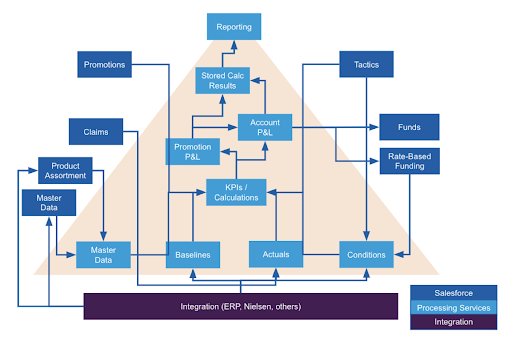
First, a management team defines targets to achieve in the current fiscal year based on the team’s performance in the previous year. Then these country- or region-level targets are broken down and shown to at the account level on the Account P&L that Key Account Managers can view. Various promotions are planned to achieve these planned targets. Funds are allocated to KAMs to plan and manage their promotional activities. KAMs can also manage other aspects of TPM, such as assortment, tactics, and claims.
- Main Objects in the Trade Promotion Management Data Model
Use the objects in the Trade Promotion Management (TPM) data model to get a complete view of active promotions across all stages. To increase sales of specific products, a Key Account Manager (KAM) can use TPM to budget, plan, and run promotions between a manufacturer and a retailer. - Master Data
Master Data includes data related to accounts, products, assortments, and users. Use Master Data to collect, aggregate, and distribute data consistently across business processes, such as promotions, tactics, funds, and claims. - Main Objects in Customer Master
Customer Master objects store information about customer hierarchies, contacts, users, roles, and relationships. - Main Objects in Product Master
Product Master objects contain details of all sellable products, advertising material, and competitor products. Products in a promotion are defined through the product resolution using various product filter expressions. - Main Objects in User and Substitution
Use the User and Substitution objects to store and manage substitutes for unavailable sales reps. The substitute performs key tasks for the reps’ accounts for specific periods. - Main Objects in Product Assortment
Use the objects in Product Assortment to create and maintain product assortments within stores. Assortments provide continued product distribution, brand awareness, and sales over time. A sales manager or KAM maintains product assortments in the desktop version of Salesforce or integrates them via Enterprise Resource Planning (ERP). - Main Objects in Advanced Promotions
Use the Advanced Promotions objects to increase revenue and market share for your product through Temporary Price Reductions (TPR), coupons, or in-store displays. Create multiple short-term or long-term promotions for customers or products at a national or regional level. A Key Account Manager (KAM) can plan, run, and monitor promotions in TPM. Products in a promotion are defined through the product resolution using various product filter expressions. - Main Objects of Tactics
Use the Tactics objects to run promotions. Tactics are the tasks in a promotion, such as displays, advertisements, consumer price reductions, and allowances. - Main Objects in Funds
Funds are budgets allocated for promotional activities. Expand your account, market, or brand by using the objects of Funds to manage and transfer promotional budgets. - Main Objects in Rate-Based Funding (RBF)
Use the RBF objects to create flexible budgets and facilitate a fair-share distribution of the trade budget to retailers. - Main Objects in Multi-Fund Transactions
Use the multi-fund transaction objects to create and move funds allocated for promotions or payments. - Main Objects in Claims
Claims represent the value retailers expect as compensation for tactics. To facilitate clearing of the payments within Trade Promotion Management(TPM), Claims integrates with Accounts Receivable (A/R) and Accounts Payable (A/P).
