Prioritize your data stream processing tasks by organizing them in the queue based on
priority. Place the task at the top of the queue for the highest priority. Priority is allocated
based on the placement of the tasks in the queue.
Required Editions
User Permissions Needed
To prioritize a task:
Admin
Note Previously, if you needed to process over 180 days of data you needed to open a support
ticket. You can now process 365 days without having to open a support ticket. For more
information click here to view a short video.
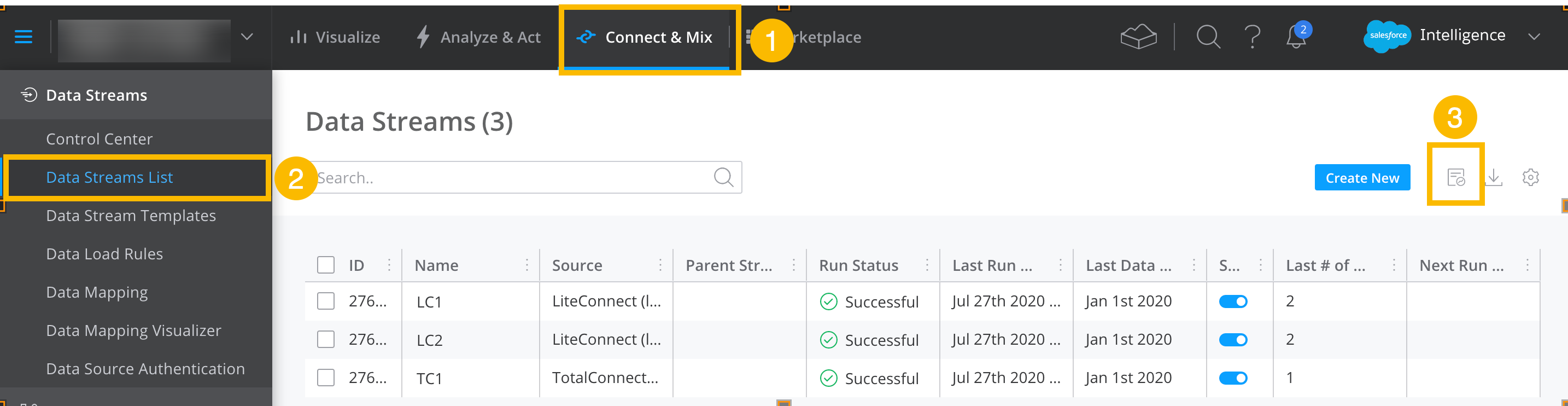
On the Connect & Mix tab (1), from the Data Stream List window (2), click the
Processing Queue icon (3).
Click the reorder icon, drag the task to the top of the queue for the highest priority, or
lower down on the queue based on the task's priority, and then click
Save.
To view all the data streams being processed and their progress in your task, click the
expand icon on a task tile.
To remove a specific data stream from a task, expand the task tile, hover over the stream,
and click the remove icon.
To cancel a task, click the settings icon on the task tile and then click Cancel
Task.
Completed tasks remain in the queue for a while and then disappear so that you can see the
current tasks in progress.
Did this article solve your issue?
Let us know so we can improve!
Loading
Salesforce Help | Article
Cookie Consent Manager
General Information
Required Cookies
Functional Cookies
Advertising Cookies
General Information
We use three kinds of cookies on our websites: required, functional, and advertising. You can choose whether functional and advertising cookies apply. Click on the different cookie categories to find out more about each category and to change the default settings.
Privacy Statement
Required Cookies
Always Active
Required cookies are necessary for basic website functionality. Some examples include: session cookies needed to transmit the website, authentication cookies, and security cookies.
Functional Cookies
Functional cookies enhance functions, performance, and services on the website. Some examples include: cookies used to analyze site traffic, cookies used for market research, and cookies used to display advertising that is not directed to a particular individual.
Advertising Cookies
Advertising cookies track activity across websites in order to understand a viewer’s interests, and direct them specific marketing. Some examples include: cookies used for remarketing, or interest-based advertising.