
You are here:
Einstein Send Time Optimization for Email Model Card
The model in this card analyzes the optimal time to send an email to a subscriber to maximize the probability of the subscriber opening the email.
- Model Details
The Einstein Send Time Optimization model in Marketing Cloud Engagement maximizes customer engagement using optimal send times for email content using these training algorithms, parameters, fairness constraints, features, and other applied approaches. - Intended Use
The Einstein Send Time Optimization model in Marketing Cloud Engagement is intended for these use cases. - Relevant Factors
These factors are associated with the Einstein Send Time Optimization model in Marketing Cloud Engagement. - Metrics
Einstein evaluates and monitors model performance metrics to ensure and improve the quality of the model. These performance measures are associated with the Einstein Send Time Optimization model in Marketing Cloud Engagement. Customers are responsible for monitoring the accuracy of Einstein Send Time Optimization. - Training Data
You have a customized version of the model that’s trained on your data alone, unless you’re opted in to use global model data. Data from one Salesforce customer doesn’t affect the behavior for another Salesforce customer. While model training happens for each customer on their data, the initial development of the model is validated with a representative set of pilot customers’ data. - Ethical Considerations
Before you use Einstein Send Time Optimization in Marketing Cloud Engagement, review the ethical factors associated with the model. To avoid bias and other ethical risks, this model doesn’t include demographic data. - Refresh Cadence
Understand the refresh cadence associated with the Einstein Send Time Optimization model.
Model Details
The Einstein Send Time Optimization model in Marketing Cloud Engagement maximizes customer engagement using optimal send times for email content using these training algorithms, parameters, fairness constraints, features, and other applied approaches.
Person or Organization
Salesforce Einstein for Marketing Cloud Engagement
Model Date and Version
- October 2021
- Minor changes can occur throughout the release
- Major changes can occur and are communicated via release notes
Model Type
- Recommendation/Prediction, Latent factor matrix factorization
General Information
- Einstein Send Time Optimization (STO) is the Marketing Cloud Engagement solution to maximize the engagement rate of email sends based on the send time.
- The model chooses the optimal time to send an email to the subscriber to maximize the probability of the subscriber engaging with the message. Because customer sending patterns vary greatly, we developed parameter sets that are best suited for different patterns. During training, a parameter selector determines the set chosen for the particular enterprise. The parameter selector bases its decision on the variation of the sending and engagement patterns over 90 days of history.
- A subscriber who doesn’t have at least one engagement event in the past 90 days
is designated as pending a personalized send time. The model sends to these
subscribers according to the Insufficient Data option that their admin selects
in Setup.
- The Send at Einstein optimal default time option aggregates scores of all your subscribers that have sufficient data, creating a distribution of scores for every hour. Einstein STO then uses this distribution to assign scores randomly to subscribers who lack sufficient data. A subscriber with insufficient data can get any optimal default time, but it’s more likely that the subscriber is given an optimal default time with a higher score than a lower score. Randomization prevents each pending subscriber from receiving an email at the same time, which helps avoid sending spikes and helps Einstein STO get better data.
- The send immediately option means that subscribers who are pending a personalized send time are sent an email immediately when they reach the STO activity.
- Subscribers with adequate data are assigned a personalized send time. The model sends at one of the top three hours for each subscriber. Einstein STO randomly selects a single hour to send according to the distribution of the top three scores. Randomization allows Einstein STO to constantly monitor which hours can be better for sending and then improve send time selection.
- Salesforce customers have the option to contribute to and benefit from global modeling by opting in or out in Setup.
-
- For customers that opt in, global modeling is applied when recommending personalized optimal send times, where other tenants' data can participate in the analysis and modeling process. The global model can use richer information provided by the opted-in data pool while emphasizing the local tenant’s characteristics in each individual recommendation.
- Individual subscribers who already have strong engagement patterns in the local tenant are influenced less by the global model. Conversely, individual subscribers who don’t have strong engagement patterns in the local tenant are influenced more by the global model.
- Customers that opt in contribute data to global modeling. No additional data fields are required for customers using the global model. Contributed data is anonymized and aggregated at both the tenant and contact levels before being used in local orgs. In this way, the STO global model is conducted without sharing personal data, such as email addresses, between tenant instances.
- For customers that opt out, the customer’s model is trained only using that customer’s data.
- Send Time Optimization for Marketing Cloud Account Engagement (formerly Pardot) isn’t included in global modeling.
- Einstein STO analyzes the past 90 days of email engagement history of all subscribers within the enterprise (top-level tenant in SFMC Email Studio).
Licenses
Einstein Send Time Optimization is available to Engagement customers with these editions.
- Corporate Edition
- Enterprise Edition
- Enterprise+ Edition
- Pro Edition with a Journey Builder for Pro Edition SKU
- Einstein Send Time Optimization SKU
Intended Use
The Einstein Send Time Optimization model in Marketing Cloud Engagement is intended for these use cases.
Primary Intended Uses
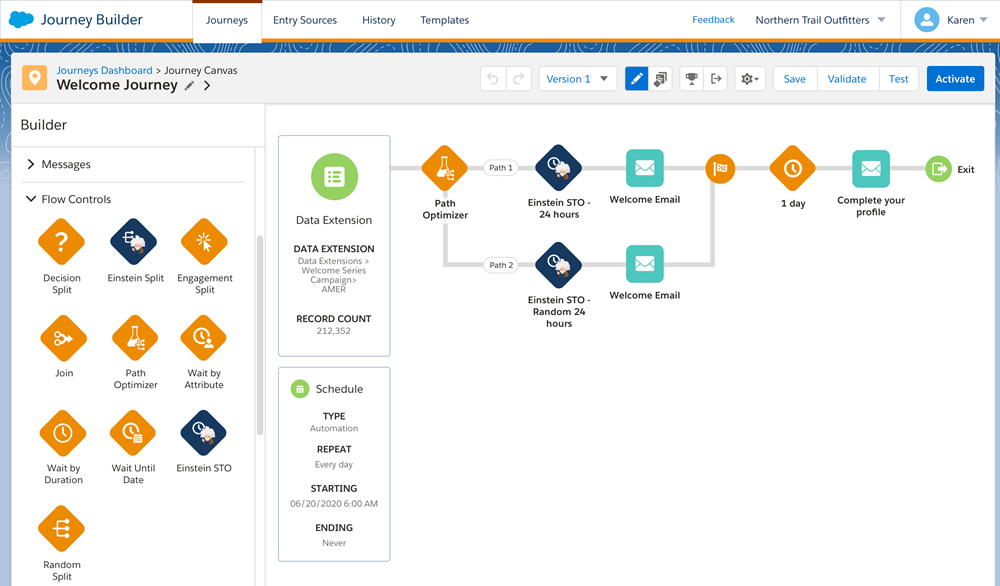
The Send Time Optimization model powers the Einstein Send Time Optimization activity in Journey Builder. Journey Builder is a tool that marketing professionals use to increase effectiveness in their email marketing campaigns.
Out-of-Scope Use Cases
Anything other than the primary use case is out of scope and not recommended. For example, reducing overall send latency for reservation booking emails isn’t an intended use case.
Relevant Factors
These factors are associated with the Einstein Send Time Optimization model in Marketing Cloud Engagement.
Model Input
Einstein Send Time Optimization analyzes up to 90 days of historical engagement patterns. The engagement history includes these factors.
- Email sends, bounces, and engagement events including open, click, and unsubscribe, spam complaints, and associated timestamps
- Data and metadata about customer sending patterns, including how campaigns are executed
The engagement history that Einstein STO analyzes excludes these factors
- Data purchased or collected from third parties
- Demographic Data, which is typically stored in SFMC as data extensions or subscriber or contact attributes
- Specific content within the email template or rendered email body
- Transactional emails such as purchase confirmations, password resets, and others aren’t included
Groups
The model doesn’t include any demographic data or other data purchased from third-party data providers. The model uses engagement data such as Opens, Sends, and patterns.
Environment
The model is trained and deployed in Marketing Cloud Engagement.
Metrics
Einstein evaluates and monitors model performance metrics to ensure and improve the quality of the model. These performance measures are associated with the Einstein Send Time Optimization model in Marketing Cloud Engagement. Customers are responsible for monitoring the accuracy of Einstein Send Time Optimization.
Model Performance Measures
Aggregated model performance metrics are gathered to monitor, ensure, and improve the quality of the model. Model performance metrics included the spread and sparsity of input metrics and the correlation of output scores to historical observations. All metrics are aggregated and anonymized.
Training Data
You have a customized version of the model that’s trained on your data alone, unless you’re opted in to use global model data. Data from one Salesforce customer doesn’t affect the behavior for another Salesforce customer. While model training happens for each customer on their data, the initial development of the model is validated with a representative set of pilot customers’ data.
For details about global models and training data, see Global Model Data.
In general, to provide recommendations, Salesforce requires at least one engagement event, such as opens or clicks of a commercial email in the past 90 days. When you activate Einstein Send Time Optimization, existing data counts toward the 90 days.
Ethical Considerations
Before you use Einstein Send Time Optimization in Marketing Cloud Engagement, review the ethical factors associated with the model. To avoid bias and other ethical risks, this model doesn’t include demographic data.
However, biased use of Send Time Optimization can still introduce bias to your marketing process.

Refresh Cadence
Understand the refresh cadence associated with the Einstein Send Time Optimization model.
Scores and Models
Einstein Engagement Scoring scores and models for email are updated approximately weekly. The refresh cadence varies by one to several days based on a customer's individual business unit.
