
You are here:
Retail Campaigns
Retailers use marketing campaigns built in Journey Builder to promote a sale, announce a new product, or invite customers to a special event. The goal for these campaigns is to increase conversion and drive sales.
Here are examples of retail marketing campaigns:

Abandoned Cart
Re-engage customers who left without a purchase. Abandoned cart campaigns include a sequence of reminder messages.
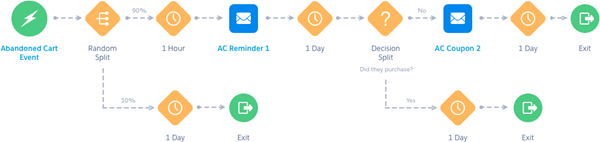
The difficulty is in deciding the timing and content of the messages, and the availability of real-time data from your website. The data enables you to place customers into the journey in a timely manner or remove them when they make a purchase or clear their cart.
Think about why your customers leave items in their cart. Are they trying to determine the total price for comparison? Are they scared off by the shipping cost or the extra step of creating an account to make the purchase?
If you find customers leaving after they see the shipping cost, consider including a free shipping coupon in your abandoned cart campaign. If the items have a low purchase price, send your first email more quickly. Perhaps the customer needs a reminder to complete the order.
Entry Source
Timing is important for an abandoned cart campaign. You want to remind the customer in a timely manner, generally around an hour after the customer has left the cart. You can break this rule for big-ticket items or items that customers often spend time researching, like computers or mattresses.
Contacts can enter a journey from an API event tied to the shopping cart technology on your website. That way, the timing of the journey is based on customer behavior, and not on their inclusion in an audience segment or population.
If they abandon another cart in the future, contacts can reenter the journey. In other words, if customers add products to a cart, they don’t reenter the journey until they complete the campaign sequence.
Message Sequence and Content
You can send two or three emails as part of an abandoned cart campaign, but the first two are the most important and effective. Remind customers of the items in the cart and provide a clear call to action in the first email. Pictures of the products are best, and the call to action can take the customer to their cart.
Incorporate coupons into any email in the sequence. Some retailers hold off sending a coupon until the second or third email as an extra incentive, while others send a coupon immediately. Knowing your customer’s buying preferences can help you decide when and how to offer incentives.
| Email 1 | Remind customers of their abandoned items and provide a clear call to action to return customers to their cart. |
| Email 2 | Provide a coupon or another incentive to lower the total cost and prompt customers to revisit their abandoned cart. |
Journey Path
To track the effectiveness of the abandoned cart emails, incorporate a Random Split in the path. To measure overall effectiveness, track and compare conversions between customers who see the reminder emails and customers who don’t. Or, to test different creative subject lines, add a branch. If you prefer to have all of your customers complete the journey, simply delete the random split.
Waits are important to time the delivery of messages. In most abandoned cart campaigns, you want to remind customers quickly so they don’t lose interest or buy from another site. Typically, the first wait is set between 1 hour and 1 day, depending on your knowledge of your customer’s buying behavior. The best practice is to send the first email 1 or 2 hours after the customer abandons the cart.
Set the second wait time to anywhere from 24 to 72 hours. We recommend a 1-day wait before sending a second email. Remember to set a Goal or use a Decision Split to remove customers from the journey if they complete a purchase or clear their cart.
Abandoned Cart for Big Ticket Items
Support customers who left large-ticket items in their cart or who have abandoned a funnel by helping them make an informed choice.

Abandoned cart or funnel campaigns are a sequence of reminder messages, so the journey is fairly simple. The difficulty is in deciding the timing and content of the messages, and the availability of real-time data from your website. The data enables you to place customers into the journey in a timely manner or remove them when they make a purchase or clear their cart.
Think about why your customers don’t complete a purchase. If you sell products that customers research extensively before a purchase, such as auto insurance or electronics, you want to help customers make an informed choice. You can give customers more time and provide details, such as ratings or links to more information, to help them decide.
Entry Source
Timing is important for an abandoned cart or funnel campaign. You want to remind the customer in a timely manner without rushing them through a decision about a big-ticket purchase.
Contacts can enter a journey from an API event tied to the shopping cart or purchase funnel on your website. That way, the delivery of the messages is based on customer behavior, not on their inclusion in an audience segment or population.
Configure the journey to allow customers who abandon another cart in the future to reenter. This setting enables customers to add products to a cart or review a saved quote, without reentering the journey until they complete the entire campaign sequence.
Message Sequence and Content
For a longer buying cycle, three emails are often sent to support customers as they go through their decision-making. The first message reminds the customer of what they abandoned and provides a clear call to action to return and complete the purchase.
The second email can incorporate customer ratings, reviews, or more details about the products or services. The third email is generally your last chance and can include a harder sell than the previous messages. If not used previously, you could also include an incentive here.
| Email 1 | Remind customers of their abandoned products or services and provide a clear call to action to allow customers to complete a purchase. |
| Email 2 | Include more details, such as customer ratings or reviews, to help customers make an informed purchasing decision. |
| Email 3 | Include new incentives or a stronger sales pitch. |
Journey Path
Waits are important to time the delivery of messages. In most abandoned cart campaigns, you want to remind customers quickly so they don’t lose interest or buy from another site. But if you expect customers to need extra time to research or decide on their purchase, make your wait activities longer.
Set the second wait time to anywhere from 24 to 72 hours. We recommend a 1-day wait before sending a second email. The final wait can also be from 24 to 72 hours from the previous email, depending on what you know about the customer’s buying behavior.
If contacts complete a purchase or clear their cart, use Decision Splits and Goals Decision Split to remove them from the journey.
