To assign a Visualforce page or Lightning component as an override, first create the
page or component (or use one created by a Salesforce developer in your org). It’s important
to understand the action override options for each user experience and how your selections
for each one can affect the others.
Required Editions
Available in: Salesforce Classic and Lightning Experience
Available in: Enterprise, Performance,
Unlimited, and Developer Editions
Visualforce
overrides also available in: Contact Manager,
Group, and Professional Editions
Record
types available in: Professional, Enterprise,
Performance, Unlimited, and Developer
Editions
User
Permissions Needed
To override standard buttons:
Customize Application
When assigning overrides, keep in mind the following requirements.
Salesforce Classic—To use a Visualforce page to override an action, the
Visualforce page must use the standard controller for the object on which the
action appears. To use a Visualforce page to override a tab, the Visualforce
page must use the standard list controller for that tab’s associated
object.
Lightning Experience and the Salesforce mobile app—To make a Visualforce
page available for use as an override, select Available for Lightning
Experience, Experience Builder sites, and the mobile app in the
Visualforce Pages setup panel.
From Setup, select Object Manager, and select the object
that you want to modify.
In the Object Manager settings list, select Buttons, Links, and
Actions.
In the row for the action you want to modify, select
Edit from the dropdown menu.
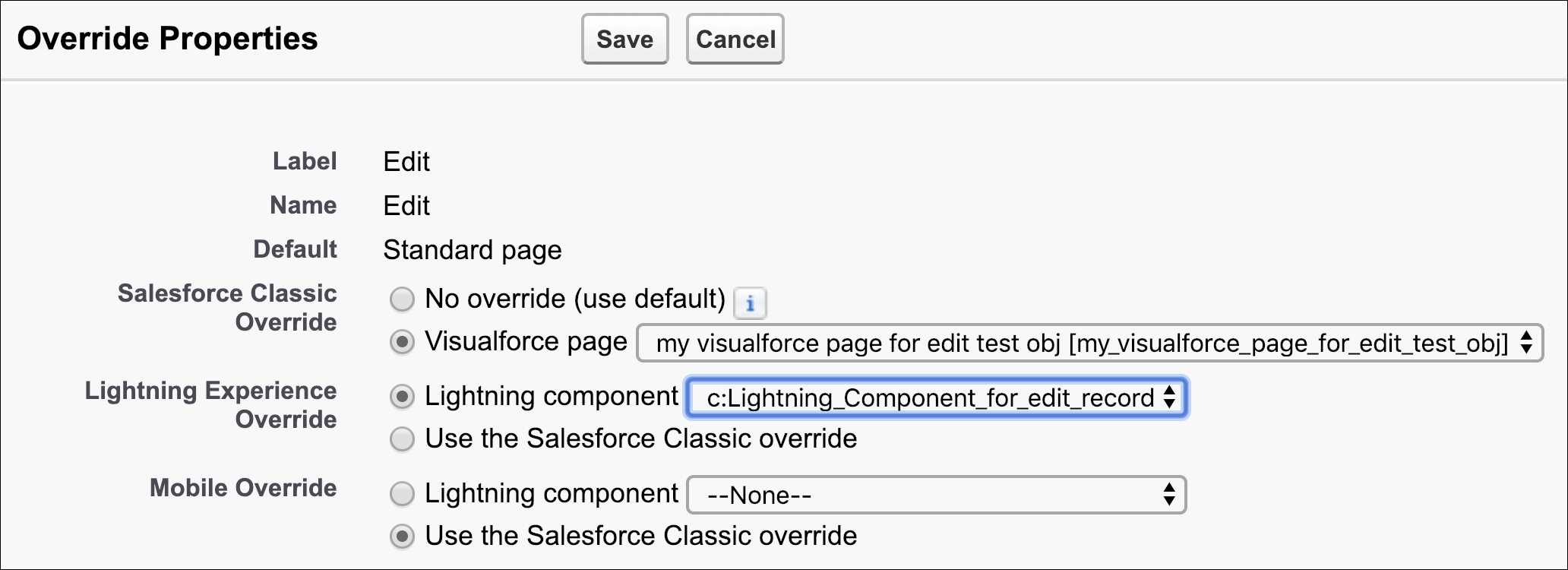
Specify the override option for each user experience.
Example This Override Properties panel specifies a Visualforce page for Salesforce Classic
and a Lightning component for Lightning Experience. The mobile override specifies the
Salesforce Classic override, so mobile users see the Visualforce page.
We use three kinds of cookies on our websites: required, functional, and advertising. You can choose whether functional and advertising cookies apply. Click on the different cookie categories to find out more about each category and to change the default settings.
Privacy Statement
Required Cookies
Always Active
Required cookies are necessary for basic website functionality. Some examples include: session cookies needed to transmit the website, authentication cookies, and security cookies.
Functional Cookies
Functional cookies enhance functions, performance, and services on the website. Some examples include: cookies used to analyze site traffic, cookies used for market research, and cookies used to display advertising that is not directed to a particular individual.
Advertising Cookies
Advertising cookies track activity across websites in order to understand a viewer’s interests, and direct them specific marketing. Some examples include: cookies used for remarketing, or interest-based advertising.