Assign a Lightning Record Page Override for the View Action
When you create an override for the View action for Lightning Experience, you can use
either a Lightning record page or a Lightning component. To use a Lightning record page as
an override, you must activate the page in the Lightning App Builder and choose the type of
override you want.
Required Editions
Available in: Salesforce Classic and Lightning Experience
Available in: Enterprise, Performance,
Unlimited, and Developer Editions
Visualforce
overrides also available in: Contact Manager,
Group, and Professional Editions
Record
types available in: Professional, Enterprise,
Performance, Unlimited, and Developer
Editions
User
Permissions Needed
To override standard buttons:
Customize Application
From Setup, enter Lightning App in the Quick Find box,
and select Lightning App Builder.
Click Edit next to the Lightning page that you want to
use as an override.
In the Lightning App Builder, click Activation.
You have a few options for activating a Lightning record page as an
override.
Make the page the org default for the object.
After you activate the
Lightning page as the org default, the page is selected as the Lightning
Experience override for the View action in the Override Properties
panel.
Make the page the default object record page for specific Lightning
apps.
If you activate the Lightning record page for specific Lightning
apps only, the page takes precedence over the Lightning Experience
Override setting for the View action on the object in those
apps.
Assign the page to a combination of Lightning apps, record types, and
profiles.
To remove the Lightning page as an override, return to the Activation page in
the Lightning App Builder, select the type of override you want to remove, and
walk through the activation wizard.
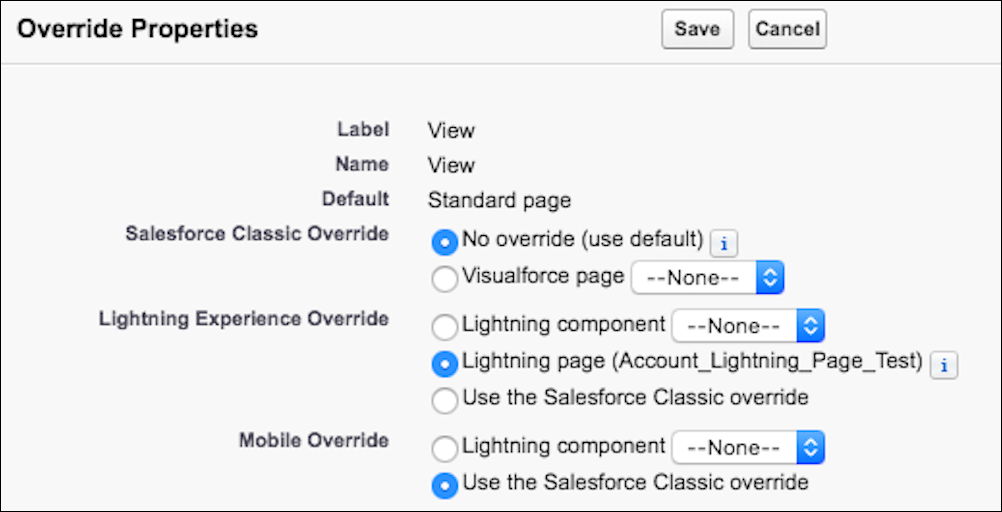
Example In this Override Properties panel, the Lightning page
Account_Lightning_Page_Test is the specified Lightning
Experience override for the View action.
We use three kinds of cookies on our websites: required, functional, and advertising. You can choose whether functional and advertising cookies apply. Click on the different cookie categories to find out more about each category and to change the default settings.
Privacy Statement
Required Cookies
Always Active
Required cookies are necessary for basic website functionality. Some examples include: session cookies needed to transmit the website, authentication cookies, and security cookies.
Functional Cookies
Functional cookies enhance functions, performance, and services on the website. Some examples include: cookies used to analyze site traffic, cookies used for market research, and cookies used to display advertising that is not directed to a particular individual.
Advertising Cookies
Advertising cookies track activity across websites in order to understand a viewer’s interests, and direct them specific marketing. Some examples include: cookies used for remarketing, or interest-based advertising.