Use this example to understand how External Services actions in Apex or Flow map to
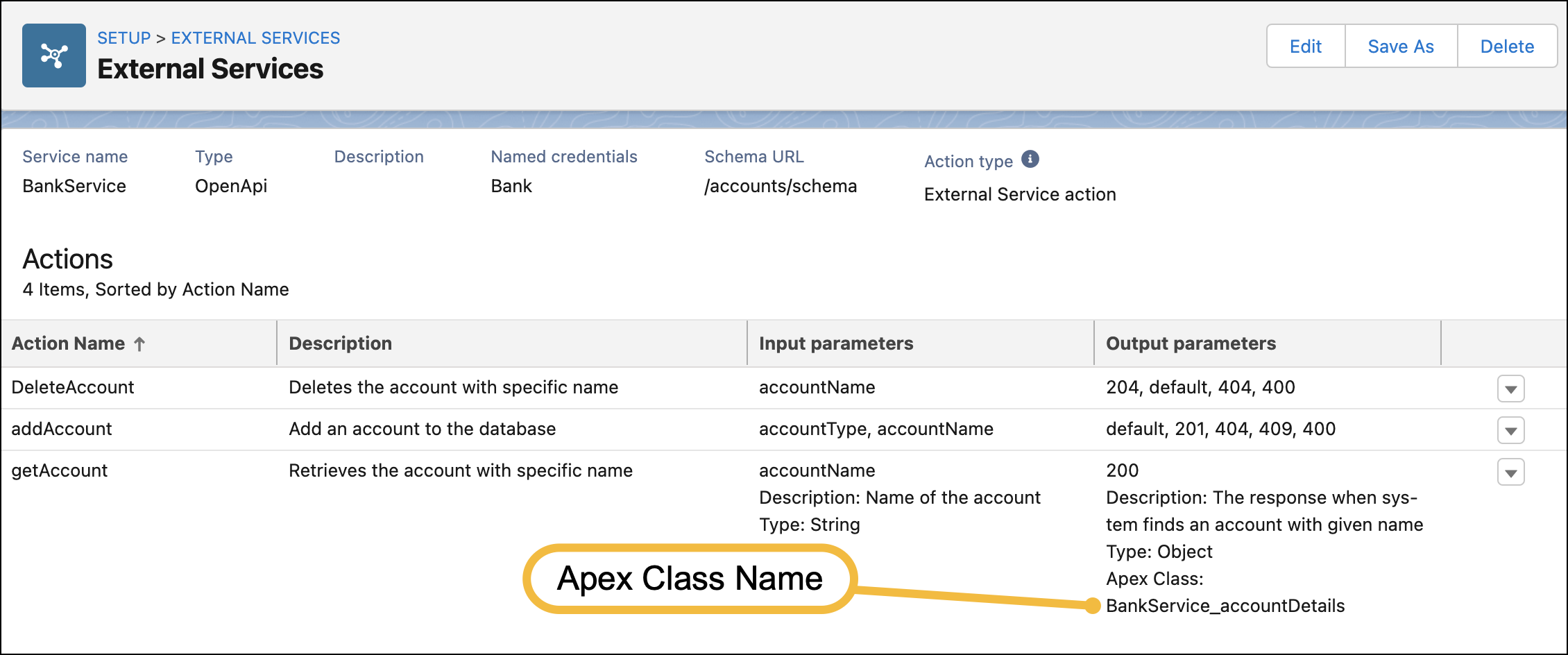
specific actions in an External Service registration. An object’s unique Apex class name is
specified in View Actions > More Details. This name also appears when searching for actions
in Flow Builder.
Required Editions
Available in: Lightning Experience
Available in: Enterprise, Performance,
Unlimited, and Developer Editions
For example, if your API spec defines a response accountDetails for a getAccount
operation, referenced in the spec as
"paths": {
        "/accounts/{accountName}": {
            "get": {
                "operationId": "getAccount",
                "summary": "Retrieves an account",
                "description": "Retrieves the account with specific name",
                "consumes": [
                    "text/plain"
                ],
                "produces": [
                    "application/json"
                ],
                "parameters": [
                    {
                        "name": "accountName",
                        "in": "path",
                        "required": true,
                        "type": "string",
                        "description": "Name of the account"
                    }
                ],
                "responses": {
                    "200": {
                        "description": "The response when system finds an account with given name",
                        "schema": {
                            "$ref": "#/definitions/accountDetails"
                        }
Where the definition for accountDetails is
defined at the end of the spec as
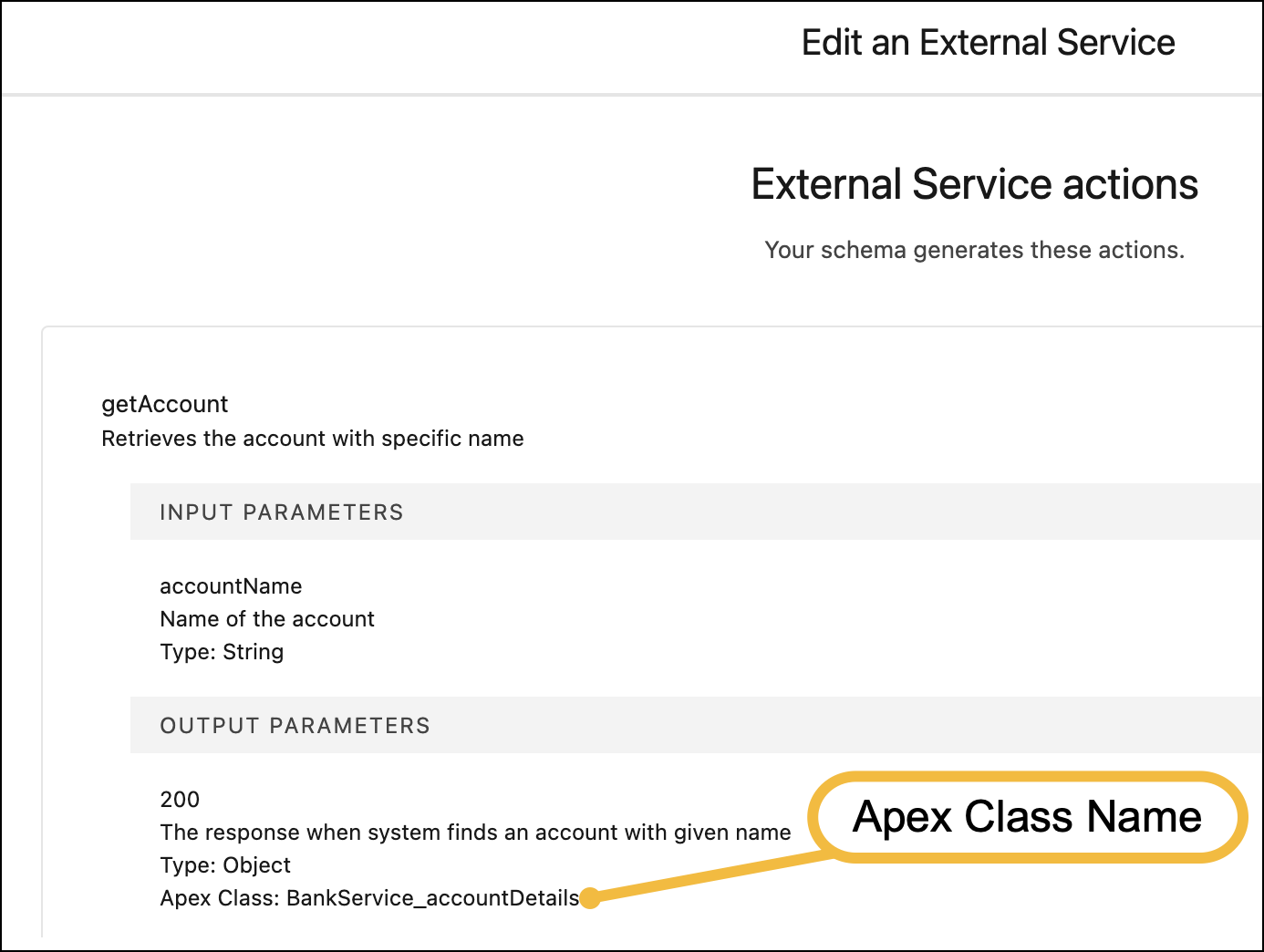
When the spec is registered in External Services, you can see the Apex Class name
during registration.
Or you can navigate to the action in External Services and then click View
Actions > More Details.
External Services automatically registered our accountDetails object as BankService_accountDetails.
Now in Flow, when you add a resource for a new action, it’s clear that you’re
selecting the correct action from the correct registration.
Did this article solve your issue?
Let us know so we can improve!
Loading
Salesforce Help | Article
Cookie Consent Manager
General Information
Required Cookies
Functional Cookies
Advertising Cookies
General Information
We use three kinds of cookies on our websites: required, functional, and advertising. You can choose whether functional and advertising cookies apply. Click on the different cookie categories to find out more about each category and to change the default settings.
Privacy Statement
Required Cookies
Always Active
Required cookies are necessary for basic website functionality. Some examples include: session cookies needed to transmit the website, authentication cookies, and security cookies.
Functional Cookies
Functional cookies enhance functions, performance, and services on the website. Some examples include: cookies used to analyze site traffic, cookies used for market research, and cookies used to display advertising that is not directed to a particular individual.
Advertising Cookies
Advertising cookies track activity across websites in order to understand a viewer’s interests, and direct them specific marketing. Some examples include: cookies used for remarketing, or interest-based advertising.