Activate the Partner Event Source in Amazon EventBridge
Salesforce creates a partner event source in Amazon EventBridge in pending status
after you create an event relay. Associate the event bus with the partner event source in
EventBridge so that the event source is ready to receive events from Salesforce.
Required Editions
User
Permissions Needed
To create an event relay:
Customize Application
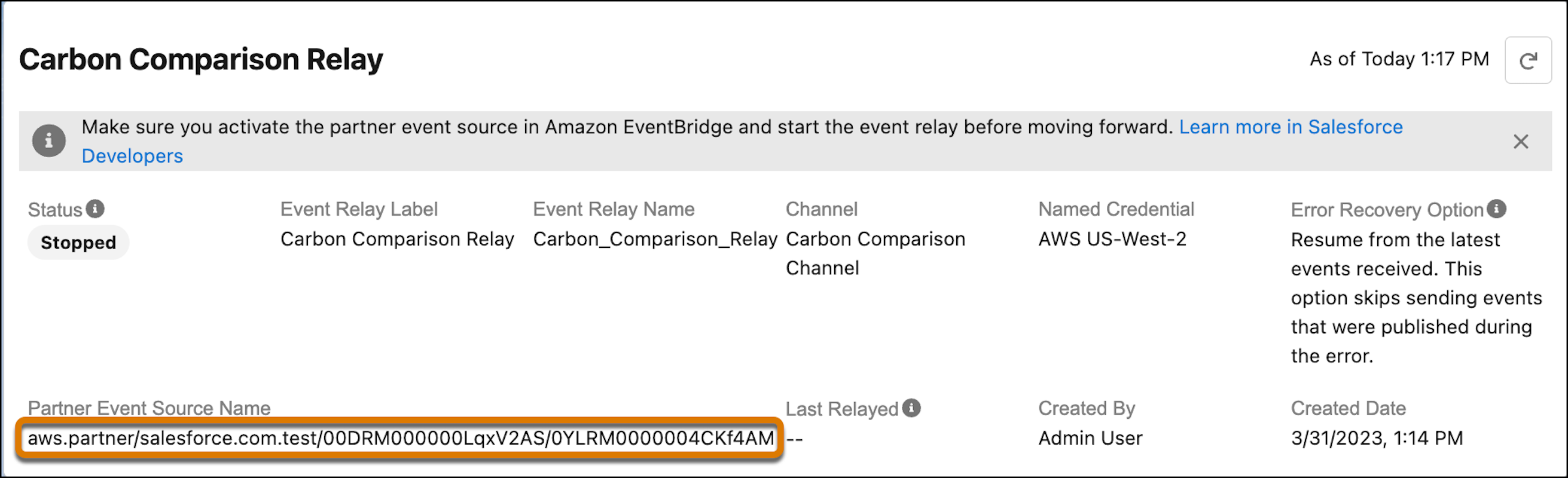
Get the partner event source name from the event relay. In the Event Relays
page, click the event relay. Copy the Partner Event Source
Name field value.
There can be a small delay before this field value is displayed after you
create the event relay. Refresh the page until you get the partner event source
name.
Log in to the AWS console. Navigate to https://aws.amazon.com and sign in using your
AWS account credentials.
In the search box, enter Amazon EventBridge, and then
from Services, select Amazon EventBridge.
In Amazon Eventbridge, under Integration, select Partner event
sources.
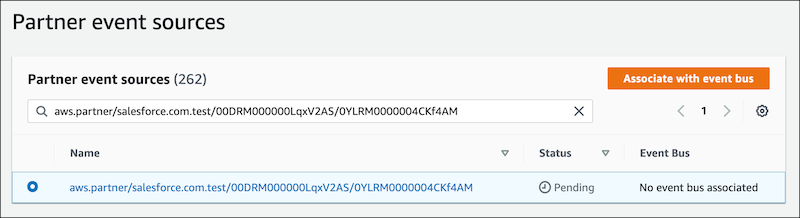
In the search box, enter the name of your event source, the Partner
Event Source Name field value that you copied earlier.
Select your event source, and click Associate with event
bus.
Click Associate. The status of the event source changes
to Active.
Did this article solve your issue?
Let us know so we can improve!
Loading
Salesforce Help | Article
Cookie Consent Manager
General Information
Required Cookies
Functional Cookies
Advertising Cookies
General Information
We use three kinds of cookies on our websites: required, functional, and advertising. You can choose whether functional and advertising cookies apply. Click on the different cookie categories to find out more about each category and to change the default settings.
Privacy Statement
Required Cookies
Always Active
Required cookies are necessary for basic website functionality. Some examples include: session cookies needed to transmit the website, authentication cookies, and security cookies.
Functional Cookies
Functional cookies enhance functions, performance, and services on the website. Some examples include: cookies used to analyze site traffic, cookies used for market research, and cookies used to display advertising that is not directed to a particular individual.
Advertising Cookies
Advertising cookies track activity across websites in order to understand a viewer’s interests, and direct them specific marketing. Some examples include: cookies used for remarketing, or interest-based advertising.