Generate an Appointment Invitation URL for a Customer Website
You can generate an appointment invitation URL that directly opens within a customer
portal via Lightning Out.
Required Editions
Available in: Lightning Experience.
Available in: Enterprise and Unlimited Editions
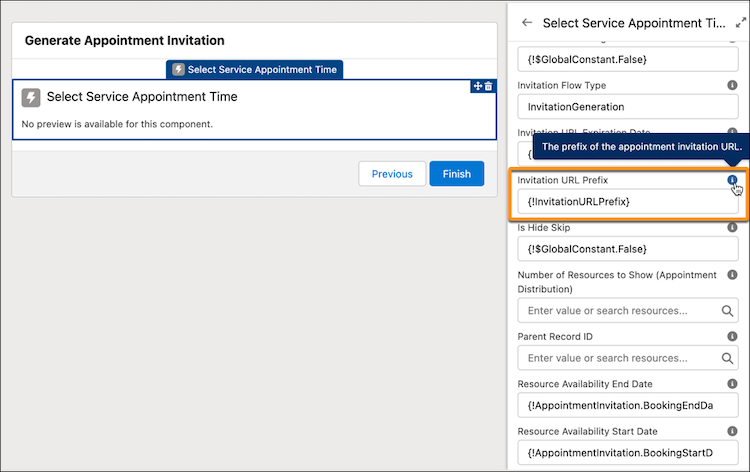
The invitation URL includes two components: invitation URL prefix and invitation key. The
invitation key is auto-generated. You can specify the invitation URL prefix in the Select Service Appointment Time
flow screen component.
For an invitation URL to open in a customer’s portal via Lightning Out, specify the
customer website URL in the InvitationURLPrefix flow variable. After you specify the prefix
in the flow and activate the flow, follow the steps in Generate an
Appointment Invitation URL.
To add the Generate Appointment Invitation flow to a website, follow the steps in Add the Inbound New Guest Appointment Flow to a
Website. Ensure that you change the flow to the Generate Appointment Invitation
flow and then pass the invitationKey parameter.
Here's a sample JavaScript code to load and activate the lightningOutGuest app on your
webpage.
<script>
    $Lightning.use("runtime_appointmentbooking:lightningOutGuest",    // name of the Lightning app
        function() {
            $Lightning.createComponent(
                "lightning:flow", // top-level component of your app
                { },
                "lightningLocator",   // the DOM location to insert the component
                function(component) { // callback when component is created and active on the page
                    var inputVariables = [
                                    {
                                        name : 'invitationKey',
                                        type : 'String',
                                        value : new URLSearchParams(window.location.search).get('invitationKey')
                                    }
                    ];
                    component.startFlow('Invitation_Booking',inputVariables);
                }
            );
        }, 'https://YourSiteDomain/SiteURL/'  // Community endpoint
    );
</script>
Did this article solve your issue?
Let us know so we can improve!
Loading
Salesforce Help | Article
Cookie Consent Manager
General Information
Required Cookies
Functional Cookies
Advertising Cookies
General Information
We use three kinds of cookies on our websites: required, functional, and advertising. You can choose whether functional and advertising cookies apply. Click on the different cookie categories to find out more about each category and to change the default settings.
Privacy Statement
Required Cookies
Always Active
Required cookies are necessary for basic website functionality. Some examples include: session cookies needed to transmit the website, authentication cookies, and security cookies.
Functional Cookies
Functional cookies enhance functions, performance, and services on the website. Some examples include: cookies used to analyze site traffic, cookies used for market research, and cookies used to display advertising that is not directed to a particular individual.
Advertising Cookies
Advertising cookies track activity across websites in order to understand a viewer’s interests, and direct them specific marketing. Some examples include: cookies used for remarketing, or interest-based advertising.