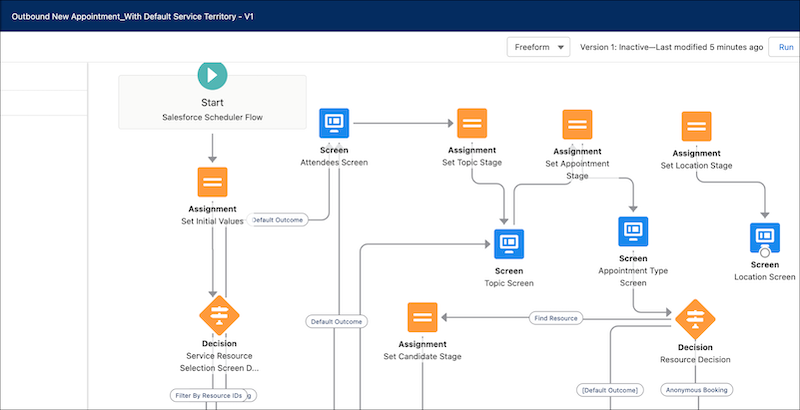
If you want to use virtual territories or set a default service territory, modify the
flow to set a default service territory and skip the Select Service Territory screen. You can skip
the service territory selection screen for the Outbound New Appointment, Inbound New Appointment,
and Inbound New Guest Appointment flows and their instances. You can also show the service
territory address on the review screen if necessary.
Required Editions
Available in: Lightning Experience.
Available in: Enterprise and Unlimited Editions
User Permissions Needed
To open, edit, or create a flow in Flow Builder:
Manage Flow
To run a flow:
Run Flows
To modify page layouts for Service Appointment:
View Setup and Configuration
Customize Application
Click the Service Territories tab.
Click the service territory record that you want to set as default.
Copy the Salesforce ID of the service territory.
From Setup, in the Quick Find box, enter Flows, and then select
Flows.
Click the flow for which you want to skip the service territory selection screen.
Perform a step:
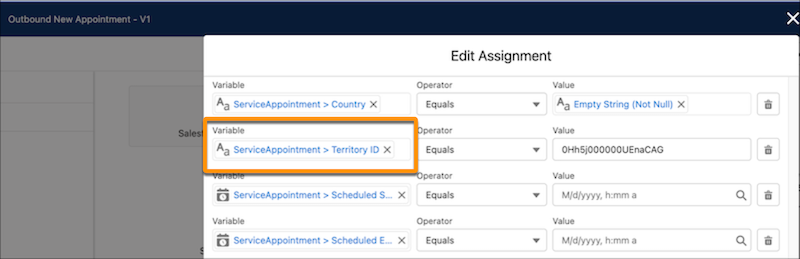
If you’re modifying the Outbound New Appointment flow, double-click Set Initial
Values.
If you’re modifying the Inbound New Appointment or the Inbound New Guest Appointment
flow, double-click Initial Assignment.
In the value column of the Service Territory > Territory ID variable, paste the copied
Salesforce ID of the service territory.
If you want the review appointment screen to show address details, enter values for the
address-related fields: Street, City, State/Province, Zip/Postal Code, and Country.
Click Done.
Delete these flow connectors:
The connector from the Appointment Type Screen component to the Set Location Stage
component.
The connector from the Location Screen component to the Resource Decision component.
Add a connector from the Appointment Type Screen component to the Resource Decision
component.
Delete the Set Location Stage and Location Screen components and the connector between
them.
Click Save As.
Enter values for Flow Label and Flow API Name, and then save your changes.
An instance of the flow is created.
Activate the flow.
Add the flow instance to the page layout from which the flow is to be used.
As Salesforce Scheduler checks internal and external calendars in real time to determine time
slots, test your setup's performance after you make these changes.
Did this article solve your issue?
Let us know so we can improve!
Loading
Salesforce Help | Article
Cookie Consent Manager
General Information
Required Cookies
Functional Cookies
Advertising Cookies
General Information
We use three kinds of cookies on our websites: required, functional, and advertising. You can choose whether functional and advertising cookies apply. Click on the different cookie categories to find out more about each category and to change the default settings.
Privacy Statement
Required Cookies
Always Active
Required cookies are necessary for basic website functionality. Some examples include: session cookies needed to transmit the website, authentication cookies, and security cookies.
Functional Cookies
Functional cookies enhance functions, performance, and services on the website. Some examples include: cookies used to analyze site traffic, cookies used for market research, and cookies used to display advertising that is not directed to a particular individual.
Advertising Cookies
Advertising cookies track activity across websites in order to understand a viewer’s interests, and direct them specific marketing. Some examples include: cookies used for remarketing, or interest-based advertising.