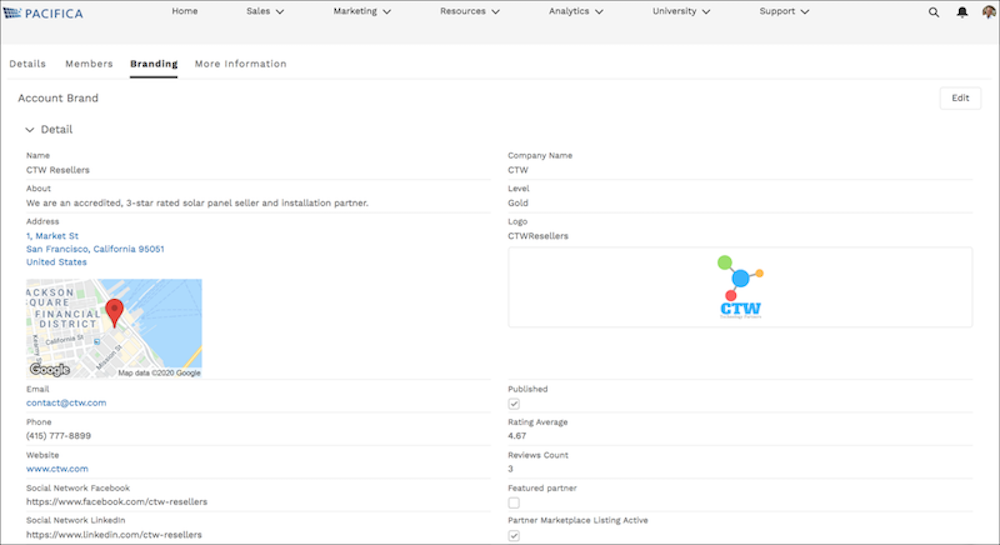
In addition to administrators and internal users, partner users with the Delegated
External User Administrator permission can update and access partner brand information. They can
also create co-branded emails, marketing campaigns, websites, and apps for channel sales from
information uploaded to the Branding tab.
Required Editions
Available in: both Salesforce Classic and Lightning Experience
Available in: Enterprise, Performance, Unlimited, and
Developer Editions
Admin Permissions
Needed
To manage external users:
Manage External Users
To create, edit, and delete profiles:
Manage Profiles and Permission Sets
To allow partner users with the Delegated External User Administrator permission to
manage brands, add the Account Brand related list to the Accounts page
layout.
Select the icon of the account that you’re managing, and select Account
Management.
To access the Account Brand Detail page, select the Branding
tab.
Note When you merge accounts with brands, the brand information associated with the
primary account is retained. Brand information associated with the secondary account is
moved to the Recycle Bin, even if there isn’t brand information for the primary
account.
To add account brand details, click New.
To update Account Brand details, click Edit.
To create co-branded emails or templates using information from the Account Brand page,
use the merge fields under Sender Brand. These merge fields pull information directly from
the Account Brand page. Users must have access to Account Brand to use the Account Brand
merge fields, otherwise the merge fields are unresolved.
Did this article solve your issue?
Let us know so we can improve!
Loading
Salesforce Help | Article
Cookie Consent Manager
General Information
Required Cookies
Functional Cookies
Advertising Cookies
General Information
We use three kinds of cookies on our websites: required, functional, and advertising. You can choose whether functional and advertising cookies apply. Click on the different cookie categories to find out more about each category and to change the default settings.
Privacy Statement
Required Cookies
Always Active
Required cookies are necessary for basic website functionality. Some examples include: session cookies needed to transmit the website, authentication cookies, and security cookies.
Functional Cookies
Functional cookies enhance functions, performance, and services on the website. Some examples include: cookies used to analyze site traffic, cookies used for market research, and cookies used to display advertising that is not directed to a particular individual.
Advertising Cookies
Advertising cookies track activity across websites in order to understand a viewer’s interests, and direct them specific marketing. Some examples include: cookies used for remarketing, or interest-based advertising.