A standard permission set consists of a group of common permissions for a particular
feature associated with a permission set license. Using a standard permission set saves you time
and facilitates administration because you don’t need to create the custom permission
set.
Required Editions
Available in: both Salesforce Classic and Lightning Experience
Available in: Essentials, Contact Manager,
Professional, Group, Enterprise,
Performance, Unlimited, Developer, and
Database.com Editions
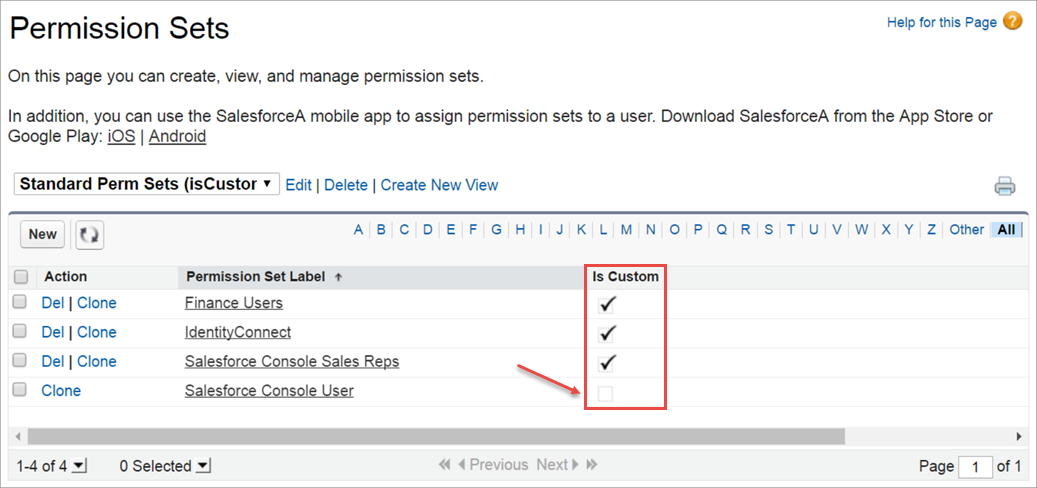
To see which permission sets are standard, add Is Custom to your list
view. The Is Custom box isn’t checked for standard permission set. Permission sets you created
or cloned are indicated with a checkmark.
Salesforce can update the permissions and settings in a standard permission set to account
for new features or functionality. When this occurs, the Last Modified By field displays
"salesforce.com, inc." and the timestamp for the update.
You can see all permissions enabled for a standard permission set on its summary page. Select
a permission set, and then click View Summary.
Standard permission sets don’t count against your org’s permission set limits. You can clone
a standard permission set as many times as you want, but you can’t edit it. Clones do count
against your org’s permission set limits.
Example Let’s say you purchased 10 Sales Console User permission set licenses. You can do any
of the following.
Assign all 10 users to the Salesforce Console User permission set.
Assign some of the users to the Salesforce Console User permission set, and assign the
remainder to a clone of Salesforce Console User.
Clone the Salesforce Console User permission set and assign different users to each
clone, based on your org’s structure.
Did this article solve your issue?
Let us know so we can improve!
Loading
Salesforce Help | Article
Cookie Consent Manager
General Information
Required Cookies
Functional Cookies
Advertising Cookies
General Information
We use three kinds of cookies on our websites: required, functional, and advertising. You can choose whether functional and advertising cookies apply. Click on the different cookie categories to find out more about each category and to change the default settings.
Privacy Statement
Required Cookies
Always Active
Required cookies are necessary for basic website functionality. Some examples include: session cookies needed to transmit the website, authentication cookies, and security cookies.
Functional Cookies
Functional cookies enhance functions, performance, and services on the website. Some examples include: cookies used to analyze site traffic, cookies used for market research, and cookies used to display advertising that is not directed to a particular individual.
Advertising Cookies
Advertising cookies track activity across websites in order to understand a viewer’s interests, and direct them specific marketing. Some examples include: cookies used for remarketing, or interest-based advertising.