Show the relationships between parent accounts and their subsidiaries to sales reps
using Lightning Experience. You can customize hierarchy columns to show the information that’s
most useful to your sales teams.
Required Editions
Available in: Lightning Experience
Available in: Essentials, Group, Professional, Enterprise,
Performance, Unlimited, and Developer Editions
User Permissions Needed
To view account hierarchies:
Read on accounts
To create account hierarchies:
Edit on accounts
To add, edit or delete hierarchy columns:
Modify All Data
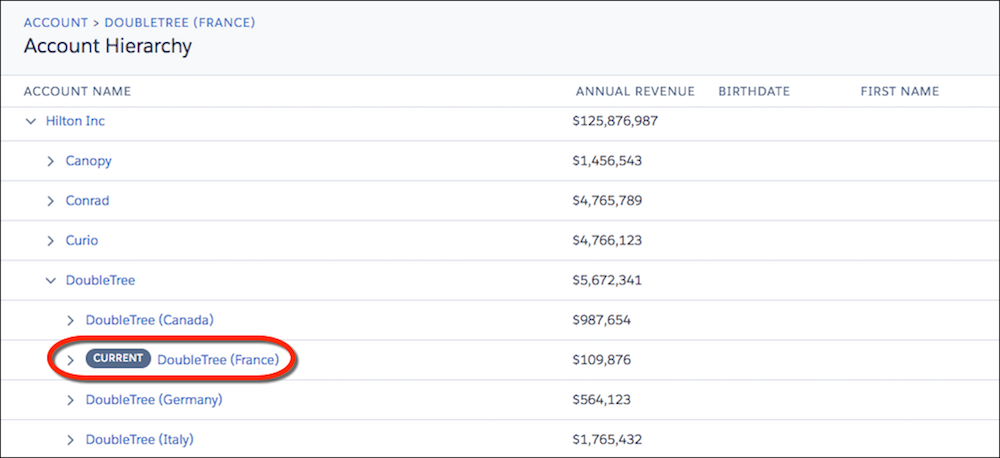
Account hierarchies display accounts related via the Parent Account field.
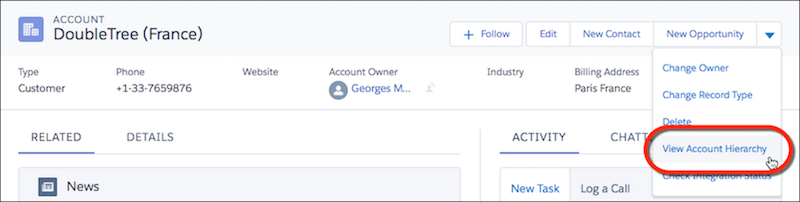
Give your sales reps access to account hierarchies from account pages. In Setup, in the
Salesforce Mobile and Lightning Experience Actions section of your account page layout, add the
View Account Hierarchy action.
The Actions menu includes the View Account Hierarchy action unless you customized the
account page layout before Spring ’17.
Sales reps can expand or collapse parts of a hierarchy as they navigate it. They can view
up to 2,000 accounts from each point where they enter a hierarchy. To view accounts in a
different part of the hierarchy, a sales rep can enter the hierarchy from a different
account.
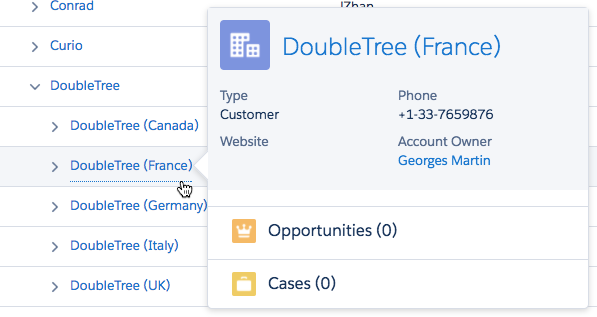
Hovering over an account name shows more details.
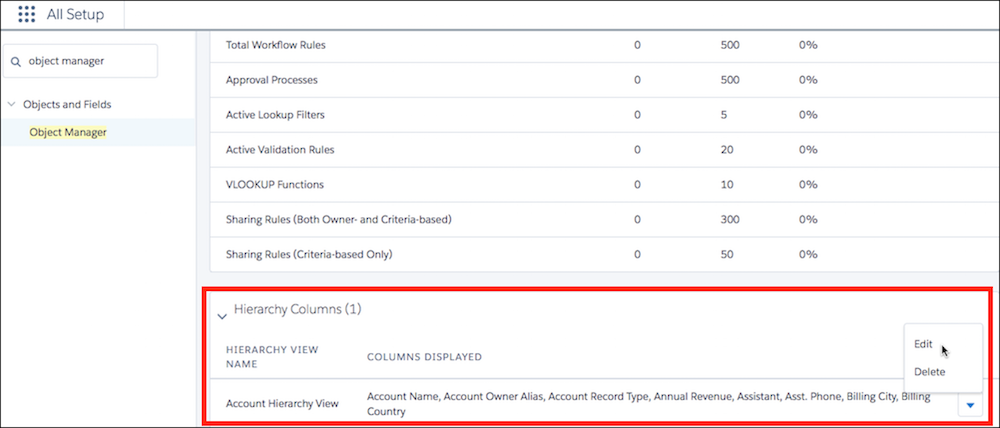
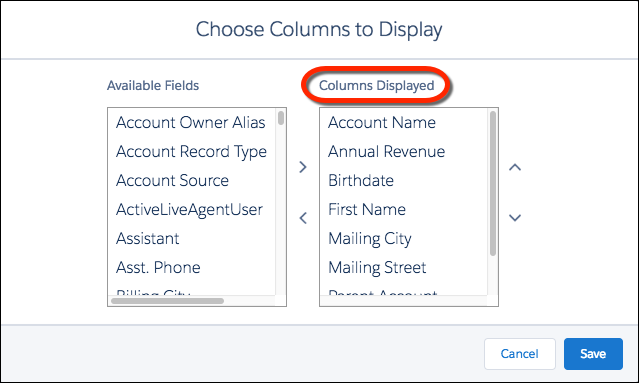
You can edit the hierarchy columns to show the information that’s most useful to your sales
reps.
From Setup, at the top of the page, select Object Manager.
In Account, click Hierarchy Columns and then edit the
columns.
You can include up to 15 columns.
By default, account hierarchies display the same columns as the Recently Viewed Accounts
standard list view. However, the list view columns don’t change when you customize the
hierarchy columns.
Note After you customize hierarchy columns, the item Org_Account_Hierarchy is added to the
Accounts list view menu. Deleting this item resets the columns to the defaults.
We use three kinds of cookies on our websites: required, functional, and advertising. You can choose whether functional and advertising cookies apply. Click on the different cookie categories to find out more about each category and to change the default settings.
Privacy Statement
Required Cookies
Always Active
Required cookies are necessary for basic website functionality. Some examples include: session cookies needed to transmit the website, authentication cookies, and security cookies.
Functional Cookies
Functional cookies enhance functions, performance, and services on the website. Some examples include: cookies used to analyze site traffic, cookies used for market research, and cookies used to display advertising that is not directed to a particular individual.
Advertising Cookies
Advertising cookies track activity across websites in order to understand a viewer’s interests, and direct them specific marketing. Some examples include: cookies used for remarketing, or interest-based advertising.