Loading
Manage Your Billing Processes with Salesforce Billing
Table of Contents
Select Filters

          No results
          No results
          Here are some search tips

          Check the spelling of your keywords.
          Use more general search terms.
          Select fewer filters to broaden your search.

          Search all of Salesforce Help
          Invoicing Usage Summaries with Consumption Schedules

          Invoicing Usage Summaries with Consumption Schedules

          An order product consumption schedule inherits its billing rule, tax rule, and revenue recognition rule inherited from the original consumption schedule. When an invoice scheduler evaluates a usage summary related to an order product consumption schedule, it uses the schedule's rules and treatments rather than the parent order product's rules and treatments. The invoicing process also evaluates a usage summary’s next billing date separately from the order product’s next billing date, so that usage summaries can end up on different invoices than their parent subscription order product if desired. These separate combinations let you further customize how Salesforce Billing invoices a usage order product relative to its usage summaries. (Salesforce Billing Managed Package)

          Required Editions

          Available in: Salesforce Billing Spring ’19 and later

          Next Billing Date

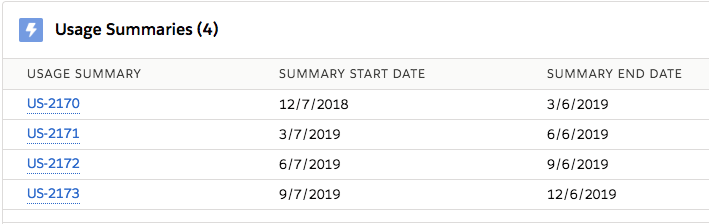
          After Salesforce CPQ creates an order product associated with a consumption schedule, Salesforce Billing generates usage summaries based off the schedule's billing term and billing term unit. The term and unit represent the length of one usage summary, repeated through the order product's start and end date. This setup lets you create usage summaries with different billing terms from the parent order product. For example, you could have an order product that bills monthly in arrears from 12/07/2018 through 12/06/2019. Its order product consumption schedule has a 1-quarter term, so you’ll have one three-month usage summary each quarter for the duration of your order product’s term. This setup leads to a total of four usage summaries.

          A picture of four usage summaries. Their terms are quarterly over the course of one year.

          Usage summaries have their own next billing dates. A usage summary inherits its next billing date from its summary end date. When you bill an order or during an invoice run, Salesforce Billing looks at each next billing date on order products and usage summaries. If an invoice run with a target date of 01/06/2019 evaluates our order, it picks up the order product, but it won’t pick up any of our usage summaries as the earliest summary has a next billing date of 03/06/2019.

          Because order product and usage summary next billing dates are independent, overriding the order product next billing date doesn’t change the usage summary’s next billing date. Order products and usage summaries have independent invoice run processing statuses as well. If an order product’s Hold Billing field is selected, Salesforce Billing will hold billing for the order product and all its usage summaries. Bill Now and invoice runs will not pick the order product or its usage summaries up for invoicing.

          Important
          Important When Bill Now or an invoice run evaluates a usage summary, it includes the usage summary on the invoice if the usage summary’s next billing date is less than the invoice’s target date (for Bill Now) or the invoice run’s target date (for invoice runs). This process is different from invoicing an order product or billing transaction, which are included on the invoice if their next billing date is less than or equal to the invoice or invoice run’s target date. If your usage summary doesn’t have a next billing date, the Bill Now process or invoice run evaluates the Summary End Date field instead.

          If you want your order product and its usage summaries to appear on the same invoice, configure the consumption schedule so that its term matches your order product’s term. If your product bills monthly from 01/01/2019 through 12/31/2019, the consumption schedule must have a billing term of one month. When a sales rep orders the product, Salesforce Billing creates a one-month usage summary each month during your order product's term. This leads to a total of 12 usage summaries.

          Rules

          You can apply different rules between your subscription order product and its usage. For example, you could apply tax to the order product while not applying tax to one of the order product's consumption schedules. You could also record order product transactions to a different GL Account than your usage summary transactions.

          For more information on rules in Salesforce Billing, check out Defining Rules and Treatments.

          Example
          Example

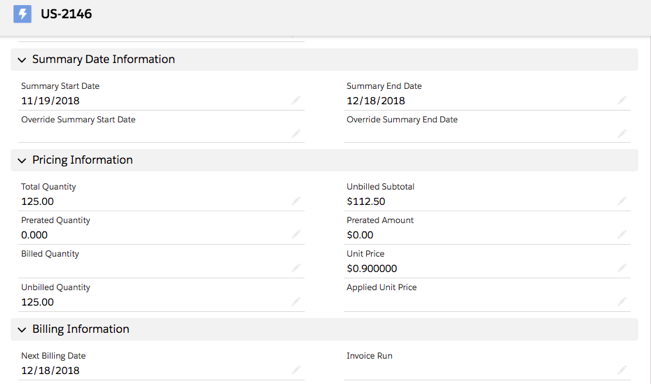
          Your order product has a billable unit price of $100 and bills monthly from 11/19/2018 through 11/18/2019. Its current Next Billing Date is 12/18/2018. It contains 12 usage summaries, each the duration of one month. Let's look at the billing information on your order product's first usage summary.

          A usage summary

          When your invoice scheduler evaluates these records, it creates one invoice line for each on the resulting invoice. The first invoice line reflects the order product, with a subtotal of $100. The second invoice line reflects the usage summary, with a subtotal of $112.50.

          Two invoice lines

          Tip
          Tip By default, both invoice line product names match the name of the order product that you invoiced. We recommend using automation to change the product names so you can tell which invoice line relates to the order product and which relates to the usage summary. In this example, we've changed the second invoice line's product name to reflect that it came from your usage summary for the phone plan minutes.

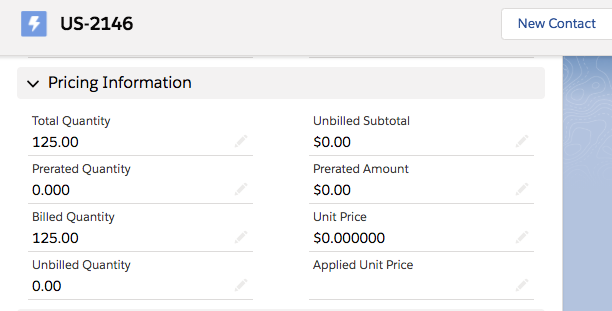
          When you post the invoice, Salesforce Billing updates the usage summary's billed quantity and unbilled subtotal to reflect the changed billing status.

          A usage summary following invoicing

          Example
          Example

          Your order product bills $100 monthly from 12/07/2018 through 12/06/2019. Its current Next Billing Date is 01/07/2019, while its Next Charge Date is 12/07/2018. Its usage summaries bill quarterly.

          Four usage summaries for quarterly billing

          Since a usage summary inherits its next billing date from its summary end date, your first usage summary has a next billing date of 03/06/2019. It has an unbilled subtotal of $50.

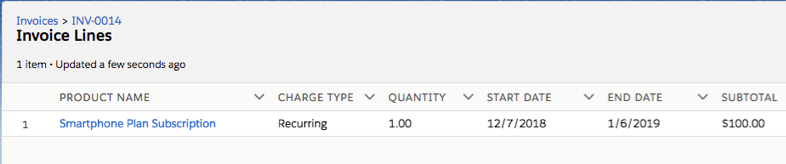
          When an invoice scheduler or Bill Now evaluates your order, it evaluates the order product's Next Charge Date and creates an invoice with an invoice line for your order product. However, since your usage summary has a future Next Billing Date, the invoice doesn't include an invoice line for the usage summary. You'll bill the usage summary later.

          An invoice line

           
          Loading
          Salesforce Help | Article